Small Buildings and Climate Change
Yvonne PeñaBrianna Soleyn
Overview
Small buildings—structures with one to four housing units—are widely distributed across New York City and house a diverse range of residents. One-to-four-unit residential buildings account for over 37 percent of all housing in New York City.[1] This housing stock is unique in that it is home to some of the wealthiest and some of the lowest-income New Yorkers: the owner of a single-family home and the tenant of an unauthorized basement apartment are both classified as residents of small buildings.
One-to-four-unit buildings are often owner-occupied,[2] and, in general, homeowners have higher incomes than renters living in unregulated units such as basement apartments.[3] At the same time, this housing type includes many low-income tenants living in informal or precarious conditions.
These differences shape how residents experience climate risks. Recent extreme weather events have highlighted the particular vulnerabilities of small buildings, as well as the types of mitigation strategies that may help reduce property damage and prevent negative health consequences.
Climate Risks
Flood Risk
Flooding is a growing threat across New York City, but it presents distinct risks in small buildings. Unlike large multifamily developments, small homes often include subgrade space used for housing, making residents of basement apartments particularly vulnerable to stormwater flooding, where the risks of injury or death are especially high.
New York City faces three types of flooding: tidal flooding, caused by high tides; storm surge flooding, which pushes seawater inland during major storms; and stormwater flooding, which occurs when heavy rainfall overwhelms drainage systems. Of these, stormwater flooding poses the most immediate and widespread risk to small buildings because it can occur far from the coastline and often impacts basement units.
Climate change is expected to bring more frequent and intense rainfall. Historically, the city has averaged 16.3 days per year with at least one inch of rainfall, but by the 2080s this could increase to 23.7 days. Annual precipitation is projected to rise by 10 percent by the 2030s and by up to 30 percent by the end of the century. New York City’s sewer system is designed to handle 1.5 to 1.75 inches of rain per hour, depending on the borough. However, storms producing 2.1 inches of rain per hour are expected to occur every five years. The Department of Environmental Protection has identified more than 100 areas that experience chronic stormwater flooding, though only a portion are designated as priority areas for infrastructure investment.
These trends are already producing deadly outcomes. During Hurricane Ida in 2021, 14 New Yorkers died, 11 of them drowning in basement apartments across seven homes—most in low-rise, one-to-four family buildings.[4] Smaller residences were also disproportionately affected, accounting for 75 percent of damaged buildings despite representing 52 percent of the housing stock.
Coastal flooding presents an additional and growing threat. Sea levels are projected to rise significantly in the coming decades, increasing the frequency and severity of tidal flooding in neighborhoods such as Jamaica Bay, Old Howard Beach, and the Rockaways[5]—areas where over three-quarters of buildings are small buildings. Despite this, real estate development continues in flood-prone areas: an estimated $3.6 billion worth of one- to three-family homes sold in 2023 are likely to flood before the end of their 30-year mortgage.[6]
Heat Risk
As an urban metropolis, with extensive paving and limited green space, New York City is warmer than surrounding suburban or rural areas. Projections indicate that extreme heat events will become more frequent, more intense, and longer in duration. Extreme heat is already an increasingly serious and deadly threat in the city, with most heat-related deaths occurring in the home. These risks manifest in distinct ways in small buildings.
In basement and attic apartments—both common in this housing stock—temperature extremes can be difficult to regulate. Basement units may lack adequate ventilation, while attic units often experience excessive heat due to direct sun exposure and poor insulation.
Economic constraints further shape exposure. Low-income tenants in small buildings, particularly those in informal units, may be unable to afford the cost of purchasing or operating air conditioning. As a result, access to cooling does not always translate into use, increasing the risk of heat-related illness during prolonged heat events.
These risks are compounded by neighborhood-level inequities. Many areas with high concentrations of small buildings—such as Bensonhurst, Gravesend, Flatlands, and Canarsie in Brooklyn and Flushing, Jamaica, St. Albans, Cambria Heights, and Laurelton in Queens—also rank among the city’s most heat-vulnerable communities on the NYC Heat Vulnerability Index, reflecting longstanding patterns of disinvestment and limited access to green space.
Structural & Social Vulnerabilities
Small residential buildings frequently include subgrade or top-floor spaces used for housing, commonly known as basement and attic apartments. These units are especially vulnerable to both flooding and extreme heat, creating significant risks for residents.
Basement apartments are particularly susceptible to stormwater flooding, which can occur quickly and with little warning. Many such units lack adequate drainage, egress, or flood protection, increasing the risk of injury or death during extreme weather events. Of all the New York City single-story buildings that will likely be inundated by extreme rainfall flooding, nearly 93,528 (45 percent) have a subgrade space,[7] some of which are likely unregulated basement apartments.
Attic apartments present a different but related set of risks. Because they often do not meet safety codes for occupancy, these units—and the people who live in them—are not always captured in the City’s official housing statistics. However, certain characteristics are common. These units often lack proper insulation and ventilation and are exposed to more direct sunlight, making them especially susceptible to extreme heat in the summer. As a result, residents may face heightened risk of heat-related illness or death during sustained heat waves.
Although precise numbers are difficult to determine,[8] estimates suggest that 300,000 to 500,000 New Yorkers live in basement or attic apartments, with the highest concentrations in Eastern Brooklyn and Queens.[9][10] These units are more likely to house recent immigrants, low-income households, and other socially vulnerable populations, further compounding climate risks in this housing stock.
Mitigation Opportunities
For Property Owners
Accessory Dwelling Units
As Mayor Adams’ City of Yes for Housing Opportunity plan is implemented, property owners will have expanded opportunities to create Accessory Dwelling Units (ADUs), including through the legalization of existing basement and attic apartments as well as the construction of new backyard units on residential lots.
For small buildings, this policy is particularly relevant to basement and attic units, which are already widely used for housing but often exist outside of code compliance. Bringing these units into compliance can improve safety by reducing flood risk, improving ventilation and insulation, and ensuring adequate egress. Simultaneously, the creation of new, code-compliant ADUs offers a pathway to expand the housing supply without introducing the same level of climate vulnerability associated with subgrade units.
Legalization and new construction together may also improve the City’s ability to identify and support households living in small buildings, particularly those currently residing in informal units.
Flood Alarms
Existing basement apartments that remain out of code compliance will continue to remain susceptible to flooding. Flood alarms—similar to smoke detectors—can provide early warning when water is detected, giving residents more time to evacuate. These relatively low-cost devices could help reduce injury and loss of life, particularly in basement units. A city-supported program could expand access to flood alarms as an interim safety measure for residents in vulnerable units, particularly where property owners can demonstrate progress toward bringing those units into compliance.
Ventilation and Air Conditioning
Access to air conditioning is critical to preventing heat-related illness and death, but cost remains a barrier for many households in small buildings, particularly for low-income tenants responsible for their own electricity.[11] Residents in basement and attic units may face additional financial burdens because physical constraints—such as limited window access, poor insulation, and high heat exposure—can make cooling systems less effective and more expensive to operate. The state’s Heat and Energy Assistance Program (HEAP) Cooling Assistance Program helps offset the cost of purchasing and installing air conditioning units, with up to $1,000 per year for low-income households. However, funding is limited and distributed on a first-come, first-served basis; and the program does not provide ongoing financial assistance toward electricity costs.
At the city level, a new law will require property owners to provide air conditioning units for tenants who request them. However, tenants will remain responsible for electricity costs; and some tenants may see their rent increase slightly to cover the cost. Full implementation will not occur until 2030, leaving several summers before tenants can reap the cooling benefits of the law.
For Government
Infrastructure Investment
New York City’s sewer system does not have the capacity to handle projected increases in stormwater. As a result, flooding is expected to become more frequent in neighborhoods across the city, including areas with high concentrations of small buildings. Upgrading this infrastructure is essential but costly and time intensive.
Complementary investments in green infrastructure—such as rain gardens, permeable pavement, and expanded tree cover—can help absorb stormwater before it enters the sewer system while also reducing neighborhood temperatures. These strategies are particularly important in areas with many small buildings, where residents rely on surrounding infrastructure to mitigate both flooding and heat.
Funding for Resilient Acquisitions/Buyouts
Buyout programs can provide a pathway for homeowners in the most flood-prone areas to relocate and reduce long-term exposure to risk. Following Superstorm Sandy in 2012, New York State implemented voluntary buyouts in heavily impacted neighborhoods. In Oakwood, Staten Island, where most of the properties were small buildings, 99 percent of the residents opted to participate in the buyout program.[12] The cleared areas where their homes once stood would create a buffer zone that might make the rest of Staten Island safer.
Some local efforts to revive acquisition programs are underway, but they remain in early stages and lack dedicated funding. Expanding and reinstating buyout programs would provide an important option for homeowners in the most vulnerable areas (e.g., South Ozone Park in Queens, East New York in Brooklyn), particularly where repeated flooding makes long-term habitation unsafe.
Financing and Capital Support for Homeowners
Small buildings are often owner-occupied or operated by small landlords with limited access to capital for flood mitigation or post-flood repairs. Existing city and state programs provide grants and low-interest loans to support improvements such as floodproofing, insulation, and energy-efficient systems.
At the state level, the Resilient Retrofits program provides grants and low-interest loans to low- and moderate-income homeowners living in flood prone areas for projects such as sealing below-grade space, improving insulation, and upgrading heating and cooling systems with heat pumps. At the city level, programs such as HomeFix provide financing to homeowners of one-to-four-family homes for repairs and upgrades, such as for energy efficiency. The forgivable loans can be used to improve conditions in the home that can affect the health and safety of the people that live there.
Expanding access to these programs—and ensuring small building owners are aware of them—will be critical to reducing climate risk in this housing stock, which requires policies and investments that reflect the realities of building form, informality, and limited resources.
Explore climate risks by housing type
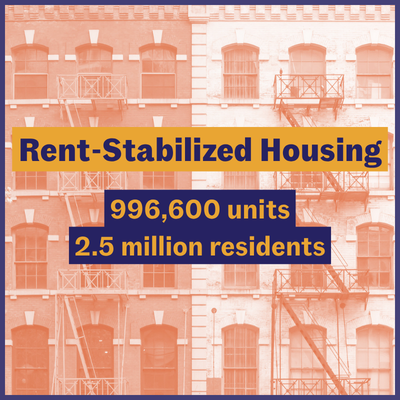
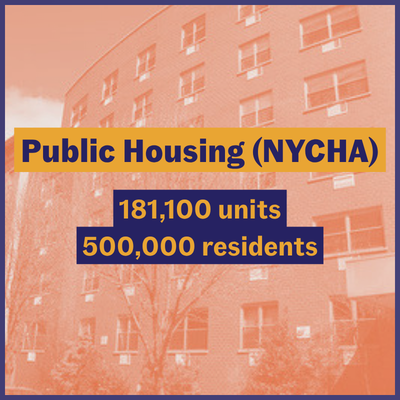
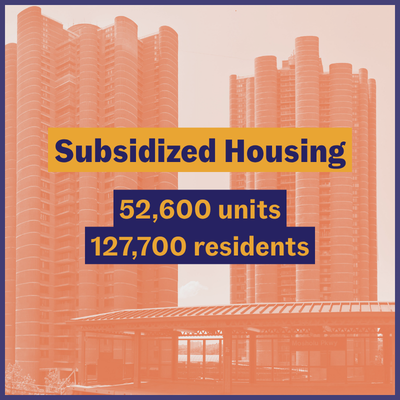
This post is part of our 2026 Earth Week series Climate Change and New York City's Housing Stock. View other posts in this series on rent-stabilized housing, subsidized housing, and public housing.
Notes
1. In NYC, there 3.7 million housing units, of which 1.4 million are in one-to-four-unit buildings. Source: U.S. Census Bureau. “Selected Housing Characteristics.” American Community Survey, ACS 1-Year Estimates Data Profiles, Table DP04.
2. 2023 NYC Housing Vacancy Survey: Selected Initial Findings, page 7.
3. “Our Fast Analysis of the 2021 New York City Housing and Vacancy Survey.” October 2023. Community Service Society of New York.
4. Yuan, Ariel et al. “Immediate Injury Deaths Related to the Remnants From Hurricane Ida in New York City, September 1-2, 2021.” Disaster Medicine and Public Health Preparedness 18 (2024): e55.
5. Orton, Philip et al. “New York City Panel on Climate Change (NPCC) 2019 Report Chapter 4: Coastal Flooding.” Ann. N.Y. Acad. Sci., 1439 (2019): 95-114.
6. “Selling Flood Risk: NYC.” May 2024. Rebuild by Design.
7. Rosenzweig, Bernice et al. New York City Panel on Climate Change 4 (NPCC4): Climate Change and New York City's Flood Risk. Ann. N.Y. Acad. Sci., 1539 (2024): 127–184.
8. Lander, Brad. “Bringing Basement Apartments into the Light: Establishing a NYC Basement Board to Provide Basic Rights, Responsibilities, and Protections for Basement Apartment Residents and Owners.” August 2022.
9. “New York’s Housing Underground: A Refuge and Resource.” March 2008. Pratt Center for Community Development and Chhaya Community Development Corporation.
10. Basements Data Dashboard by Pratt Center for Community Development. March 2022.
11. “Protecting New Yorkers from Extreme Heat.” September 2020. NYC Environment & Health Data Portal by the NYC Department of Health and Mental Hygiene.
12. Salles, Joaquim. “Left Behind: What life is like for the last residents of Staten Island’s Oakwood Beach.” September 21, 2022.