Our Fast Analysis of the 2021 New York City Housing and Vacancy Survey
Oksana MironovaSamuel Stein
In August 2023, the city released the full 2021 New York City Housing and Vacancy Survey (HVS), which gives us a representative picture of housing market conditions in New York City. While there are a number of other competing rental market data sources, including those published by real estate listing aggregators or scraped from city agency websites, they generally offer a pointin- time view of a portion of the rental market. HVS offers the most rounded view of housing conditions in both occupied and vacant units across all housing types: regulated, unregulated, government-subsidized, and owner-occupied.
The HVS is fielded by the U.S. Census Bureau on behalf of the City of New York about once every three or four years (learn more about the HVS here). While the 2021 HVS is shaped by the pandemic’s short-term impact on the real estate market, many long-term trends are also observable in the data.
Our analysis of the 2021 HVS shows rent regulation’s continued importance for low-income households and people of color in New York City. The data show that gradual improvements to the state’s rent laws after 2014, which culminated in the 2019 Housing Stability and Tenant Protection Act (HSTPA), have stabilized runaway rents, helping stem the loss of low-rent apartments.
Key Findings
- Thirty-eight percent (395,700) of low-income households live in rent regulated housing. That is more than double the number of low-income households (156,300) living in public housing and governmentsubsidized rentals.
- The median New York City household earns 71 percent of the Area Median Income (AMI), a level the city’s Department of Housing Preservation and Development characterizes as “low income.” The only housing typology with a median income above 100 percent of AMI is private homeowners.
- Three quarters of rent regulated tenants are people of color, and Latino New Yorkers make up the plurality (40 percent) of people living in rent regulated housing.
- Black and Latino New Yorkers represent two-thirds of all occupants living in limited- and shared-equity cooperatives like Mitchell Lama coops and HDFCs. Only one-third of Black and Latino New Yorkers live in private condos, coops, or single-family homes.
- The 2019 Housing Stability and Tenant Protection Act (HSTPA) helped slow the loss of low-rent units. New York City lost 47 percent of its low-rent stock (441,500 apartments) between 2002 and 2014. Between 2014 and 2021, the city lost an additional five percent of its low-rent apartments, bringing the total count down to 526,800.
- Most New Yorkers—55 percent or 1,196,100 households—were rent burdened in 2021. A third of New York renter households, overwhelmingly low-income tenants, are severely rent burdened.
- Housing in New York City is becoming simultaneously more expensive and less habitable. Owner-occupied private housing residents reported the fewest deficiencies, while public housing residents reported the most.
NOTE: This brief carries on a tradition started by Tom Waters at CSS, who would offer his analysis of each HVS as soon as it came out. We offer this “fast analysis” in his honor and memory. One of the mainstays of Tom’s work was neighborhood-level analysis, but unfortunately this year’s HVS microdata does not allow researchers to make observations about anything smaller than the borough.
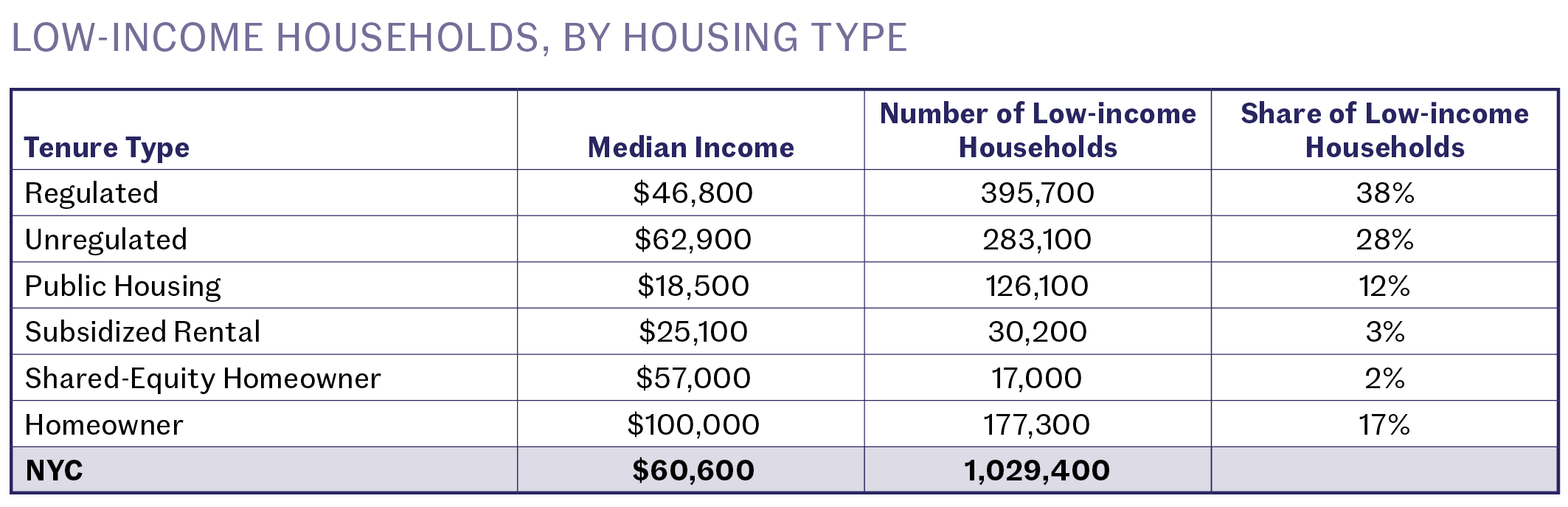
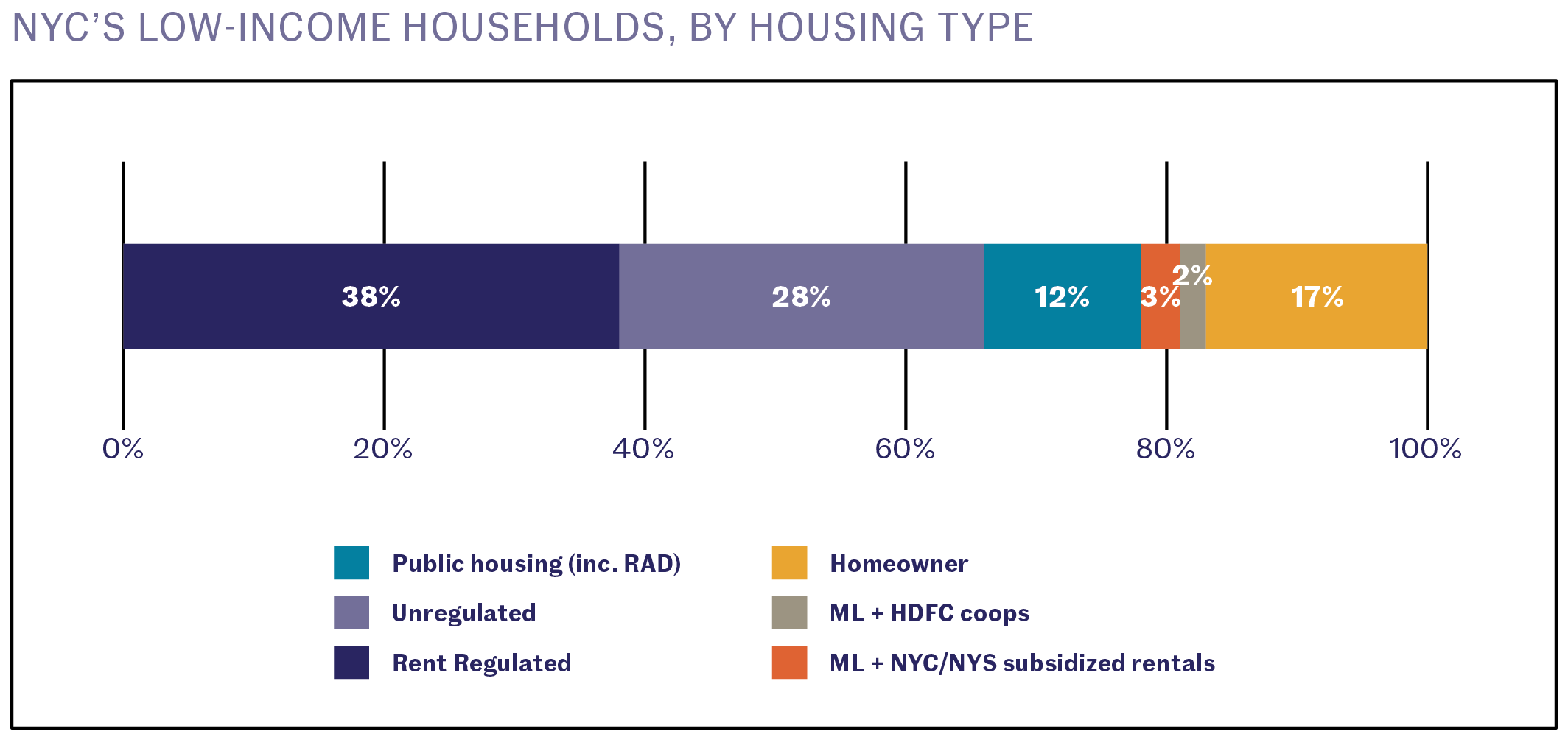
Thirty-eight percent (395,700) of low-income households—those earning under 200 percent of the federal poverty level ($41,182 for a family of three in 2020)—live in rent regulated housing. That is more than double the number of low-income households (156,300) living in public housing and government-subsidized rentals. Tenants living in rent regulated housing benefit from lower rents, increased stability, broader protections from eviction and landlord reprisals than those afforded to the substantial number of low-income households (283,100) living in unregulated apartments. While most rent stabilized tenants do not receive housing assistance, they are more likely to pay their rent with a voucher than unregulated tenants (16 percent of tenants in regulated apartments compared to 9 percent of tenants in unregulated apartments), underlining this stock’s importance as a resource to low-income households.
The annual median income for rent regulated households is $13,800 lower than the city’s overall median of $60,600. Public housing and subsidized rental households earn $42,100 and $35,500 a year less respectively than the median NYC household. Government subsidized housing types provide housing at rent levels that the private market simply does not produce. Homeowners earn $39,400 above the city’s median income. Given this discrepancy, it is surprising that 177,300 low-income households are homeowners. However, two-thirds of low-income homeowners are seniors and are likely living on fixed incomes.
In U.S. housing discourse, we usually describe income-targeted housing as being available for different households as percentages of the Area Median Income, or AMI. Area Median Incomes are set annually by the federal Housing and Urban Development agency, and factor in both income and housing costs for a metropolitan area. As the Association for Neighborhood Housing and Development showed last year, the New York City metropolitan area’s AMI levels are wildly out of sync with the city’s actual income level, largely because HUD adjusts our AMI upward because of the region’s already high housing costs—paradoxically resulting in affordable housing production that is more expansive than what the city really needs.
The 2021 HVS sheds further light on this problem. At the time of the survey, the city’s median income was just 71% of AMI. For every housing type but private homeowners, residents’ median AMI falls below 100 percent—and often well below. In fact, the city’s Department of Housing Preservation and Development would characterize the median household in every housing typology but private homeownership as either “extremely low income” (public housing residents), “very low income” (subsidized rental tenants), or simply “low income” (rent regulated tenants, shared-equity homeowners, and even unregulated tenants).
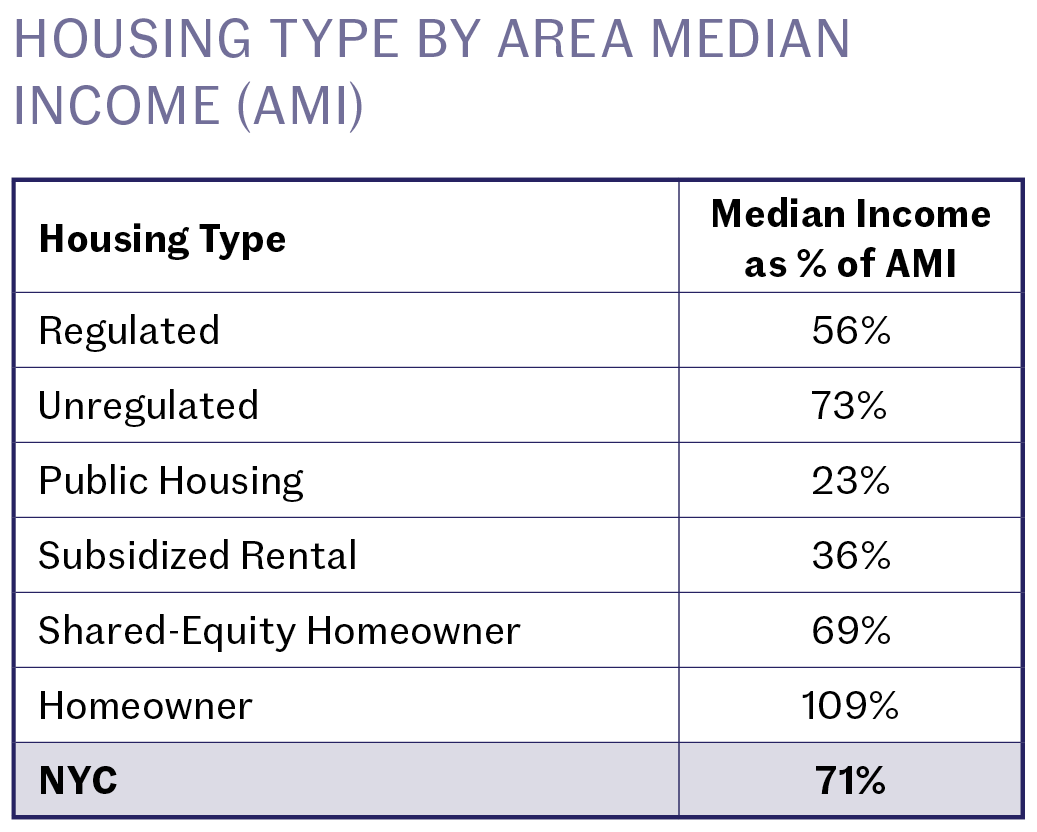
Programs like the 421-a tax exemption, which mostly produced “affordable” units for households making 130 percent of AMI, were targeted to people making almost twice as much as the average New Yorker, and more than three and a half times the income of the average subsidized renter. The federal Low-Income Housing Tax Credit program—the primary driver of affordable housing production for roughly the past 40 years—is mainly targeted at households making 60 percent of AMI, which is more than most rent stabilized tenants earn. Given AMI inflation over the past year, the next HVS will most likely show New Yorkers today earn an even lower percentage of AMI than they did three years ago.
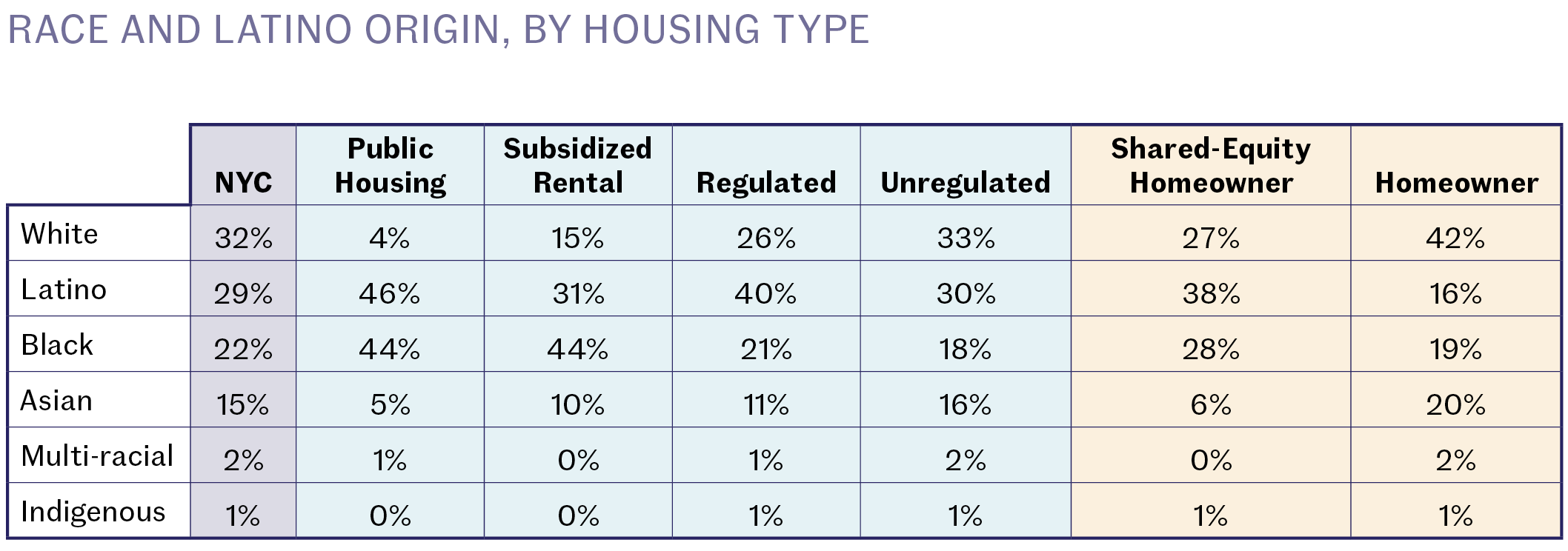
Homeownership emains more accessible to white people than to people of color in New York City. While white people make up 32 percent of New York City’s population, they represent 42 percent of homeowners. During the foreclosure crisis, Black and Latino homeownership declined in New York City as a result of predatory lending practices by mortgage lenders and oversight failures by the government. The pandemic compounded these racist practices, putting Black homeowners in particular at high risk for foreclosure.
Black and Latino New Yorkers are much more likely to live in subsidized owner-occupied homes, representing two-thirds of all occupants living in limited- and shared-equity cooperatives like Mitchell Lamas and HDFCs. Shared-equity homeownership models have proven to be more stable in times of financial crisis and are often structured to empower people who have been excluded by redlining or preyed upon by racist mortgage lending practices. Their affordability lowers the bar of entry: 78 percent of Mitchell Lama and HDFC cooperators reported that they were first-time home buyers, 18 percentage points higher than the rate for private cooperatives.
Three-quarters of rent regulated tenants are people of color, and Latino New Yorkers make up the plurality (40 percent) of people living in rent regulated housing. Black and Latino New Yorkers are also much more likely to live in public housing and subsidized housing than white and Asian New Yorkers. As bars of entry for first time homeownership and renting on the unregulated market become higher, both rent regulation and rental subsidies become even more vital for New Yorkers of color.
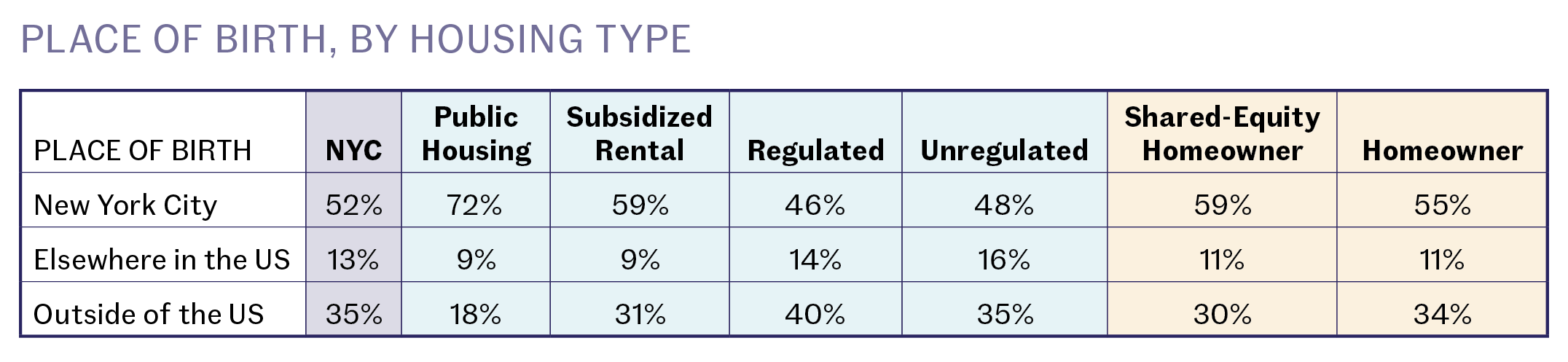
About one-third of New Yorkers were not born in the United States. Immigrants are underrepresented in public housing, making up only 18 percent of the residents, which is 17 percentage points lower than their share of the city’s overall population. This is likely a result of both NYCHA’s extremely long waiting lists and federal policies that make public housing more difficult to access for undocumented people. At the same time, 40 percent of regulated tenants are immigrants. While, on average, not as deeply affordable as government-assisted housing, rent regulation offers a level of stability and protection to all tenants because it is not a means-tested program.
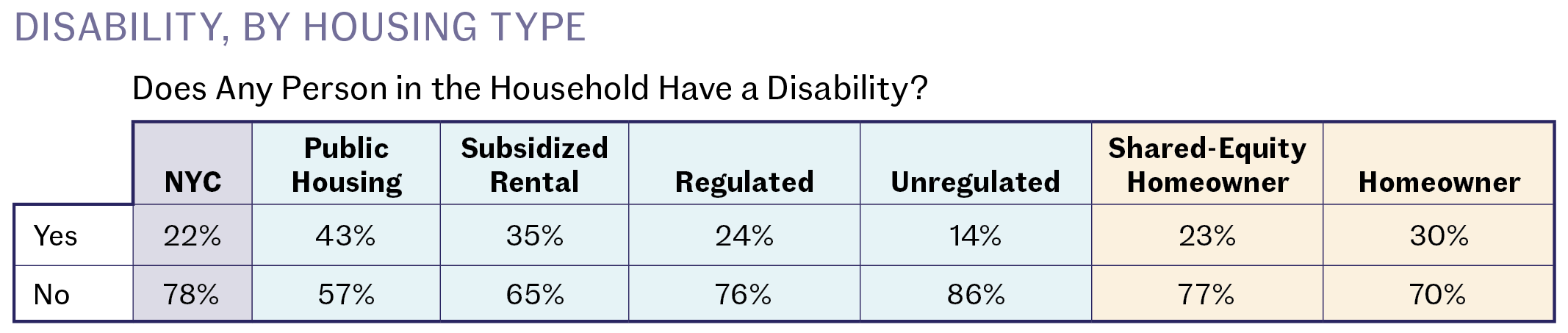
One in five households in New York City includes a person living with a disability, which (within the HVS definition) can include people with hearing and sight limitations, memory disorders, or people who have difficulty walking and running everyday errands on their own. People with disabilities are over-represented in public and subsidized housing. Forty-three percent of households in public housing include a person with disability, 21 points above their representation in the city overall. Thirty-five percent of subsidized households include a disabled person, 13 percent above the city’s overall share.
There are three primary reasons for this:
- New Yorkers with disabilities are more than twice as likely to live in poverty as those without disabilities because of pervasive job discrimination and other barriers to employment like the inaccessibility of the city’s public transit network.
- Households living in public and subsidized housing are more likely to include seniors than market or rent regulated rentals. One-third of households in New York City include a person over 62 years of age. In public housing, 41 percent of households include a senior; the share is even higher in subsidized housing: 54 percent.
- Low-rent apartments within the private market, including both regulated and unregulated units, are often not accessible. For example, less than a third of occupied units in NYC are accessible without climbing any steps. In public or subsidized buildings, more than half of apartments are reachable without steps.
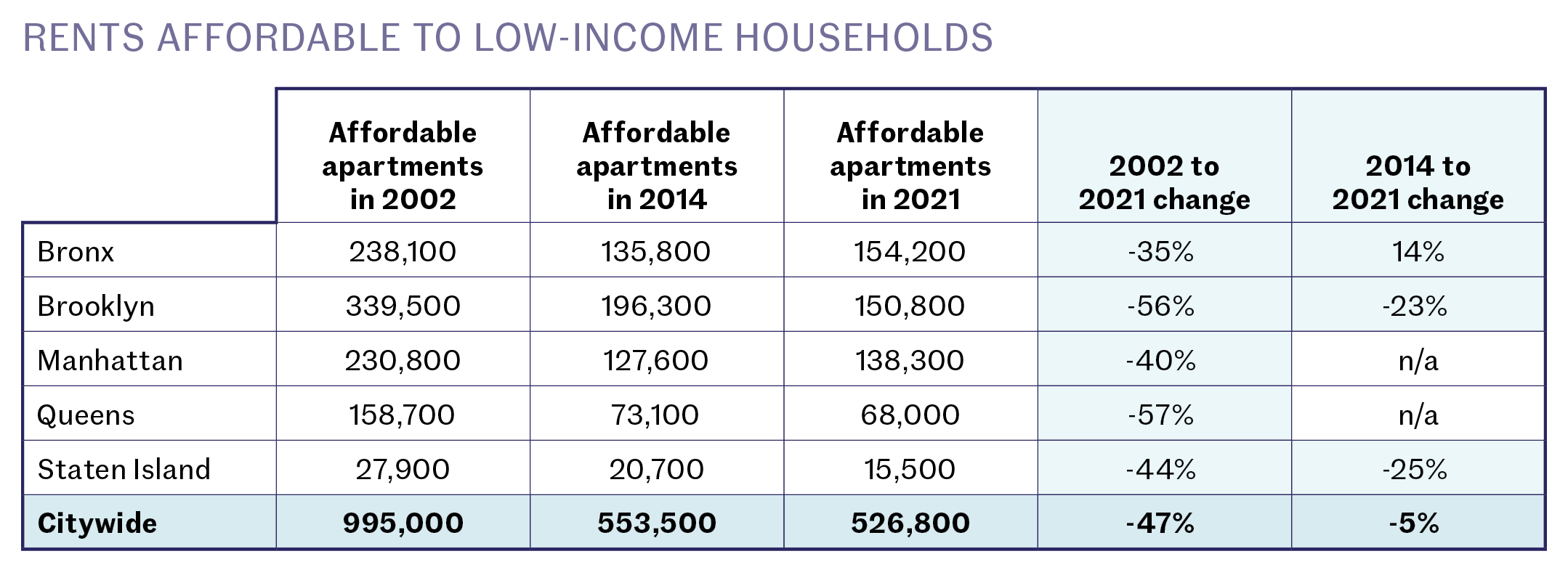
Between 2002 and 2014, New York City lost nearly half of its low-rent apartments. Brooklyn and Manhattan lost more than half of their units affordable to a typical three-person household earning less than 200 percent of the federal poverty level ($41,182 in 2020). These losses occurred across all tenure types in New York City, as building values skyrocketed in the leadup to the foreclosure crisis and landlords used legal and illegal tools to raise rents and pull equity out of their buildings (see our report Corporate Windfalls or Social Housing Conversions?). Landlords privatized formerly subsidized buildings, sometimes hiking up rents for thousands of households at a time. In rent regulated apartments, low-rent units disappeared because of high rent increases permitted under the Bloomberg-era Rent Guides Board (RGB) and loopholes in the law that allowed landlords to increase rents by 20 percent or more during vacancy and eventually remove apartments from rent stabilization all together. Unmitigated rent hikes in unregulated apartments, particularly in gentrifying neighborhoods, contributed to these losses as well.
The foreclosure crisis interrupted the relentless climb of multifamily property values, but only for a moment. They continued to climb after 2010, doubling in some neighborhoods. While the real estate market conditions leading up to the pandemic where not that different than those leading up to the foreclosure crisis, the loss of low-rent units slowed down between 2014 and 2021. The total share of low-rent units decreased by five percent, to 526,800.
This occurred for three reasons:
- Relentless organizing by tenants and advocates improved the rent stabilization system. New York State adopted limited reforms that made it more difficult to deregulate units in 2015 and 2017. In 2019, tenants won the Housing Stability and Tenant Protection Act (HSTPA), which ended the vacancy bonus and high rent deregulation all together. Today, 48 percent of low-rent units (252,900) are rent regulated. A large share would have been lost, if not for the HSTPA.
- The de Blasio administration spent record sums on preserving and building new affordable housing, much of it concentrated in the Bronx. While the relentless rent burdens and homelessness persisted (see our report Assessing de Blasio’s Housing Legacy), the spending on preservation stemmed the privatization of large subsidized-complexes. The administration added over 17,000 new units affordable to low-income tenants1. By no means did this meet the need for low-rent units or make up for the 440,000 units lost in the previous decade, but it is likely why the number of low-rent units in the Bronx increased by 14 percent between 2014 and 2021.
- The de Blasio-era RGB worked to undo some of the damage to the city’s low-rent stock done by the Bloomberg-era Board. Their annual rent adjustments were lower, on average, and more considerate of tenants’ economic realities.
At the same time, while the loss of low-rent units slowed down in the Bronx, Manhattan, and Queens, Brooklyn lost another 23 percent of its low-rent units between 2014 and 2021. Staten Island, which had a low share of rentals to begin with, also lost a quarter of its low-rent units.
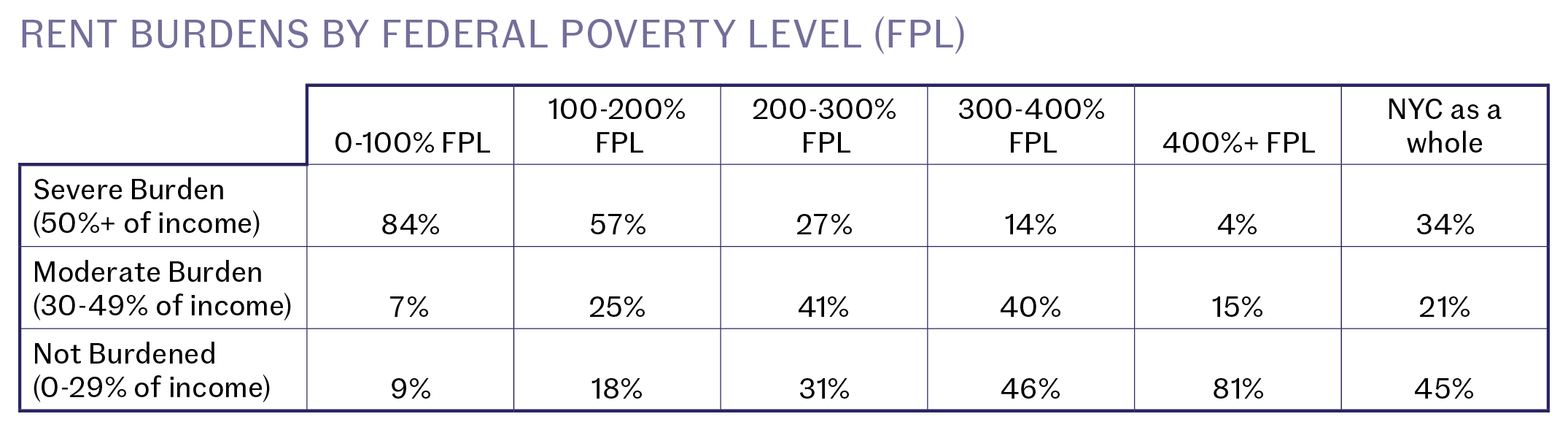
Despite the gains described above, a shocking proportion of New Yorkers remain rent burdened, or paying rents that exceed 30 percent of gross household income. In fact, most New Yorkers—55 percent, or 1,196,100 households—were rent burdened in 2021. A third of New York renter households are severely rent burdened and put most of their income toward rent each month.
All of these trends are skewed by income levels. A staggering 84 percent (399,300) of households under the Federal Poverty Level pay more than half of their incomes toward rent and are constantly on the precipice of eviction. Compare that to households earning above 400 percent of the Federal Poverty Level, just 4 percent of whom are severely rent burdened. In fact, these households were the only category of renters more likely to be able to afford their rent than not.
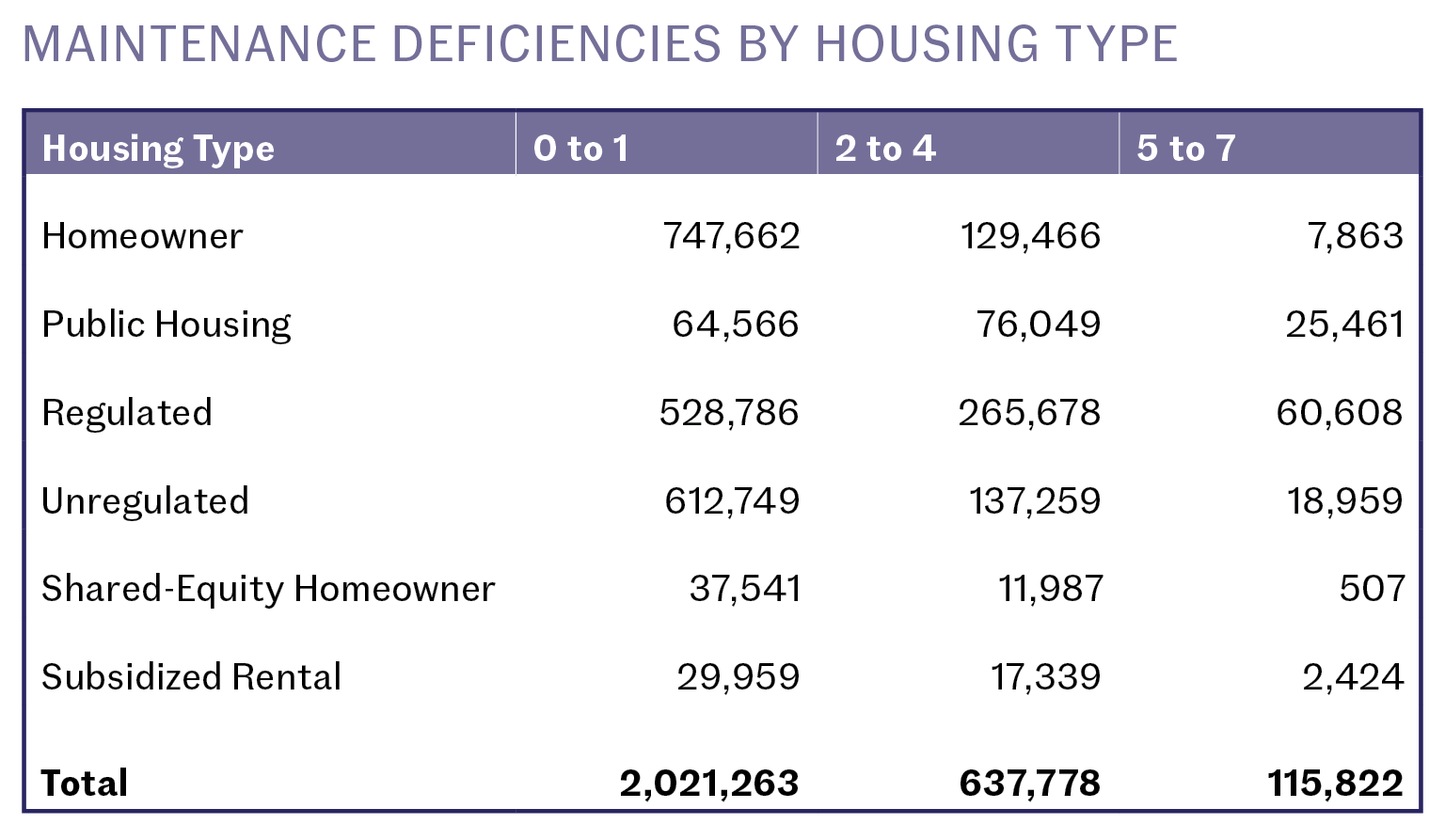
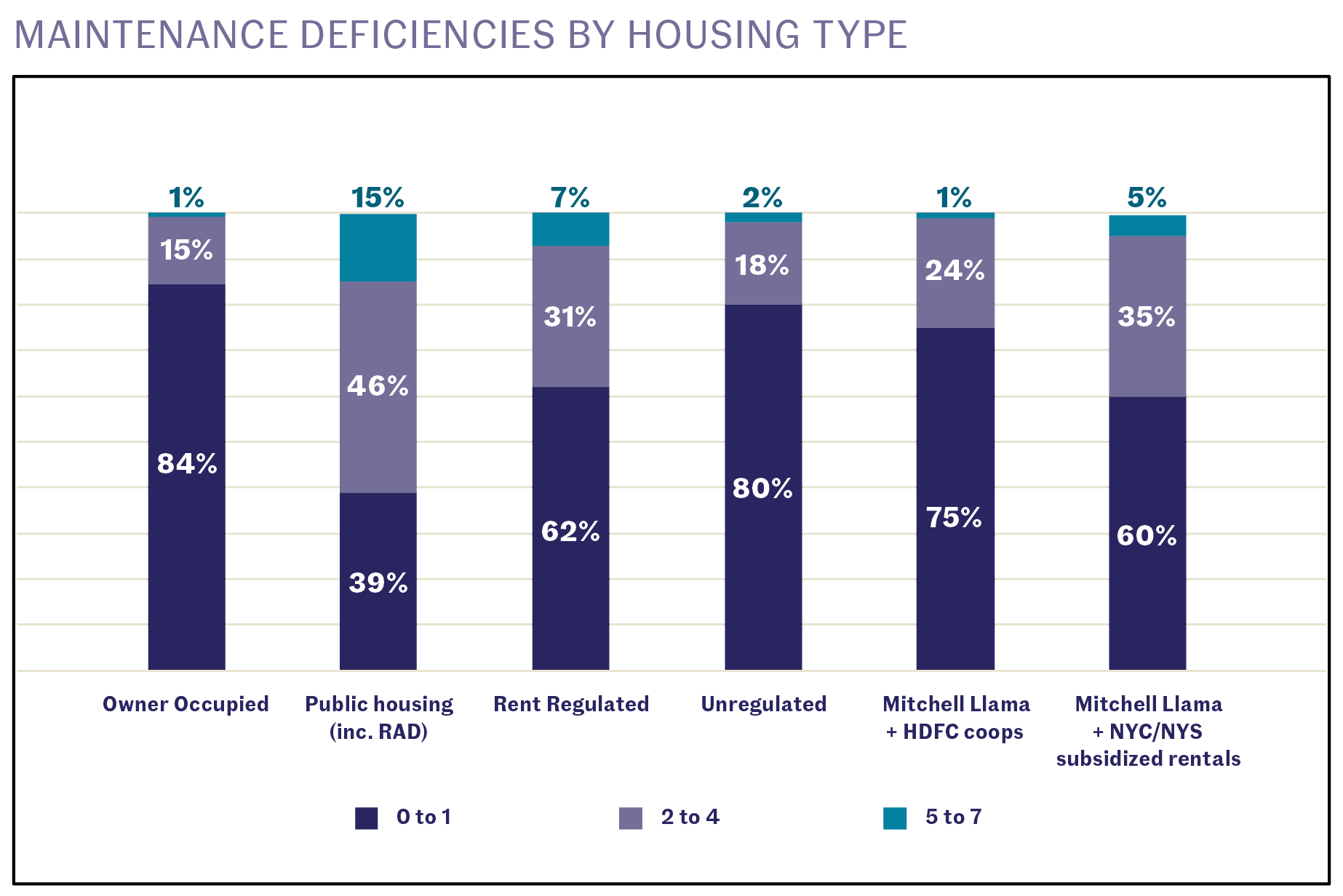
The 2021 HVS also shows an alarming rise in housing maintenance deficiencies. As we reported in our summary of the survey’s initial findings, the survey shows housing in New York City becoming simultaneously more expensive and less habitable, with a 24 percent of New York City homes reporting rodent infestations, 18 percent reporting leaks, 17 percent reporting cracks in ceilings or floors, 16 percent reporting winter heat outages, and 9 percent reporting mold.
If we treat these kinds of housing deficiencies as metrics of overall housing health, and we count the number of deficiencies reported by housing type, two clear trends emerge: owner-occupied private housing residents reported the fewest deficiencies, with 84 percent of respondents reporting 0 or 1 maintenance problem, while public housing residents reported the most deficiencies, with a majority of residents (61 percent) reporting 2-7 deficiencies. Of these, a staggering 15 percent (or nearly 1 in 6 public housing residents) reported having 5 to 7 maintenance deficiencies.
Conclusion
This year’s Housing and Vacancy Survey was, in some ways, unlike any that preceded it. Because it was fielded during the first half of 2021, when the city was gripped by COVID-19, it captured a moment of extreme distress for the city and its residents. Some of this distress is revealed in the data itself. The survey includes a battery of questions about who was affected by the virus and who worked through the pandemic in person. The survey also reflects a moment when many people who could leave the city did, at least temporarily.
But one of the core values of the HVS is that it is a longitudinal study. Many of the most distressing signs in the survey are, in fact, not news at all. The median tenant has been rent burdened since 2005. The vacancy rate for very low-rent apartments, now 0.9 percent, was just 1.1 percent in 2011. While a shocking 102,900 units were vacant and unavailable because they are held for “seasonal, recreational, or occasional use,” the number of such units was already quite high in 2017 at 74,950.
Clearly, New York City remains in a housing crisis, with rents unaffordable to most residents and housing quality in much of the stock falling into dangerous disrepair. The city, state, and federal governments must take action on multiple fronts to preserve and expand affordability and to ensure housing quality. Rent stabilization, the largest source of housing for low-income New Yorkers and immigrants alike, must be preserved as an affordable option with strong tenants’ rights and protections. Public Housing must be reinvested in to return the stock to decent conditions. Social housing—including public and subsidized rentals, shared equity cooperatives, and Community Land Trusts—must be preserved and expanded into a larger proportion of the city’s overall housing system. With affordability dwindling and housing conditions faltering, now is the time for bold action on tenant protections, code enforcement, and social housing production.
Endnotes
1. For this brief, we use 200 percent of the Federal Poverty Level and below to quantify “low-income” households. The construction figure here refers to units priced for households making up to 50 percent AMI – what HPD calls “extremely lowincome” and “very low-income” households.