Subsidized Housing and Climate Change
Oksana MironovaBrianna Soleyn
Overview
Nearly 127,700 New Yorkers earning under 50 percent of Area Median Income live in apartments that receive federal, state, or local subsidies.[1] This category encompasses a wide range of building types and development histories.
Mid-20th century developments, such as Mitchell-Lama rentals and project-based Section 8 buildings, were constructed as large campus-style affordable housing complexes. Later, in the mid-1980s and 1990s, community development corporations and emerging for-profit affordable housing developers converted tenements and older mid-rise apartment buildings into affordable housing using the federal Low-Income Housing Tax Credit program. Since then, continued public investment has supported both new construction and preservation efforts across the city.
Climate Risks
Flood Risk
Subsidized housing is exposed to multiple forms of flooding, each of which is intensifying with climate change.
Tidal flooding already affects low-lying neighborhoods with large concentrations of subsidized housing, including the Rockaways and Coney Island.[2] In a recent five-year risk assessment, the New York City Department of Health and Mental Hygiene identified tidal flooding as a top public health threat that is being exacerbated by sea level rise.[3]
Coastal storm surges from extreme weather events are less frequent but more destructive, and subsidized housing has borne heavy impacts. For example, Superstorm Sandy in 2012 severely damaged Ocean Towers, a Mitchell-Lama rental in Coney Island, requiring a $50 million rehabilitation in the aftermath of the storm.[4]
Stormwater flooding—caused when the heavy rains overwhelm the city’s aging water drainage systems—is increasing in frequency and severity. Unlike tidal floods and coastal storm surges, stormwater flooding can occur in neighborhoods that are far from the coast, affecting New Yorkers across a much wider swath of the city.[5]
Despite these growing risks, new construction in flood-prone areas has continued at a rapid pace. A 2022 NYC Comptroller report found that market-rate real estate values in the 100-year floodplain have risen to over $176 billion, a 44 percent increase since Superstorm Sandy.[6] Coney Island alone has added nearly 2,000 new apartments since the storm, all within the city’s floodplain.[7] Much of new development in the neighborhood is driven by a 2009, Bloomberg-era, rezoning, which created the capacity for 4,500 new apartments, including around 1,000 city-subsidized units.[8]
While some new coastal developments include climate-mitigating features—such as the geothermal heating and cooling system in a new luxury rental on Surf Avenue—all the new rentals are likely to be impacted by persistent flooding during high tides in the next 60 years.[9] Affordable housing construction, which is highly dependent on private market development, follows the same pattern: the city and state funnel public dollars to private developers, who then build below-market units. New subsidized rentals, like the 446-unit Coney Island Phase I and 183-unit Rockaway Village Apartments, continue to be sited in flood-prone neighborhoods.[10]
Heat Risk
Heat has proven to be far deadlier to New Yorkers year to year than flooding. On average, 350 people die each year as a result of heat waves, with most deaths occurring at home. Older adults are most vulnerable to heat-related illnesses, but racial inequities also shape outcomes: Black New Yorkers are twice as likely to die from heat-related illnesses as white New Yorkers and are more than twice as likely to live in subsidized housing.[11]
The City’s Heat Vulnerability Index, which accounts for factors such as daytime surface temperatures and access to air conditioning, illustrates the racialized and class-based inequities in climate change impacts on the city’s neighborhoods.[12] Neighborhoods with higher shares of Black, Latino, and low-income residents—including East Harlem and the South Bronx—have higher heat vulnerability ratings.[13] These same neighborhoods were the sites of major urban renewal projects and affordable housing conversions throughout the 20th century and contain sizable shares of subsidized housing.
With longer, more sustained heat waves each summer, access to cooling is increasingly as important as access to heating. Subsidized housing tenants report somewhat better air conditioning access than those in the private rental market.[14] And policy changes, including new requirements for landlords to provide air conditioning in certain housing types, may improve access to cooling.[15] Yet in buildings where tenants pay for their own electricity, cost remains a barrier: according to the 2023 NYC Housing Vacancy Survey, one out of five subsidized tenants did not use their air conditioning because of cost, compared to one out of three rent-stabilized tenants.
Structural & Social Vulnerabilities
A building’s age, maintenance history, and location all impact its vulnerability to climate change. Mid-20th century “slum clearance” and urban renewal policies—shaped by racist real estate and banking practices—brought Mitchell-Lama, and later, project-based Section 8 rental developments, to coastal neighborhoods that have become increasingly exposed to flooding because of climate change.[16] Today, over-reliance on market-driven development continues to push affordable housing into areas with climate risks.
Many subsidized developments include older buildings with limited floodproofing, making them especially vulnerable to building systems breakdowns, utility outages, and mold following extreme weather events.
Many older subsidized buildings are master-metered, meaning the cost of electricity is included in the general operating costs of the building. However, federal austerity measures are threatening the operating budgets of Department of Housing and Urban Development-subsidized developments and programs that provide low-income households with support for heating and cooling.[17]
Mitigation Opportunities
With sufficient political will, housing subsidies present a powerful lever for advancing environmental sustainability goals.
Campus-scale opportunities
The campus-style typology of some subsidized developments creates opportunities to implement large-scale mitigation strategies that benefit entire neighborhoods. Interventions such as tree planting and pit widening, porous pavement installation, bioswales, rain gardens, and sunken pavement can reduce flood risk for subsidized buildings while also lowering surrounding temperatures.
Large buildings and emissions policy
Because larger multifamily buildings contribute significantly to greenhouse gas emissions, New York has targeted them in climate policy. Local Law 97 (2019) set emissions caps on buildings over 25,000 square feet—a threshold that includes most of the city’s larger subsidized developments. While the law’s compliance period began in 2024, most subsidized buildings are not required to meet the caps until 2035.[18]
Financing tools and constraints
To offset the costliness of capital projects—such as building electrification or heat pump installation—that will make Local Law 97 compliance possible, there are several city and state tax incentives, as well as loan and grant programs, designed to reduce carbon emissions. For example, an updated J-51R program, currently under consideration by the state’s legislature, would provide a substantial tax break for landlords who make building-wide improvements, while the NYC Accelerator offers long-term, fixed-rate financing for energy efficiency projects and renewable energy installation. In subsidized developments with tight operating budgets and minimal reserves, these upgrades are often bundled together with more basic types of repairs, like façade work or plumbing upgrades.
State-level policy opportunities
More broadly, housing subsidies themselves provide the public with leverage to mandate the reduction of greenhouse gas emissions. The proposed Social Housing Development Authority (SHDA),[19] for instance, would create a new, statewide public authority with power to both finance social housing conversions and build new, permanently affordable rentals and cooperatives to high levels of environmental sustainability.
The lack of political will remains the primary obstacle to protecting existing subsidized tenants from the harmful impacts of climate change and to reducing greenhouse gas emissions in new affordable housing.
Explore climate risks by housing type
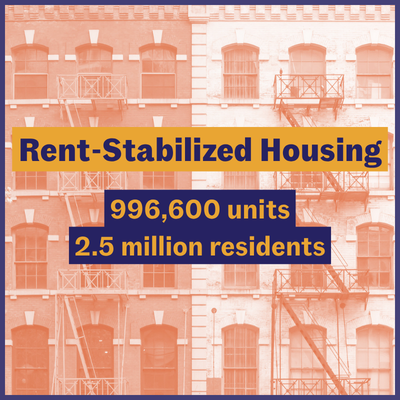
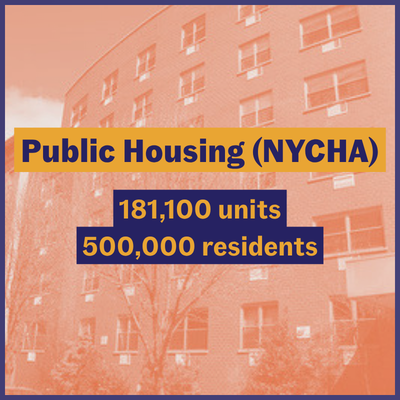
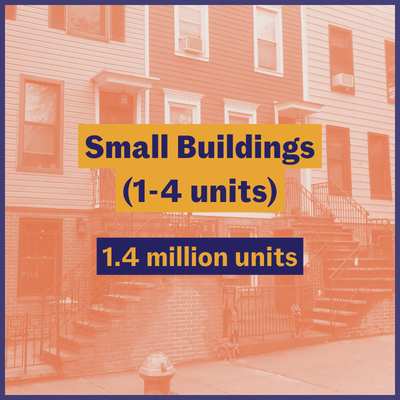
This post is part of our 2026 Earth Week series Climate Change and New York City's Housing Stock. View other posts in this series on rent-stabilized housing, public housing, and small buildings.
Notes
1. “Rent Regulation Keeps New York, New York.” Community Service Society of New York, April, 2025.
2. Hernandez, Natalie. “Coney Island residents brace for coastal flooding.” News 12, October 12, 2025.
3. “Jurisdictional Risk Assessment 2024.” New York City Department of Health and Mental Hygiene, June 2025.
4. “Ocean Towers.” New York Housing Conference.
5. NYC Department of Environmental Protection. “2024 Stormwater Analysis.”
6. Lander, Brad. “Ten Years After Sandy Barriers to Resilience.” October 13, 2022.
7. Maldonado, Samantha and Pierre-Louis, Kendra. “Hurricane Sandy Devastated Coney Island 10 Years Ago. So Why Has NYC Added Almost 2,000 Homes to the Area Since?” The City. October 27, 2022.
8. “Coney Island Comprehensive Rezoning Plan.” NYC Economic Development Corporation. January 20, 2009.
9. “NYC Flood Hazard Mapper.” NYC Department of City Planning.
10. “2926 West 19th Street.” L+M Development Partners.
11. “The Urban Heat Island Effect in NYC.” NYC Environmental & Health Data Portal. According to the 2023 NYC Housing Vacancy Survey, white tenants make up 15 percent of subsidized housing residents, while Black tenants account for 37 percent.
12. “Interactive Heat Vulnerability Index.” NYC Environmental & Health Data Portal.
13. Ibid.
14. CSS analysis of the 2023 HVS. 94 percent of subsidized renters reported having an AC or central air, compared to 88% of regulated and market tenants.
15. Venugopal, Arun. “Air conditioning in every NYC apartment? A new law aims to make that happen.” Gothamist. January 23, 2026.
16. “Rising Tides, Rising Costs: Flood Insurance and New York City’s Affordability Crisis.” Center for New York City Neighborhoods. September 2014.
17. Coburn, Jesse. “Millions Could Lose Housing Aid Under Trump Plan.” Pro Publica. September 29, 2025.
18. “Local Law 97 Timeline.” Urban Green Council.
19. “2025-2026 NYS Legislative Session: Senate Bill S5674.” New York State Senate.