Public Housing and Climate Change
Iziah ThompsonBrianna Soleyn
Overview
New York City has the nation’s largest public housing stock, with over 177,569 units managed by the New York City Housing Authority (NYCHA) across the five boroughs. Like much of public housing in the United States, many NYCHA developments were built near polluted sites,[1] exposing residents to long-standing environmental health risks. NYCHA housing serves predominantly low-income New Yorkers, including large numbers of seniors, people with disabilities, and people of color—many of whom already face significant health and economic vulnerabilities.
Climate change is expected to exacerbate these conditions. Post-Superstorm Sandy analyses suggest that low-income residents will bear a disproportionate share of climate-related impacts.[2] More extreme weather, rising temperatures, and sea level rise may increase physical injury and mental distress; worsen air pollution, allergens, pests, and ground-level ozone; and lead to more heat-related illness and death. While the precise impacts will continue to evolve, already health-burdened, low-income communities are likely to face increasingly severe consequences as climate change intensifies.
Climate Risks
Flood Risk
Many of New York’s public housing units were constructed near the then-industrial waterfront on cheap land, often to house New Yorkers displaced by “urban renewal” projects. Because of this legacy, many NYCHA developments are currently located in low-lying coastal areas and face significant flood risk. There are 921 NYCHA buildings in the 100-year flood zone, representing approximately 38 percent of all NYCHA buildings. An additional 897 NYCHA buildings are at risk of being inundated by extreme rainfall over the coming decades.
Geographically, 36 percent of NYCHA developments sit within a quarter mile of the shoreline, with major concentrations in the Rockaways, near the Brooklyn Navy Yard, in Brooklyn neighborhoods of Gowanus and Red Hook, and in Lower Manhattan.
Because NYCHA buildings are overrepresented along the waterfront, they are at high risk for both coastal flooding—including storm surge—and inland stormwater flooding caused by heavy rainfall overwhelming draining systems. Rainfall patterns are becoming more uneven and intense, and impacts vary based on drainage capacity, groundwater conditions, and local topography. These risks are compounded by the aging infrastructure of NYCHA buildings, given the lack of attention and federal funding for maintenance.
Climate change is expected to bring more frequent and intense rainfall events. Historically, New York City has averaged 16.3 days per year with at least one inch of rainfall; by the 2080s, this could reach up to 23.7 days. Annual precipitation is projected to rise by 10 percent by the 2030s and by up to 30 percent by the 2100s. Under current extreme rainfall scenarios, over 200,000 buildings citywide could be inundated by flooding, including 30 percent of all NYCHA buildings.
These risks are already evident in specific communities. The Rockaway Peninsula in Queens, for example, is geographically isolated and highly exposed, surrounded by water on both sides and facing ongoing threats from coastal storms and sea level rise. Jamaica Bay, to the north, was once a dumping ground for raw sewage, while the ocean shoreline to the south remains under constant threat from hurricanes and other major storms. Public housing developments in this area were already in poor condition prior to Superstorm Sandy and experienced severe damage during the storm. Recovery has been uneven, with more gentrified areas receiving substantial reinvestment while others—particularly those home to predominantly Black and Latino public housing residents—have taken far longer to recover.
As measured by census tract data, the Rockaway Peninsula is near the 100th percentile nationally for extreme flood risk due to projected sea level rise by 2050. Public housing communities in this area are especially vulnerable to climate impacts. NYCHA’s Beach Channel Drive, for example is located in a census tract within the 90th percentile of the U.S. Climate Vulnerability Index. This ranking reflects multiple compounding factors, including flood exposure; high rates of self-reported poor physical and mental health; elevated levels of toxic air pollution, black carbon, and emissions from nearby industrial facilities; and, lower life expectancy. These conditions are also present in neighboring developments such as Hammels and Carleton Manor.
Similarly, public housing developments along the East River in Lower Manhattan house tens of thousands of residents in areas that remain at high risk of storm surge and flooding. From Jacob Riis Houses in Alphabet City to Smith Houses in the Two Bridges neighborhood, at least 22,500 Lower East Side residents are at exceedingly high risk of flood exposure. While much of Lower Manhattan hovers around the 20th percentile of the U.S. Climate Vulnerability Index, census tracts with high concentrations of public housing along the East River average closer to the 80th percentile.
Although flooding is a concern across southern Manhattan, public housing developments are especially vulnerable due to disparities in infrastructure investment and available services. This pattern extends to NYCHA developments across the city. Click here to view an overlay of NYCHA developments and floodplains.
Heat Risk
Extreme heat is an increasingly serious and deadly threat in New York City, with most heat-related deaths occurring in the home. NYCHA residents—who are more likely to be low-income, older, or living with disabilities—face heightened exposure to heat-related illness and death.
Access to air conditioning varies across the city, and neighborhoods with the highest rates of homes lacking functioning air conditioning often include large public housing populations. The New York City Department of Health and Mental Hygiene (DOHMH) tracks self-reported rates of function air conditioning across the city. In several community districts in the Bronx, Brooklyn, and Queens with significant public housing populations—including areas such as Morrisania, Brownsville, and the Rockaways—significant shares of households lack adequate cooling, placing thousands of NYCHA residents at risk during extreme heat events.
At the same time, the physical design of public housing creates both challenges and advantages. Many NYCHA developments follow a “tower-in-the-park” model, with substantial open space and tree canopy. These features can help mitigate the urban heat island effect, and in some cases, NYCHA campuses are measurably cooler than surrounding neighborhoods. Satellite-based temperature data suggests that some developments experience lower surface temperatures than nearby built-up areas.[3]
However, these relative differences do not eliminate danger. Absolute temperatures during heat waves remain dangerously high, and outdoor cooling effects do not translate into safe indoor conditions. Access to reliable cooling—particularly air conditioning—remains critical.
Widespread air conditioning use during extreme heat can also strain the electrical grid, increasing the likelihood of outages. When outages occur, the consequences can be severe. Many NYCHA residents rely on elevators to access their homes, and outages can leave residents—particularly older adults and people with disabilities—unable to leave their apartments or reach cooling centers. In these conditions, heat exposure can quickly become life-threatening.
Structural & Social Vulnerabilities
NYCHA houses a disproportionately large share of residents with characteristics that increase exposure to climate-related harm. Approximately 110,000 residents are children, and 77,000 are seniors. Thirteen percent of residents are people under 65 living with disabilities—nearly double the citywide average of 7.3 percent.
The population characteristics intersect with existing building conditions to heighten risk. Many developments have long-standing issues such as high concentrations of lead, mold, and other harmful pollutants in public housing, as detailed in the July 2024 Community Service Society report, The Other Housing Crisis,[4]contributing to elevated rates of asthma and other chronic health conditions. As a result, residents are more likely to have underlying health needs that can be worsened by extreme heat, flooding, and prolonged utility outages.
Mobility constraints further shape how residents experience climate events. More than 31,000 NYCHA residents have mobility impairments[5] and more than 75,500 are seniors,[6] and many rely on elevators to access their homes. Power outages—particularly during extreme heat—can therefore have cascading effects, leaving residents unable to leave their apartments, reach cooling centers, or access medical care. Lacking capital, NYCHA has continued to repair and maintain mechanical systems that reflect the technologies available at the time of their original construction.
Building systems also contribute to exposure. Most NYCHA apartments (92 percent) are heated by a natural gas and/or oil-fueled steam system, an early 20th century technology that is both less efficient and much more difficult to control than modern systems. These systems are inefficient, difficult to regulate, and often result in both overheating in winter and inadequate temperature control overall. Many buildings also suffer from poor insulation and thermal bridging, making it difficult to maintain safe indoor temperatures and increasing energy use.
Research shows that power outages in public housing are both frequent and prolonged.[7] During extremely hot weather, when demand on the electrical grid is highest, NYCHA developments saw on average more than 12 hours of elevator outages, particularly in senior housing. In these conditions, residents may become effectively trapped in their high-rise apartments, increasingly the likelihood of heat-related illness or death.
Mitigation Opportunities
Preparing public housing for the impacts of climate change presents both significant challenges and unique opportunities. Program rules governing Section 9 and Section 8 ensure that residents are protected from the displacement that can accompany the gentrifying effects of green upgrades,[8] but this, combined with chronic underfunding, has limited the resources available for large-scale climate interventions. At the same time, NYCHA’s size and centralized ownership structure create opportunities that are not available in other housing types.
NYCHA has made measurable progress in advancing its Sustainability Agenda through electrification pilots, heat pumps, solar power expansion, weatherization, and roof replacements, contributing to a 17 percent reduction in annual greenhouse gas emissions, as well as improved building performance and stronger defenses against water intrusion. However, many current preservation efforts, particularly through the PACT program, do not consistently deliver the deep energy retrofits needed to meaningfully reduce emissions and improve long-term resilience.
Addressing procurement and delivery constraints
Existing state and federal procurement rules put limitations on whom housing authorities can contract with for construction work and on how they determine which contractors to select. The state specifically has a rule requiring the splitting of design and construction work into separate contracts, which makes the process slow, costly, and inefficient. Reforms such as the Public Housing Procurement Reform Act (A.3965/S.6672) would authorize a Progressive Design-Build authority, allowing agencies to integrate planning, design, and construction into a single process. This reform could help reduce costs and accelerate urgently needed retrofits.
Tackling financing constraints and misalignment
NYCHA’s ability to mitigate climate risk is shaped not only by its own planning, but by how it fits within broader city and state financing systems. New York City’s climate budgeting framework[9] creates a pathway to prioritize investments based on emissions reduction, and public housing—given its age and inefficiency—offers some of the highest potential returns. However, NYCHA is not yet fully integrated into this framework and risks being left out of capital prioritization decisions.
This misalignment extends to existing decarbonization funding streams. Under Local Law 97, the Affordable Housing Reinvestment Fund allows private building owners to comply with emissions limits by purchasing carbon offsets that fund retrofits in affordable housing. However, the program is constrained by a cap that limits offsets to 10 percent of a building’s emissions. This restricts the overall pool of funding and makes it difficult to finance the large, upfront, campus-wide upgrades required in public housing. As a result, funding tends to flow toward smaller, lower-cost projects in privately owned buildings rather than the more complex and capital-intensive work required in NYCHA developments.
Taking Advantage of NYCHA’s Scale
Legislative proposals such as the Green New Deal for Public Housing (S.6674), which would require deep energy retrofits to International Passive House standards that can save more than 70 percent in heating and cooling costs, point to a pathway for aligning climate and housing policy at scale.
Addressing the magnitude of need in public housing will require sustained capital investment. However, existing state programs are often not structured to meet these needs. For example, the Clean Energy Initiative (CEI), which funds building electrification and efficiency upgrades, relies on per-unit funding caps that do not reflect the true cost of retrofitting large, aging public housing developments. As a result, these programs are often difficult for NYCHA to access or insufficient to support comprehensive upgrades. To effectively address climate risks—including flooding, extreme heat, and ongoing building deterioration—public housing must be fully integrated into these existing funding and policy frameworks, rather than treated as a separate or secondary priority.
While New York City has committed significant resources to public housing, current capital strategies ignore avenues for further advancement. As utilized in the state legislature’s Green New Deal for Public Housing, NYCHA has a great advantage in its massive scale. One of the biggest problems in terms of financing green preservation is the math rarely adds up when it comes to the costs of capital, materials, and work when doing each project one-by-one. (This is why most green retrofits involve one-off projects for wealthy clients.) NYCHA’s scale, consistent typology, and repair needs provide the perfect opportunity to not only combine contracts but to create markets, driving innovation in the sector. The Climate and Community Institute and New York Policy Forum’s February 2026 policy report, “The Case for City-led Housing Retrofits in New York City”[10] laid out how New York City could pool retrofit projects for more efficient procurement of green retrofits. NYCHA could be the base of such a plan, lowering per-unit costs and driving innovation that will help future-proof homes across the city.
Investing in open space
Targeted investments in public housing open space could also play a role in climate mitigation. NYCHA’s extensive open space presents an opportunity to expand green infrastructure—such as rain gardens and permeable surfaces—to manage stormwater and reduce neighborhood heat.
Explore climate risks by housing type
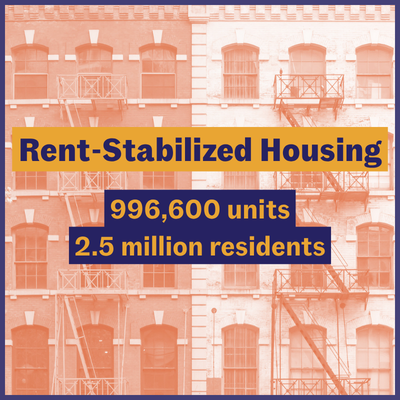
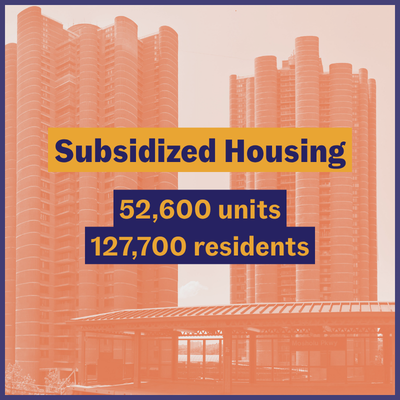
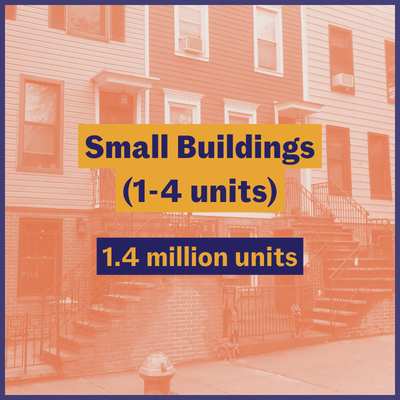
This post is part of our 2026 Earth Week series Climate Change and New York City's Housing Stock. View other posts in this series on rent-stabilized housing, subsidized housing, and small buildings.
Notes
1. Angela Caputo and Sharon Lerner, “House poor, pollution rich.” AMPreports, January, 2021.
2. Tracey Ross, “A Disaster in the Making: Addressing the Vulnerability of Low-Income Communities to Extreme Weather.” Center for American Progress, August, 2023.
3. New York City Council Data Team, NYC Heat Map (Surface Temperature).
4. Oksana Mironova, Lonnie Portis, Samuel Stein, and Iziah Thompson. "The Other Housing Crisis: Poor Housing Conditions Are Not Only a NYCHA Problem—They’re a Low-Income Housing Problem,” Community Service Society of New York, July 2024.
5. NYCHA, “PRESS RELEASE: MAYOR ADAMS, GOVERNOR HOCHUL, NYCHA UNDERTAKE EFFORT TO REPLACE ELEVATORS IN DEVELOPMENTS SERVING NEARLY 34,000 RESIDENTS,” January, 2023.
6. NYCHA Resident Data Book, January, 2025.
7. Nina M. Flores, Diana Hernández, Carolyn A. Fahey, Lonnie J. Portis, and Joan A. Casey. “Assessing the Burden of Electrical, Elevator, Heat, Hot Water, and Water Service Interruptions in New York City Public Housing,” September 2024, Journal of Urban Health, 101: 990-999.
8. Jesse M Keenan, Thomas Hill, and Anurag Gumber, “Climate gentrification: from theory to empiricism in Miami-Dade County, Florida,” Environmental Research Letters. 13 (2018): 054001.
9. New York City Climate Budgeting, 2026.
10. Julie Wagner, “The Case for City-led Housing Retrofits in New York City,” The Climate and Community Institute and New York Policy Forum, February 2026.