Rent-Stabilized Apartments and Climate Change
Samuel SteinBrianna Soleyn
Overview
More low-income households call rent-stabilized apartments home than any other type of housing. Although it is not means-tested or directly subsidized, this housing stock serves 37 percent (434,300 households) of New Yorkers earning less than 50 percent of the Area Median Income. More Black and Latino New Yorkers live in rent-stabilized apartments than any other form of housing.[1]
While rent stabilization applies to a range of building types, the vast majority of units are located in buildings with more than five apartments built before 1974. These buildings typically lack central air conditioning, and many are located in flood-prone areas, leaving residents exposed to both extreme heat and storm-related hazards.
Climate Risks
Flood Risk
Rent-stabilized apartments are distributed across all five boroughs, with particularly high concentrations in upper Manhattan, the south Bronx, and Central Brooklyn. While they are not as clustered along the waterfront as public housing, some of the neighborhoods with the highest numbers of rent-stabilized apartments–including Washington Heights/Inwood (45,000 units), Highbridge/Concourse (45,000 units), Williamsburg/Greenpoint (27,000 units), and Astoria (31,000 units)—border coastal or flood-prone areas.[2]
Flood risk is increasing across the city, driven not only by rising sea levels but also by more intense storms and overwhelmed sewer infrastructure, making non-coastal areas subject to periodic flooding. During Superstorm Sandy in 2012, over 40,000 rent-stabilized units across 839 buildings were located within the storm surge zone.[3] More recently, Hurricane Ida in 2022 demonstrated that flood risk extends far beyond mapped floodplains: fewer than 7 percent of damaged buildings were located within the 100-year floodplain.[4]
Heavy rainfall is now a major driver of flooding in neighborhoods with significant rent-stabilized housing. Sewer networks in The Bronx, Brooklyn, and Queens are designed to handle roughly up to 1.5 inches of rain per hour; Manhattan and Staten Island’s can take in 1.75 inches per hour. The city’s Department of Environmental Protection, however, expects heavier storms in the coming years, with a 20 percent chance each year of storms that rain 2.1 inches of water per hour on our streets and into our over-capacity sewers, producing more floods.[5]
Heat Risk
Extreme heat is an even more immediate and deadly threat. Each year, more New Yorkers die from heat than from flooding and cold weather combined, with most deaths occurring in the home.[6]
While all neighborhoods experience heat waves, the urban heat island effect—in which certain city blocks face elevated temperatures due to a lack of trees, shading, and unpaved surfaces—concentrates the danger. According to the City of New York’s Heat Vulnerability Index, which scores neighborhoods on a scale of one to five (with five being the greatest vulnerability), several of the neighborhoods with the highest numbers and concentrations of rent-stabilized apartments–including Inwood, Mount Hope, Hunts Point, Flatbush, Harlem and East Harlem—also rank among the city’s most heat vulnerable areas.[7]
Structural & Social Vulnerabilities
Rent-stabilized housing combines physical vulnerabilities with economic constraints that shape residents’ ability to respond to climate risks.
While rent-stabilized landlords are required to provide tenants with heat, until 2026, no such requirement related to cooling. Given that most rent-stabilized units are in older buildings without centralized air conditioning, many tenants have purchased their own window units. A new law passed in late 2025 mandates landlords to provide at least one air conditioning unit per apartment beginning in 2030. While the cost of purchase and installation can technically be passed along to rent-stabilized tenants through an Individual Apartment Improvements rent increase, this increase is likely minimal—a few dollars per month—and perhaps not worth the landlords’ trouble to get the increase approved by the state housing agency.
A greater problem, however, might be energy prices for low-income households. According to the 2023 Housing and Vacancy Survey, 34 percent of rent-stabilized households and 36 percent of rent-controlled households (an older and smaller subset of New York’s rent-regulated housing stock) did not use air conditioning because of cost—by far the largest percentage of any housing type in the city. Because most rent-regulated tenants pay for their own electricity, and because so many rent-regulated tenants are struggling to make ends meet, rising utility rates—such as Con Edison’s recent nine percent electricity rate increase—may further discourage usage.[8] As more rent-stabilized tenants avoid using their air conditioners because of cost, they may be more likely to suffer the dangerous consequences of extreme heat.
Mitigation Opportunities
Fragmented ownership and scale
The fragmented and predominantly private ownership structure of rent-stabilized housing presents challenges for building-level climate interventions. Nearly 15,000 real estate companies collectively control nearly one million units across more than 40,000 buildings.[9] Unless they are paired with another subsidy stream or tax break (like J-51), these units are not subsidized, and they are largely owned by for-profit entities.[10] Given the dispersed and profit-motivated ownership structure, neighborhood-level strategies may be necessary to protect all residents.
Neighborhood-level interventions
Some of these strategies could include tree planting, expanded tree pits, porous pavement installation, bioswales, rain gardens, and sunken pavement, all of which reduce flood risk while also lowering temperatures through increased shade and stormwater absorption. These types of interventions can provide broad protections across entire neighborhoods, regardless of building ownership.
Building-level programs and financing
At the building level, a range of existing city and state programs can finance sustainability investments and upgrades, which are required by the City’s Local Law 97—a landmark law that mandates that large buildings reduce carbon consumption and greenhouse emissions. Available financing and compliance tools to help rent-stabilized landlords upgrade buildings and apartments without imposing rent increases include:
- The expanded J-51 R program, currently under consideration by the state legislature, which offers a substantial tax break for landlords to make building-wide improvements, including those that qualify for Local Law 97 compliance;
- Landlord Ambassadors, which offers up to $50,000 in low-interest loans for emergency repairs and technical assistance, is not accepting new applications at the time of this publication, but will be available in the coming months;
- The Participation Loan Program, which offers 30-year subsidized loans for building-wide rehabilitation;
- The Multifamily Housing Rehabilitation Loan Program, which provides up to $35,000 per unit for upgrading building systems and improving building envelopes;
- The Multifamily Energy Efficiency Program, which offers incentives for installing improved equipment and technology;
- The NYC Accelerator Property Assessed Clean Energy program, which offers long-term fixed-rate financing with no money down for energy efficiency projects and renewable energy installation; and
- The Multifamily Buildings Low-Carbon Pathways Program, which includes incentives for heating, water, and energy upgrades.
Used in combination, these tax incentives and loan programs provide meaningful opportunities to upgrade building systems, improving energy efficiency, and reducing emissions.
Rent stabilization as climate policy
While these public programs and building-level interventions are all essential, rent stabilization itself plays a critical role in climate resilience. Research shows that strong community networks help improve disaster preparedness and response. For example, a study of Hurricane Sandy disaster recovery in New York City shows that while the Lower East Side and the Rockaways were both hit hard by the storm, the deep and long-standing legacy of community organizing on the Lower East Side created the conditions for a better and more equitable recovery.[11] Rent stabilization goes a long way toward encouraging tenant and community organizing, enabling tenants not only to afford to stay in their homes and communities for the long term, but also to join with their neighbors in collective action without fear of landlord retribution and targeted displacement.[12]
Rent regulation also protects from displacement linked to necessary climate upgrades. By limiting rent increases, it helps ensure that low-income tenants do not have to solely bear the costs of these upgrades via pass-through charges and steep rent hikes. This enables them to remain in their homes and benefit from improvements, rather than being displaced by them. As the Climate and Community Institute and the Sierra Club have found, “Rent regulations can ensure that the cost of repairs and retrofits are not passed onto tenants. They also ensure that in the wake of disasters, landlords cannot raise rents egregiously, enabling tenants to stay housed. Lastly, rent regulations ensure that neighborhood greening efforts happening adjacent to homes (like parks improvements and expansions of the sidewalk tree canopy) do not exacerbate a cycle of displacement.”[13]
While rent-stabilized buildings and their neighborhoods require sustained public investment to meet the challenges of climate change, rent stabilization itself remains a central component of any strategy for achieving climate resilience and housing stability.
Explore climate risks by housing type
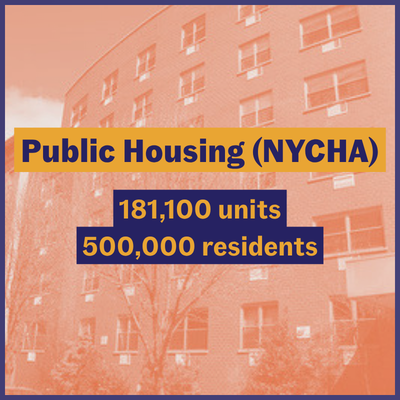
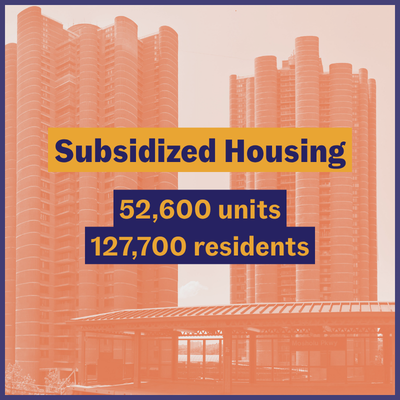
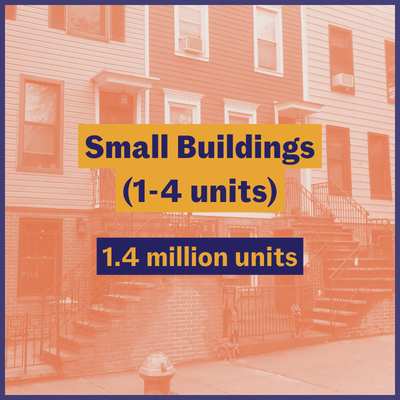
This post is part of our 2026 Earth Week series Climate Change and New York City's Housing Stock. View other posts in this series on subsidized housing, public housing, and small buildings.
Notes
1. “Rent Regulation Keeps New York, New York.” Community Service Society of New York, April, 2025.
2. 2023 HVS data. Note that neighborhoods listed are part of larger Community Districts/ Public Use Microdata Area designations and may include other neighborhoods.
3. NYU Furman Center for Real Estate & Urban Policy and NYU Moelis Institute for Affordable Housing Policy. Sandy’s Effects on Housing in New York City. March, 2013.
4. NYC Community Development Block Grand Disaster Recovery website
5. NYC Department of Environmental Protection. “2024 Stormwater Analysis.”
6. New York City, web “The Urban Heat Island Effect in NYC” published August 20, 2021.
7. NYC Environment & Health Data Portal. “Interactive Heat Vulnerability Index.”
8. Maldonado, Samantha. “Con Ed Wants to Raise Your Bill – Again.” The City, February 11, 2025.
9. Data provided by JustFix based on their “Who Owns What” tool.
10. Non-profit subsidized housing is usually also rent-stabilized. Read about climate change and subsidized housing here.
11. Graham, Leigh, Wim Debucquoy, and Isabelle Anguelovski. "The influence of urban development dynamics on community resilience practice in New York City after Superstorm Sandy: Experiences from the Lower East Side and the Rockaways." Global Environmental Change 40 (2016): 112-124.
12. Prior CSS research has shown that rent-stabilized tenants are more likely to put down roots in their communities compared to market rate tenants. Mironova, Oksana and Samuel Stein. “Stabilizing Renters by Stabilizing Rents” Community Service Society of New York, November 2025.
13. Climate and Community Institute and the Sierra Club. ”Tenant Protections for Climate Justice." October, 2024. For a concrete example of this principle, see the LA Tenant Union’s mobilization to fight rent gauging after the January, 2025 wildfires.