Testimony: Requiring City Employers to Provide Paid Personal Time
Irene Lew
Testimony by Irene Lew, CSS Policy Analyst
May 28th hearing on Int 800A:
Requiring city employers to provide earned personal time to employees
Before the NY City Council Civil Service and Labor Committee
Thank you for the opportunity to testify today. My name is Irene Lew and I am a policy analyst at the Community Service Society of New York, a nonprofit organization that works to advance the upward mobility of low-income New Yorkers. We have supported the expansion of protections and benefits for low-wage workers, including a leading role in efforts to pass the paid sick days law in New York City. I am testifying in support of the proposed amendment to the city’s paid sick time law requiring private-sector employers of five or more employees to provide an additional 10 days of paid personal time to their employees.
The drive for paid sick time was fueled by our research showing that lack of paid sick leave is a widespread problem among working New Yorkers, especially among low-income workers. National estimates, along with findings from our annual Unheard Third survey, show that low-income workers are also disproportionately impacted by the lack of paid vacation and would benefit from the proposed paid personal time bill. Nationwide, according to data from the Bureau of Labor Statistics, 41 percent of private-industry workers in the lowest 10 percent of wage earners had access to paid vacation, in contrast to 92 percent of those in the top 10 percent. Even when they do receive paid vacation days, low-wage workers receive far less than what is available to their higher-wage counterparts. After a year on the job, a worker in the lowest 10 percent of wage earners had just 5 days of paid vacation on average while a worker in the top 10 percent had twice that amount (11 days).
CSS’s Unheard Third 2018 survey found that employees least likely to have paid vacation now are those with low incomes, working part-time, employed by small firms, working in the retail sector or relying on tips. These are the employees who would most benefit from the proposed law. Among New York City residents who would be covered by the proposed paid personal time provision, only 34 percent of the working poor and 45 percent of near-poor workers (between 100-200 percent of the FPL) had paid vacation from their employers compared to 82 percent of moderate to higher income employees with incomes above 200 percent of the federal poverty level.
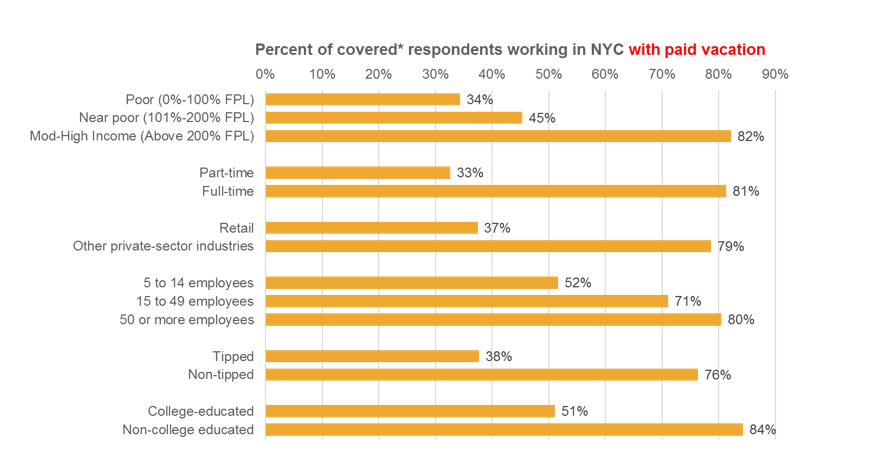
Source: The Unheard Third 2018
*Covered workers refers to survey respondents working at private-sector firms in New York City with 5 or more employees. Excludes the self-employed, those working in the public sector, those working at firms with fewer than 5 employees and those working outside of New York City.
It is especially important, and laudable, that the bill will cover employees working for firms with five or more employees. According to our Unheard Third survey data, 52 percent of private sector employees in businesses with five to 14 employees reported having paid vacation, while 80 percent of those working for employers of 50 or more did. By covering employees at firms with at least five employees, paid vacation would also be easier to administer because the existing paid safe and sick time law covers the same group of employees. Part-time employees and retail workers will also benefit from the personal time bill because they are among those least likely to have any paid vacation days. Only a third of part-time employees who would be covered by the paid personal time bill have paid vacation compared to over 80 percent of full-time workers. And only 37 percent of retail workers said that they received paid vacation from their employers, in contrast to 79 percent of those working in other private-sector industries.
We support the paid personal time bill but have some concerns about the proposed legislation that we hope the City Council will address. There is a technical problem in how the accrual rate is crafted. As written, it does not enable workers to actually accrue 10 days of personal time. Even when working a full-time schedule of 40 hours a week year-round, a worker will not accrue 80 hours of personal time. At the accrual rate of one hour of personal time for every 30 hours worked, a full-time year-round worker will only earn a maximum of 69 hours of personal time. It would take a full-time, year-round worker more than a calendar year to accrue 10 days of personal time at the current rate proposed in the legislation. We urge the City Council to adjust the accrual rate in the bill so that covered workers will receive the full 10 days of paid personal time intended in a year. To make it easier for employees and employers to track accrued time, as well as streamline administration for employers, the City Council could consider establishing the same, faster accrual rate for both personal and sick time. For example, a worker could accrue one hour of paid personal time and one hour of paid sick time for every 25 hours worked. The accrual balances for paid personal and sick time could also be listed on paystubs so that workers are aware of how many personal and sick days they have before requesting time off.
The second concern we have about the paid personal time bill is that it enables employers in the restaurant and other tipped industries to pay tipped workers the lower tipped minimum wage rather than the full minimum wage as required under the existing paid sick days law. CSS is on record with the New York State Department of Labor as a supporter of tipped workers receiving the full minimum wage with tips on top, given that tipped workers are much more likely than non-tipped employees covered under the full minimum wage to depend on public benefits and to suffer from material hardships. Our own polling data also shows that tipped workers disproportionately lack access to paid vacation days. We urge the City Council to correct the bill so that tipped workers are paid the full minimum wage for personal time and that the personal time pay rate for tipped workers is consistent with the sick time pay rate for these workers outlined under the existing paid sick time law.
CSS also urges the City Council to add a private right of action that would enable workers to vindicate their rights in court.
If enacted, New York would become the first U.S. state or city to require employers to provide paid vacation for their workers, although most of the world’s wealthiest countries already do so. This is another opportunity for New York to move towards becoming a more equitable and progressive city. Low-wage workers are the ones who can least afford to go without paid leave but are those most likely to lack this benefit. All working New Yorkers need paid personal time to spend with their families, address necessary demands outside of work, and recharge from the daily grind. We urge the City Council to address the concerns we’ve highlighted here today and to approve the paid personal time off bill.