Public Housing and Section 8 Households Under Attack by Trump’s HUD
Iziah ThompsonYvonne Peña
In March 2026, the Trump Administration proposed two extreme rule changes with the goal of evicting thousands of public housing and Section 8 tenants. The proposed rule changes were issued by the United States Department of Housing and Urban Development (HUD) under Secretary Scott Turner. The two proposals, if enacted, would do the following:
- Impose a 30-day time limit of housing assistance for mixed-status families
- Allow public housing agencies and landlords receiving Section 8 subsidies to impose:
- a requirement that non-senior adult residents work a minimum number of hours, with some exceptions
- a time limit on how long a household can remain in the program, after which they would lose their subsidy and be subject to eviction
It is important to understand that these are proposed rules. Presidents and federal agencies may submit rule changes to the Federal Register.
After a proposed rule change is posted, the public has an opportunity to comment. Following the public comment period, the administration and agencies review comments and may or may not submit a final rule. This final rule will explain when and how any changes are to be implemented.
The mixed status family rule change comments were due on April 21st but the two other proposed rule changes are currently in the public comment period until May 1, 2026. For this reason, it is crucial to understand exactly what the administration is proposing.
What is the title of the proposed rule and what agency submitted it?
The rule change is titled, “Establishing Flexibility for Implementation of Work Requirements and Term Limits” and can be found by looking up the Regulation ID Number (RIN): 2501-AE15. The US Housing and Urban Development Department (HUD) submitted it on 03/02/2026.
What regulations are changed by the proposal?
The proposal alters the Code of Federal Regulations (CFR), specifically Title 24, which holds all HUD regulations. Within Title 24, parts 5, 960, 982, and 983, which dictate general HUD rules and waivers, admissions and occupancy rules, Project-based Voucher rules, and Tenant-Based Voucher rules, respectively.
Which programs do these rules specifically apply to?
All three of the mentioned program changes would apply to both public housing (Section 9 units) and Housing Choice Voucher or Section 8 (project-based and tenant-based vouchers). This includes:
- any housing owned and operated by a Public Housing Authority (PHA), like the New York Housing Authority (NYCHA) through the Section 9 or Housing Choice Voucher Program (HCV) (formerly Section 8)
- units receiving HCV voucher subsidy
- Project-Based Rental Assistance (PBRA) and Project Based Vouchers (PBV)
(Certain Special Purpose Vouchers are exempt from the proposed rule, such as HUD-Veterans Affairs Supportive Housing (HUD-VASH)).
Who would the work requirement rule apply to?
The rule would only apply to residents in the aforementioned programs between the ages of 18 and 61, with some exceptions. The rule would not apply to individuals with disabilities, those who are pregnant, the primary caregiver for a child under six or a family member who has a disability, or an individual enrolled in secondary education.
How many hours of work would be required?
The minimum amount of work that could be required is 40 hours per week; however, a housing agency could choose less, or they could choose not to implement this rule at all.
Who would the time limit apply to?
All families in the mentioned federal housing programs could be subject to the time limit policy except families whose head of households are elderly (62 years or older) or have a disability.
How Would the Time Limit Impact NYCHA?
Figure 1
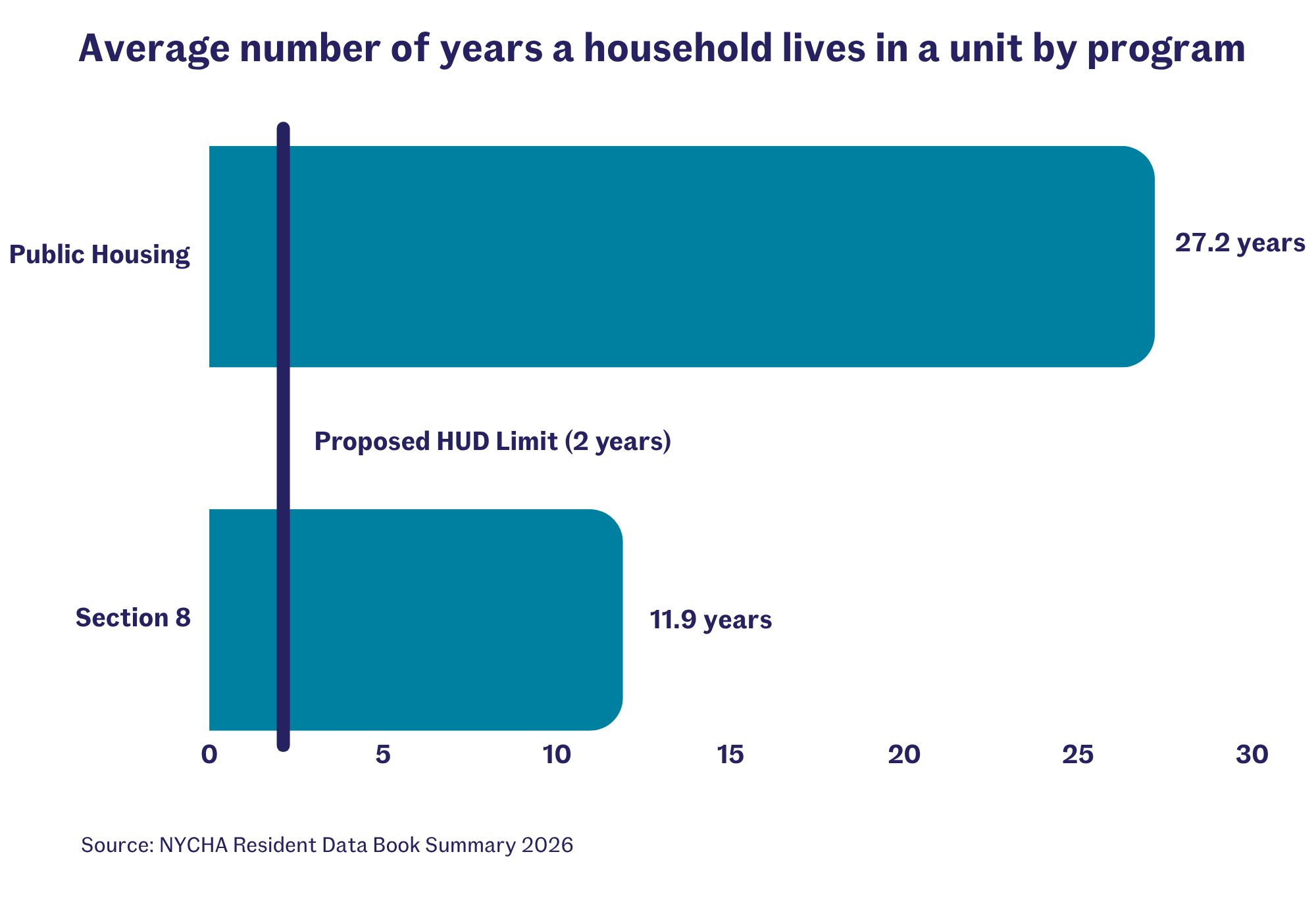
According to NYCHA's administrative records, the average Section 8 household relies on a voucher for nearly 12 years, while the average public housing household remains in their unit for over 27 years. Forcing families out after just 24 months would not encourage self-sufficiency; rather, it would intentionally manufacture mass displacement, destabilizing thousands of families and neighborhoods across the five boroughs.
Does adding a work requirement solve a real problem?
No. 4.6 million households receive federal housing assistance, and more than 60 percent are either over 61 years old or have a disability. In the rest of that “work-able” population, more than 80 percent are employed, and the rest are attending school, caregiving for a family member or are ill. There are times when employed individuals struggle with problems like inconsistent hours or layoffs driven by larger economic factors; punishing these families is only making the situation worse.
If everyone is working or in an excluded category, then won’t the work requirements have no impact?
No. Work requirements have been shown to add unnecessary costs to agencies like NYCHA and can cause eligible households to lose their assistance simply due to burdensome paperwork.
Are NYCHA Households Working?
Figure 2
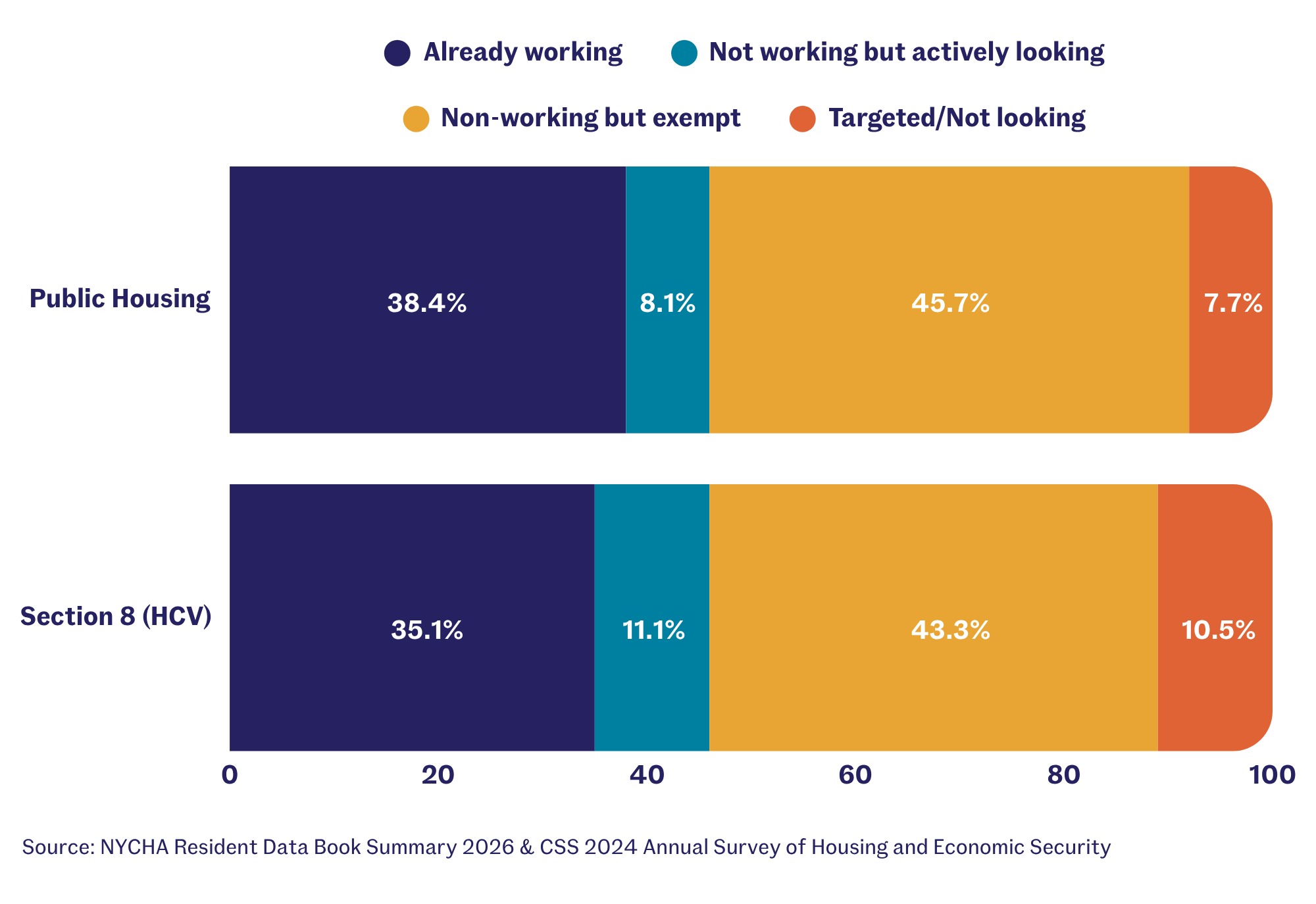
The numbers do not justify strict work requirements. Across the roughly 143,000 Public Housing and Section 8 households in NYCHA, nearly 55,000 already contain at least one working adult. Once explicitly exempt populations—such as seniors, individuals with disabilities, caregivers for young children, and enrolled students—are factored in, the pool of non-working, non-exempt adults plummets.
Data from CSS’s 2024 Annual Survey of Housing and Economic Stability further shows that over half of the remaining unemployed group is actively searching for a job, making them fully compliant with HUD's proposed rule.
Ultimately, HUD is threatening to upend the lives of 143,000 families and waste millions in taxpayer dollars just to target fewer than 10,000 households—a microscopic fraction of the tenant base, proving this sweeping mandate is a devastating solution in search of a problem.
Methodology for Figure 2:
The "Exempt" population includes Seniors, Caregivers of young children, Disabled individuals, and enrolled Students. Data was adjusted to prevent the double-counting of employed seniors. Estimates for Student enrollment (7.1%) and Active Job Seekers (51.3% of non-working tenants) were derived directly from the CSS ASHES 2024 NYS Survey. Importantly, this analysis is highly conservative: due to data limitations, we did not attempt to exclude pregnant women or caretakers of disabled adults—both of whom are explicitly exempt under HUD’s proposed rule. This means the true target population is likely even smaller than depicted.