Why New York City needs more public outreach to raise awareness of the right to paid sick time
Nancy RankinIrene Lew
Cold and flu season is here, but too many working New Yorkers—including 60 percent of low-income employees covered by NYC’s paid sick leave law—have heard little or nothing about their right to paid sick time. Lack of awareness severely hinders enforcement. After an initial steady rise in the proportion of low-income workers who reported that their jobs provided paid leave, over the past two years, we’ve seen that trend reverse.
That’s why NYC Council Member Mark Levine, at the request of Manhattan Borough President Gale Brewer, recently introduced a bill (Intro 1797) to create a public education campaign to ensure that working New Yorkers know their rights. It would include the distribution of posters and other materials that could be voluntarily displayed at pharmacies and health providers throughout the city.
Findings from CSS’s 2019 Unheard Third Survey show why we need an on-going public education campaign to inform employees of their rights under the Earned Safe and Sick Time Act.
After New York City’s paid sick leave law went into effect in 2014, we saw a steady rise in the proportion of low-income workers who reported having paid sick time on their jobs. But that trend has now started to reverse. In the past two years, access to paid leave has fallen among low-income workers covered by the law.
Prior to implementation, only 47 percent of low-income workers covered by the paid leave provision of the law (private sector employees working for employers of five or more) reported having paid leave on their jobs. By 2017, that figure had risen to 71 percent. But in the last two years, the percent of covered low-income workers with sick leave has dropped to below 60 percent. By comparison, in 2019, 78 percent of covered moderate and higher-income workers had paid sick leave.
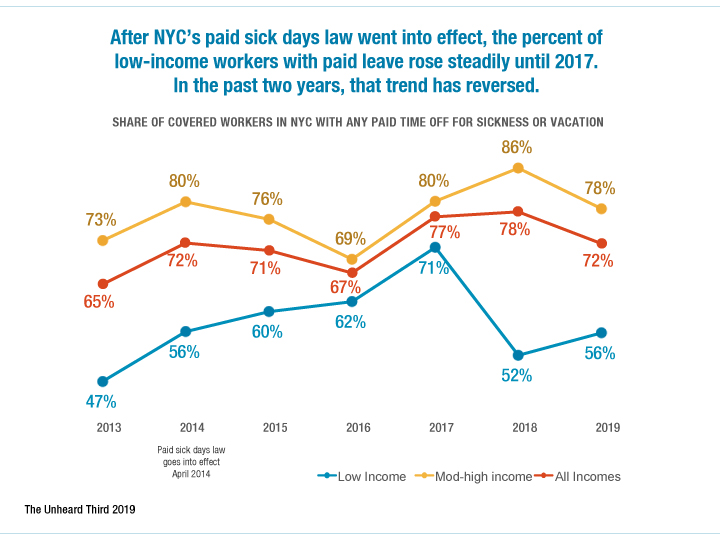
Note: Covered workers excludes those in the public sector, self-employed, and in firms with less than 5 employees. The law requires employers with under 5 employees to provide up to 5 days of unpaid sick time. The law allows paid vacation or PTO to satisfy sick time requirements if it can be used in the same way as sick time. Starting in 2018, the survey included an additional question that asked respondent whether they were self employed/independent contractor or not, which resulted in a smaller sample of private sector employees covered under paid sick time law. Prior to 2018, only those who volunteered a response of “self-employed/business owner” to the question about firm size were excluded.
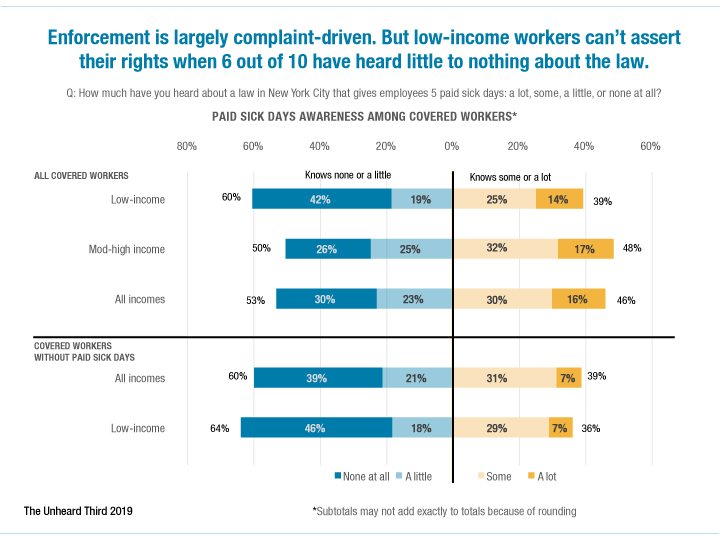
Enforcement of the paid sick leave law is largely complaint-driven. But workers are unable to assert their right to paid sick time if they are unaware of the law. That’s why awareness matters. In 2019, 60 percent of low-income workers covered by the New York City law had heard little or nothing about it and nearly two-thirds of covered workers without paid sick time were unaware of their right to it.
The Administration acknowledges that low awareness is hindering the reach of new labor standards passed by the City Council. In their latest report on the state of workers’ rights in NYC, the Department of Consumer Affairs highlights findings from testimony at its July 17, 2018 public hearing.
From the testimony it appears that these measures [including the expanded Paid Safe and Sick Leave Law] are already having an important impact and that OLPS’s enforcement actions are effective. However, significant gaps remain. In particular, lack of awareness about these rights is hindering their reach…
The report goes on to cite workers who “testified that many workers in retail and fast food, respectively, are not familiar with Fair Workweek and Paid Safe and Sick Leave and consequently, do not exercise their rights under these laws.”
And the report quotes CSS’s Vice President, Nancy Rankin’s suggestion, “Why not require posters about the right to paid sick leave at every pharmacy, clinic and doctor’s office?”
Public outreach has shown to be effective in raising awareness about labor standards.
At the height of the paid sick leave advertising and public education campaign in 2014, many workers said they had heard “a lot” about the paid sick days law. But only a small fraction of covered workers now say they know a lot about the law. For example, among covered workers, the proportion of immigrants who had heard a lot about the law was 31 percent in 2014; now it is 10 percent. Among low-income workers in smaller firms (<50), 28 percent had heard a lot about the law in 2014; now it’s just nine percent. Among black New Yorkers, the percent who had heard a lot about the law fell from 38 percent in 2014 to 20 percent in 2019.

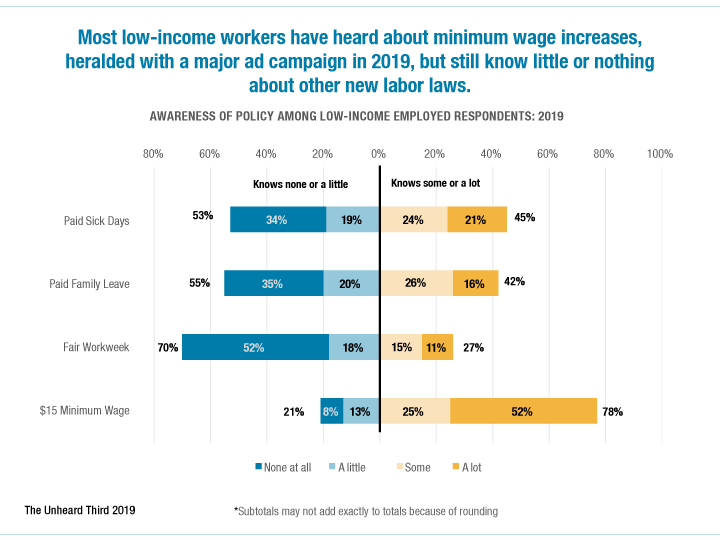
Less than half of low-income employed city residents said they knew a lot or something about the paid sick days law in 2019. In contrast, 78 percent were aware of the increase in the minimum wage, which was widely touted in subway ads this year.
The voluntary display of posters in pharmacies, hospitals and other health care locations reminding working people of their right to paid sick leave in NYC offers an optimal moment for public education; it would reach people at a time and place when their health concerns are on their minds and the information is highly relevant.
Intro 1797 would provide for a public education campaign by the Department of Consumer Affairs in coordination with the Department of Health and Mental Hygiene to educate employees of their rights under the Earned Safe and Sick Time Act. The Campaign will distribute posters and other materials for posting in pharmacies and other private health related institutions on a voluntary basis. The bill would also invite the NYC Health + Hospitals Corporation to distribute and display materials at its locations.
How the survey was conducted: The Unheard Third is a scientific telephone survey of 1,829 New York City residents reached by cell phones and landlines from June 18 to July 20, 2019. It was designed by Community Service Society in collaboration with Lake Research Partners, who administered it using Random Digit Dialing and professional interviewers. Interviews were conducted in English, Spanish and Chinese. The margin of error for the entire survey is +/- 2.29 percentage points and +/- 2.97 percentage points for the low-income component.