New sick leave laws could help prevent a resurgence of Covid-19
But only if New Yorkers know about them
Nancy RankinIrene Lew
As the pandemic began to rage, first New York State and then Washington enacted emergency measures to provide paid leave for quarantined workers sickened by the coronavirus or ordered to self-isolate as a precaution. Though the federal Families First Coronavirus Response Act (FFCRA) provides up to 80 hours of paid sick leave for employees unable to work because they are quarantined, have COVID symptoms or are seeking a diagnosis and also allows leave to be used for COVID-19 related caregiving responsibilities, it excludes key segments of the workforce. Many health care workers, emergency responders, and large businesses with 500 or more employees are left out and the law allows partial exemptions for small businesses with fewer than 50 employees.
New York State’s COVID-19 sick leave law helps fill those gaps. It provides job-protected sick leave for employees if they, or their minor child, are subject to a mandatory or precautionary order of quarantine issued by their health department and are unable to work from home. Large employers (of 100 or more) and all public employers must provide up to 14 days of paid sick leave. Other employers must give workers sick leave with financial compensation funded through a combination of employer, disability and paid family leave benefits depending on the size and net revenue of the employer. The New York State COVID-19 leave is in addition to paid time off workers are already entitled to at their jobs.
These laws are intended to help prevent the spread of COVID by enabling workers to stay home without falling into financial crisis. They temporarily expand the right to sick leave that employees in New York City have had since 2014, when the law requiring employers of five or more workers to provide up to 40 hours of paid sick time went into effect. (Smaller employers must provide similar sick time, but it can be unpaid.) It’s noteworthy that the city’s law was the first local sick days ordinance to say that leave could be used if your child’s school or day care or your place of business was closed due to a public health emergency.
The city’s law is soon to be expanded to comply with new statewide sick leave legislation enacted as part of the state budget last April. Small businesses (with four or fewer employees) that have net income of $1 million or more will now also be required to provide paid leave. In addition, large businesses of 100 or more employees must provide up to 56 hours of paid sick leave. The law takes effect on September 30, 2020, when covered employees will be entitled to begin accruing sick time which can be used starting January 1, 2021.
The trouble is that most workers have heard little or nothing about any of these laws.
A new survey by Community Service Society (CSS) and Lake Research found that just 40 percent of New York City residents had heard a lot or something about the city’s own sick days law, and even fewer—32 percent—were aware of the state’s COVID-19 sick leave. Thirty-seven percent said they had heard about the new federal paid leave law. The telephone survey of 1,632 city residents was conducted from July 7 through August 4, 2020.
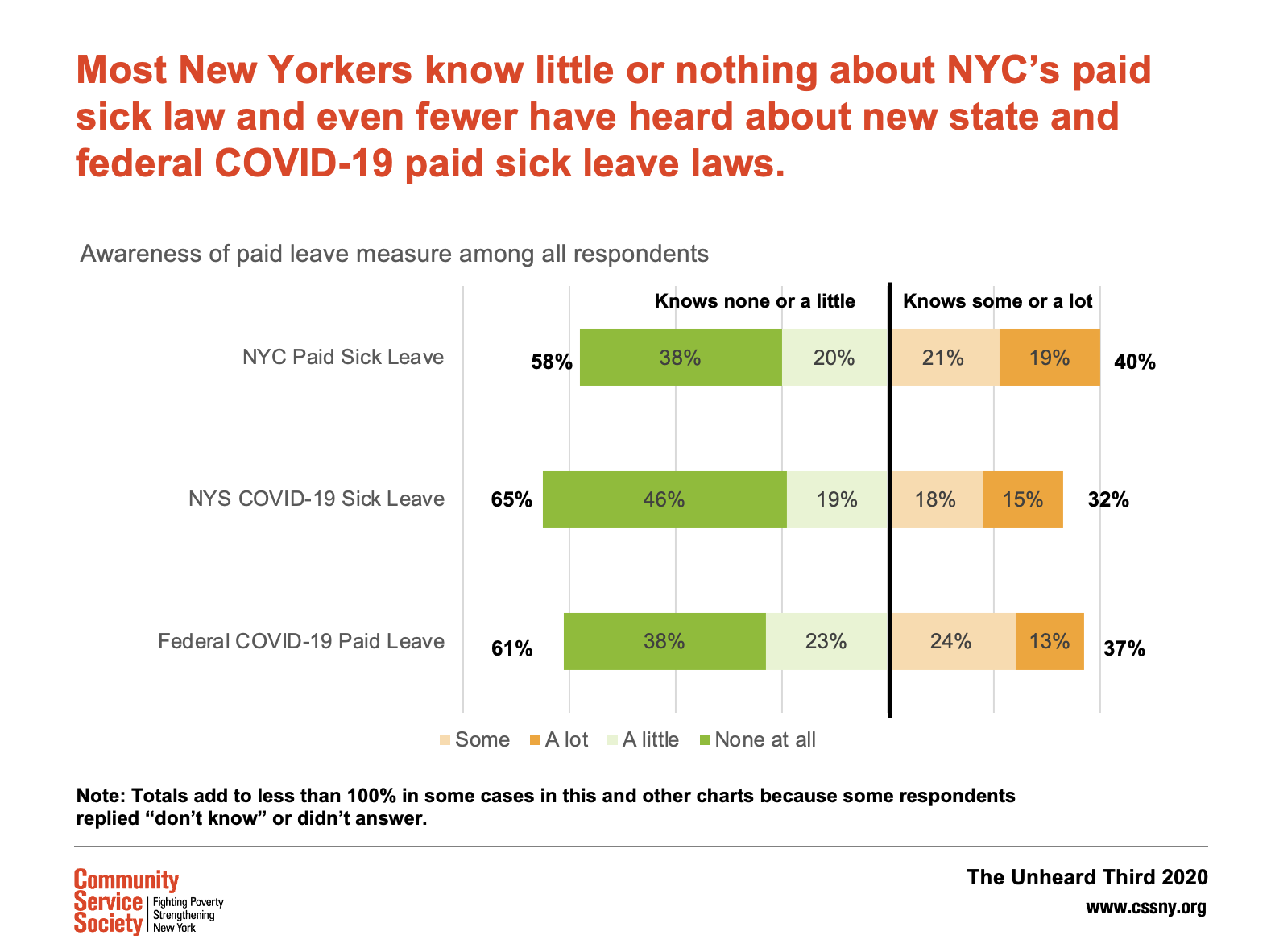
While expanded unemployment benefits have garnered a lot of media attention, the availability of additional paid leave has drawn far less coverage, and the state and federal governments did little public outreach to explain how these new emergency benefits are supposed to work. Moreover, the complexity and combination of laws—and sorting out the ways they interact—has added to the confusion. Even experts in the field have been hard-pressed to keep it all straight and remember who is entitled to what leave, for what purposes, at what level of wage replacement.
As kids prepare to head back to school and more businesses re-open, working parents are worried what will happen if outbreaks occur and they or their children are required to quarantine. The federal and state COVID-19 related leave, together with New York City’s existing mandate and the new statewide paid sick leave law are crucially important for preventing a resurgence of the virus by enabling workers who test positive, or have been exposed to someone who has, to quarantine without fear of losing their jobs or paychecks. But people have to know about them.
A bill (Intro 1797) introduced by City Council Member Mark Levine, at the request of Manhattan Borough President Gale Brewer, could do a lot to raise public awareness. It would require the city to produce posters for voluntary display at pharmacies and health care locations around the city informing New Yorkers of their right to paid sick leave. That would be a very low-cost way to get the word out and would target the information to the right people at the right time. Moreover, with many employees continuing to work remotely, they are not passing workplace bulletin boards where information on sick leave and other labor laws is posted. And they have less interaction with co-workers and HR staff who could share information by word-of-mouth. With a majority of council members already backing the sick leave outreach bill, now is the time to pass this measure that is so urgently needed, as our data show. At the current time, the posters could easily include additional information directing New Yorkers to the state and federal web sites for more information on COVID-19 related leave, as well.
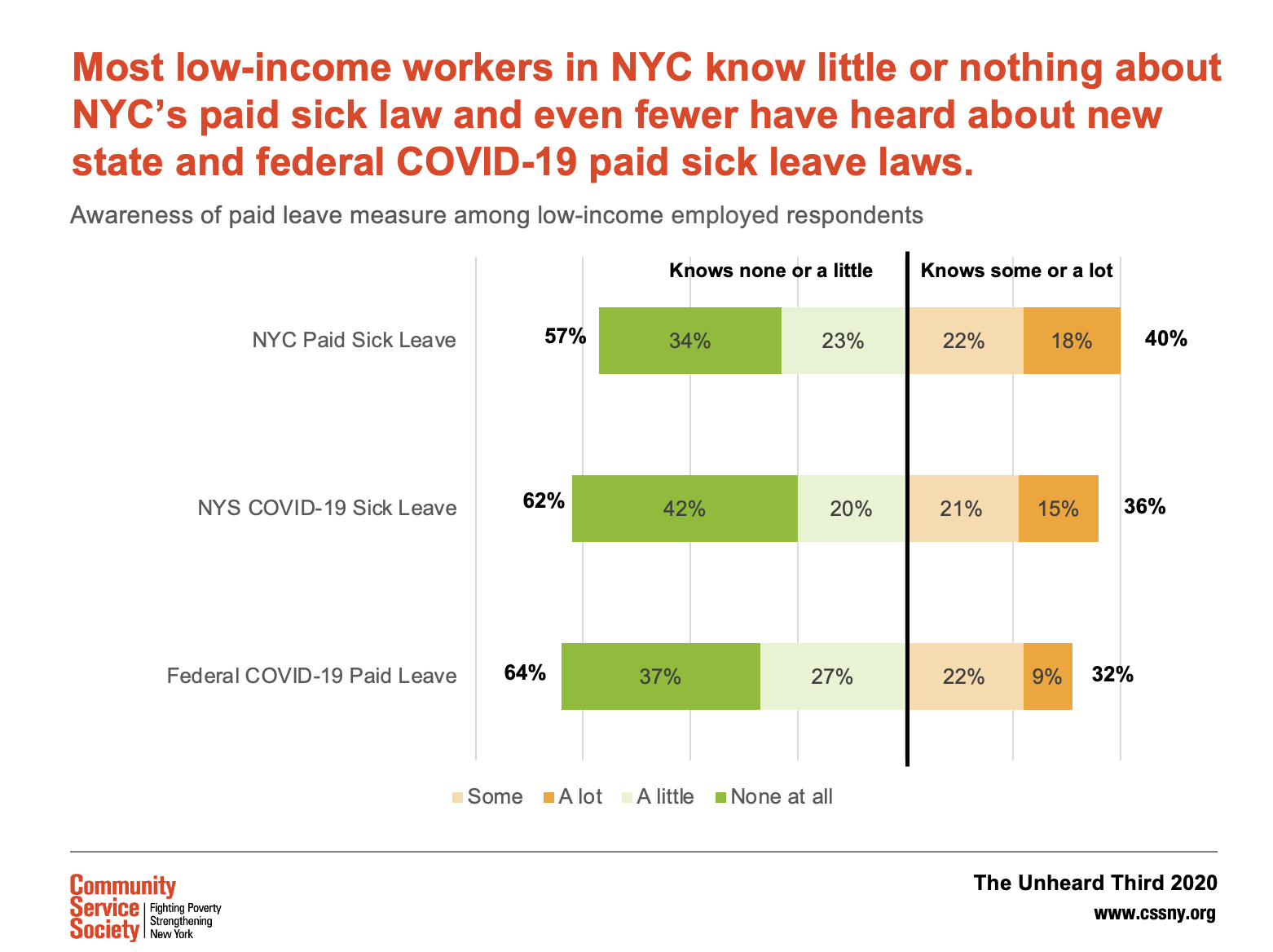
Lack of awareness of new and existing rights to paid sick leave remains widespread among categories of workers who would most stand to benefit: essential workers, at greater risk of exposure to the deadly virus; low-income workers who cannot afford to forego pay and have little or no savings to tide them over and meet sudden medical bills; and low-income working moms, who are most likely to need to quarantine for themselves as well as to care for family members. Essential workers were relatively more informed; 58 percent knew at least something about the city law, 55 percent were aware of the state COVID-19 leave, and 61 percent said they had heard some or a lot about the federal measure. But less than half of low-income workers were familiar with the city’s paid sick days requirement (40 percent), and even fewer knew much about the state COVID-19 leave (36 percent) or the federal act (32 percent).

The story is similar for low-income working mothers. Forty-three percent said they had heard a lot or some about the local law, while even fewer were aware of paid leave provided under the state measure (33 percent) or the federal law (29 percent). That so few working moms were knowledgeable about the federal FFCRA is especially dismaying since it allows paid sick time to be used for a wide range of COVID-19 related circumstances including caring for someone who is quarantined, or caring for a child whose school or child care is closed due to COVID. In addition, employees can take leave if they are unable to work or telework because they are subject to quarantine, are experiencing COVID-19 symptoms or seeking a medical diagnosis.
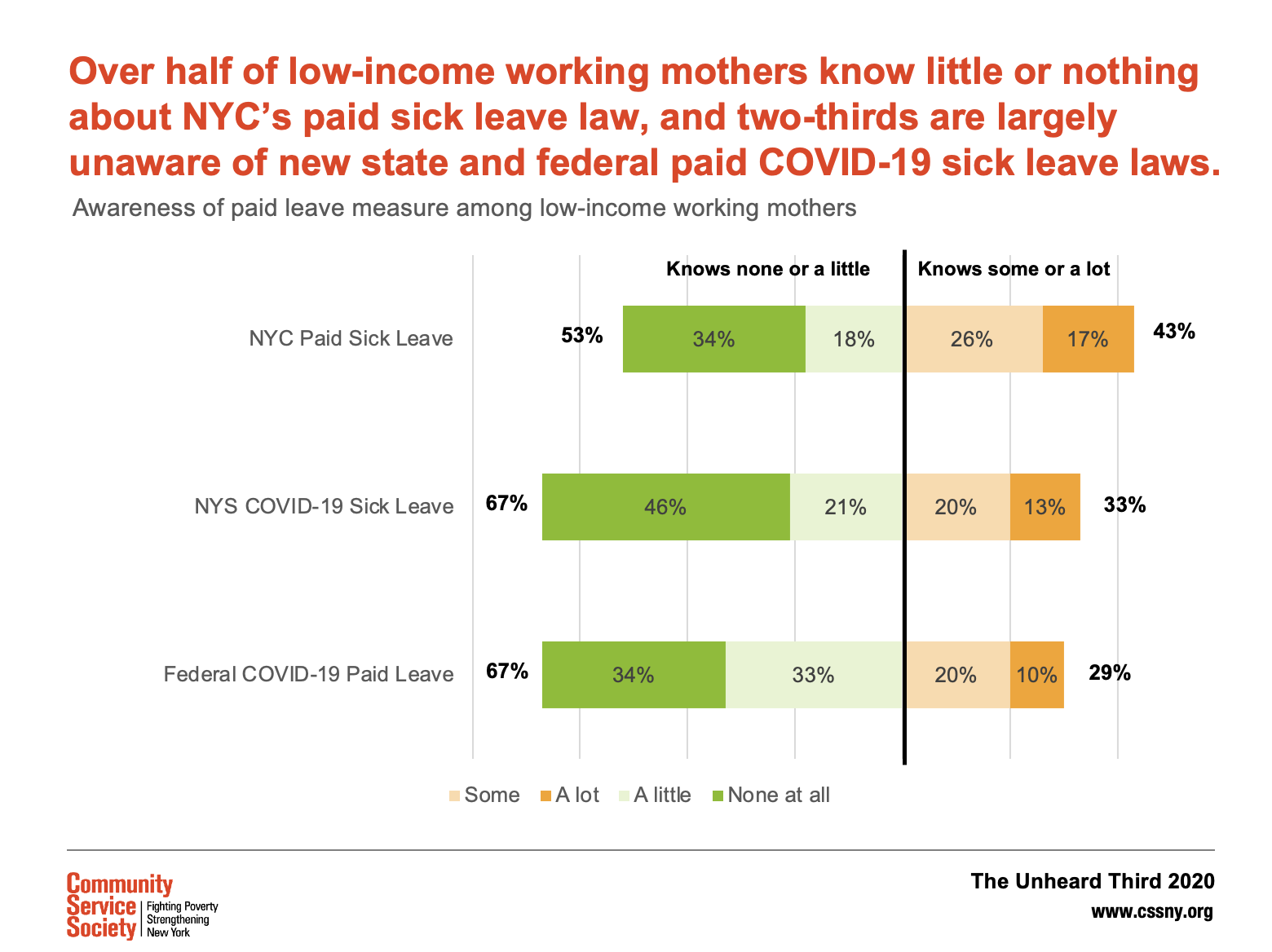
With the city’s basic sick leave law about to be expanded, and new state and federal measures providing emergency COVID-19 related leave, now is the time to make sure that working New Yorkers are aware of their rights and able to stay home to prevent the spread of COVID-19 and other illnesses. Displaying posters at pharmacies and other health care locations should be part of renewed and continuing public outreach efforts.
How the survey was conducted:
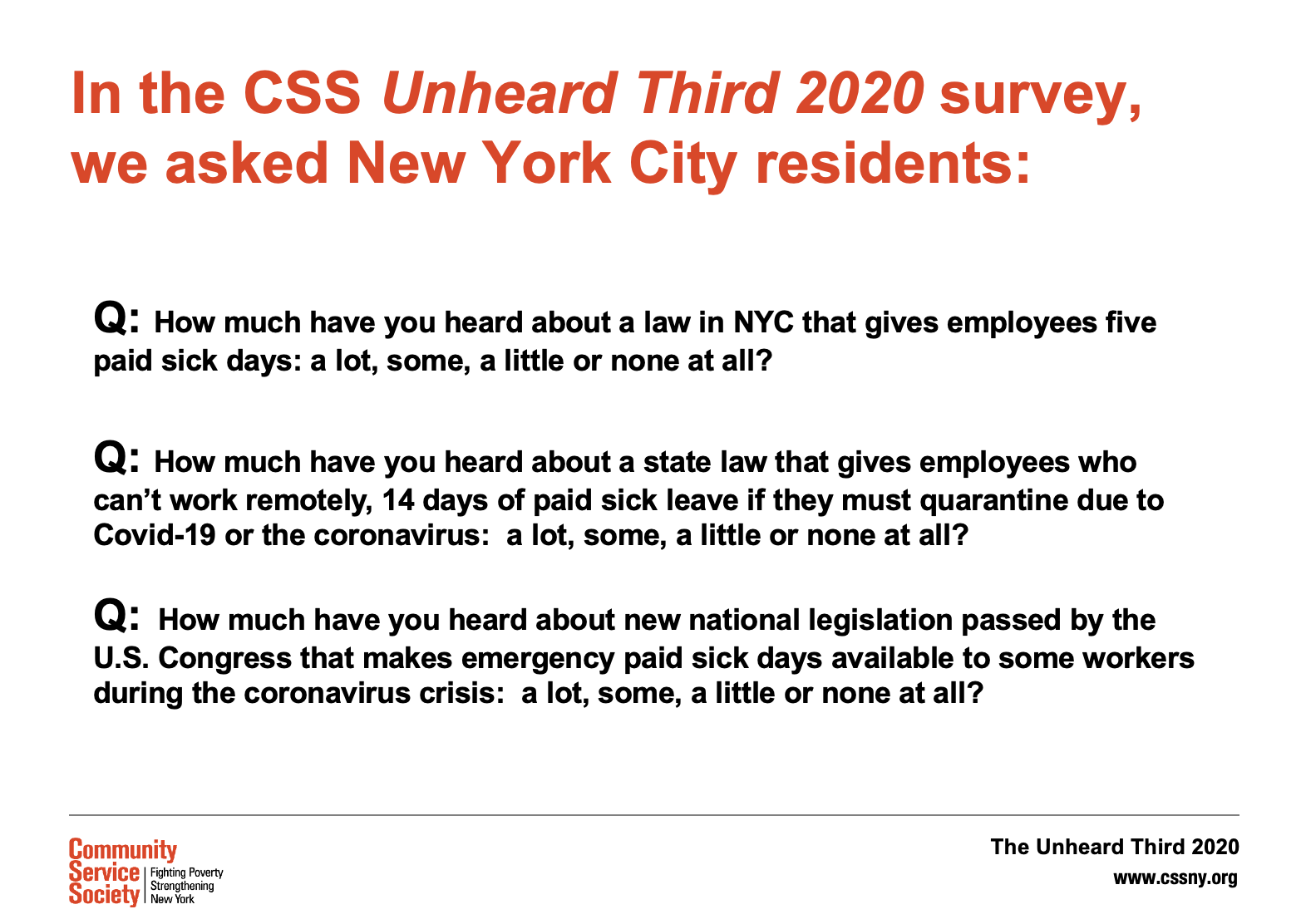
The Community Service Society designed this survey in collaboration with Lake Research Partners, who administered the survey by phone using professional interviewers. The survey was conducted from July 7 through August 4, 2020
The survey reached a total of 1,632 New York City residents, age 18 or older, divided into two samples:
- 1,002 low-income residents (up to 200% of federal poverty standards, or FPL) comprise the first sample:
- –512 poor respondents, from HH earning at or below 100% FPL (68.0% conducted by cell phone)
- –490 near-poor respondents, from HH earning 101% - 200% FPL (65.7% conducted by cell phone)
- 630 moderate- and higher-income residents (above 200% FPL) comprise the second sample:
- –430 moderate-income respondents, from HH earning 201% - 400% FPL (52.6% conducted by cell phone)
- –200 higher-income respondents, from HH earning above 400% FPL (50.0% conducted by cell phone)
Landline telephone numbers for the low-income sample were drawn using random digit dial (RDD) among exchanges in census tracts with an average annual income of no more than $43,440. Telephone numbers for the higher income sample were drawn using RDD in exchanges in the remaining census tracts. The data were weighted slightly by income level, gender, region, age, party identification, education, immigrant status, and race in order to ensure that it accurately reflects the demographic configuration of these populations. Interviews were conducted in English (1475), Spanish (90), and Chinese (67).
In interpreting survey results, all sample surveys are subject to possible sampling error; that is, the results of a survey may differ from those which would be obtained if the entire population were interviewed. The size of the sampling error depends on both the total number of respondents in the survey and the percentage distribution of responses to a particular question. The margin of error for the entire survey is +/- 2.42 percentage points, for the low-income component is +/- 3.09 percentage points, and for the higher income component is +/- 3.9 percentage points, all at the 95% confidence interval.