Testimony: HVS Shows Ongoing Housing Emergency and Need for Ongoing Rent Regulation
Samuel SteinOksana Mironova
Thank you for the opportunity to testify at today’s hearing of the City Council Committee on Housing and Buildings and the City Council Committee on the ongoing rental housing emergency and the need to extend the rent stabilization laws. Our names are Samuel Stein and Oksana Mironova, and we are housing policy analysts at the Community Service Society of New York (CSS). CSS has worked with and for New Yorkers since 1843 to promote economic opportunity and champion an equitable city and state. We center the voices and experiences of communities of color and those with low incomes, powering change through a strategic combination of research, services, and advocacy. We work extensively on tracking the New York’s housing crisis and evaluating the impact of the State’s rent and tenant protection laws.
Periodically – usually every three years, but with additional time needed this year due to both the timing of the decennial census and the ongoing pandemic – the New York City Department of Housing Preservation and Development (HPD) sponsors the preparation of the New York City Housing and Vacancy Survey (HVS). The survey is a byproduct of the city’s rent regulation system and its primary purpose is to determine the city’s vacancy rate. The continuation of rent stabilization in NYC is contingent on a continuing “housing emergency,” quantified by a vacancy rate of lower than 5 percent.
The 2021 HVS–fielded in the midst of a pandemic, February 2021 to July 2021–showed a 4.54% vacancy rate. Though this is higher than recent years, due largely to wealthy Manhattanites temporarily fleeing the city at the time the survey was conducted, it still constitutes a housing emergency, and therefore demonstrates the necessity of extending New York’s rent regulation laws.
Among housing researchers, HVS is considered the gold standard of data on New York City housing. The scale of the survey – in terms of both its sample size and the breadth of topics it covers – is unparalleled by any other source of comprehensive housing data. We find the results of the 2021 HVS to be compelling, enlightening, and evidence of the ongoing struggles facing renters in New York City. They also provide insights into the important benefits the 2019 Housing Stability and Tenant Protection Act has provided to rent stabilized renters in New York City, and to the city as a whole.
Based on the HVS’s initial findings, we strongly urge the City Council to certify the ongoing housing emergency and to extend the rent stabilization laws.
Below, we summarize our key takeaways from the initial findings of the HVS.
The rent is too damn high
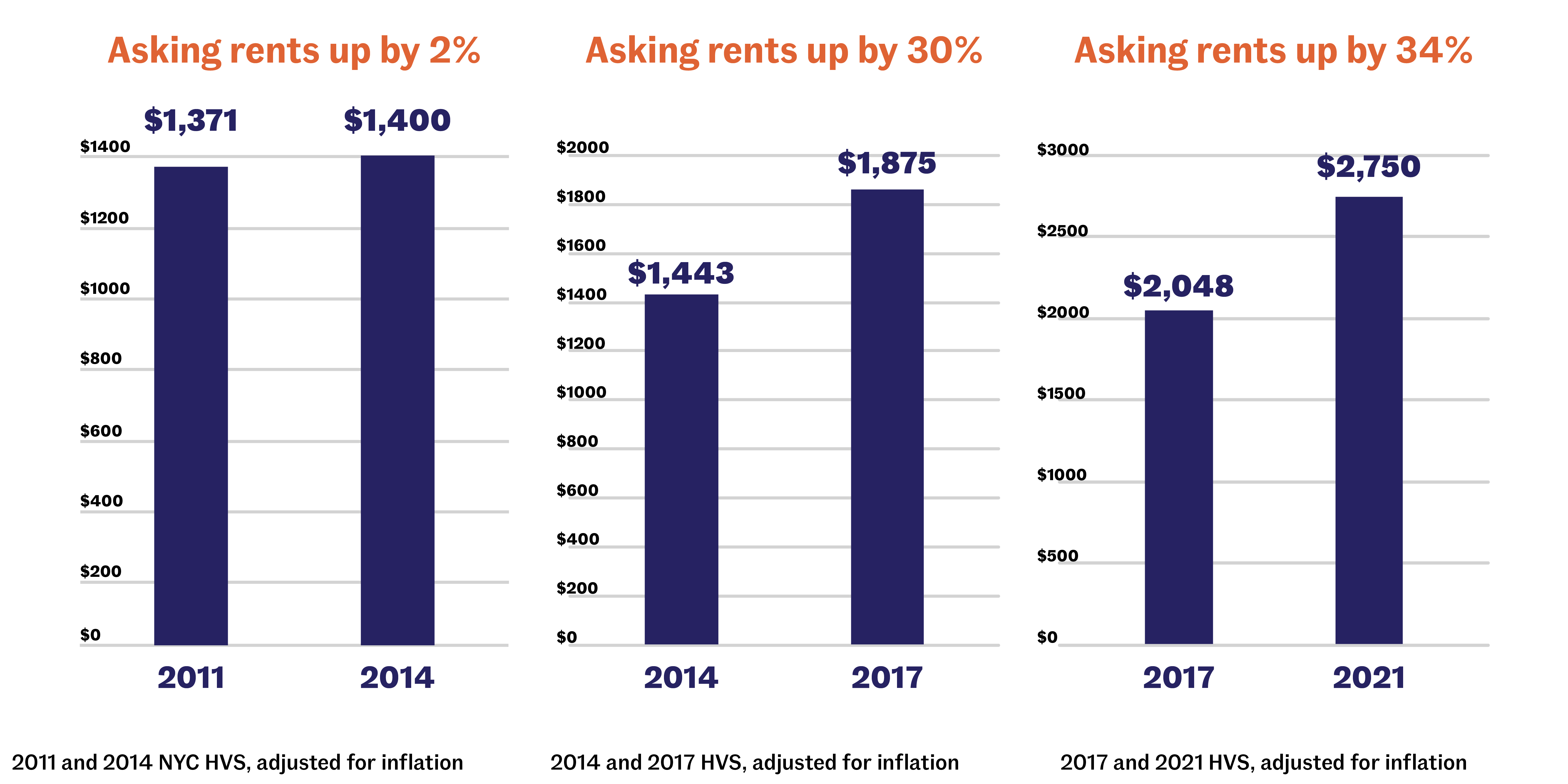
Asking rents in New York City, or rents in apartments that are were on the market when the HVS was fielded, increased by 34 percent, accounting for inflation, between 2017 and 2021.
With each HVS fielded in the past decade, the asking rent rate climbed at a rising rate, from 2 percent (2011 – 2014), to 30 percent (2014 – 2017) to 34 percent (2017 -2021), meaning that NYC’s rental unaffordability is getting worse fast.
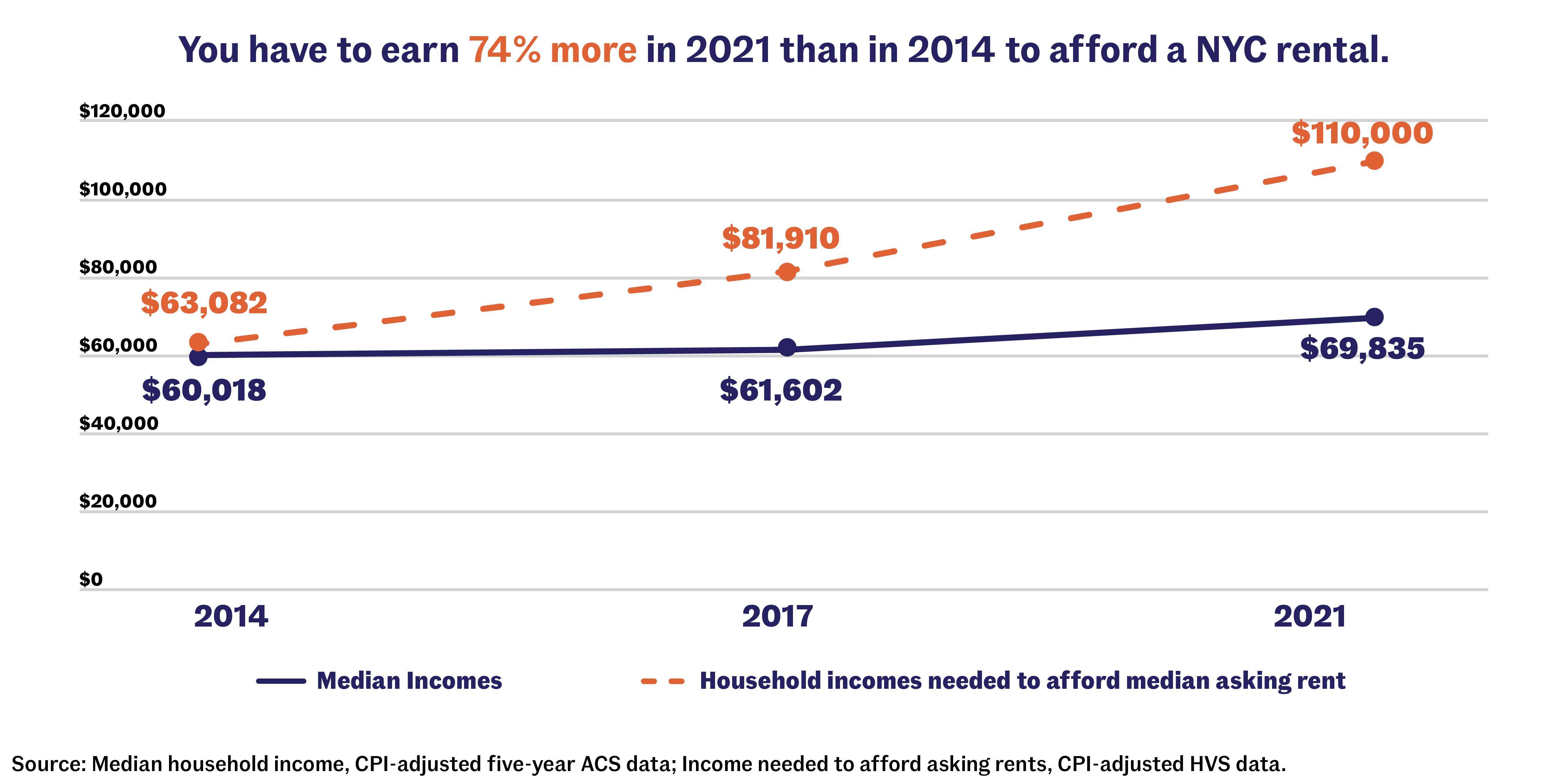
You must earn at least $110,000 to afford to move into most apartments in NYC
After decades of wages stagnation and real estate development focused on high-rent units, the rental market has dramatically shifted to serve wealthier and wealthier New Yorkers over the past ten years.
The income necessary to afford the median asking rent in NYC has gone up by 74 percent since 2014, from $63,082 (in 2021 dollars) to $110,000. Wages increase by only 16 percent over the same time period.
This means that a median priced apartment in New York City is increasingly out of reach for not only low-income New Yorkers, but for middle-income earners too.
Vacancies in high rent apartments skyrocket in 2021, as low rent apartments disappear
In 2021, more than one in ten high-rent apartments was on the market, while low and very low apartment vacancies plummeted below one percent. While the high-rent vacancy rate was inflated by the temporary exodus of wealthy renters during the height of the pandemic, it reflects a longer trend: The market is over-producing high-rent units unaffordable to the vast majority of New Yorkers, while under-producing the low-rent housing most New Yorkers need.
There are almost no apartments (0.9 percent vacancy) on the open market at the current median rent of $1,500, but plenty of high-rent apartments renting for over $2,300 (12.6 percent vacancy). This not only means that low-, moderate-, and middle-income households will have trouble finding an apartment. It also means that household living in less-than-ideal situations–including with unsafe building conditions or in overcrowded apartments–are unable move.
Geographically, vacancies were concentrated in Manhattan, which had a 10 percent vacancy rate, 5.5 points above the city-wide rate (4.5 percent), and 9.2 points higher than rate in The Bronx (.8 percent).

Strengthened rent laws prevent rents from going even higher
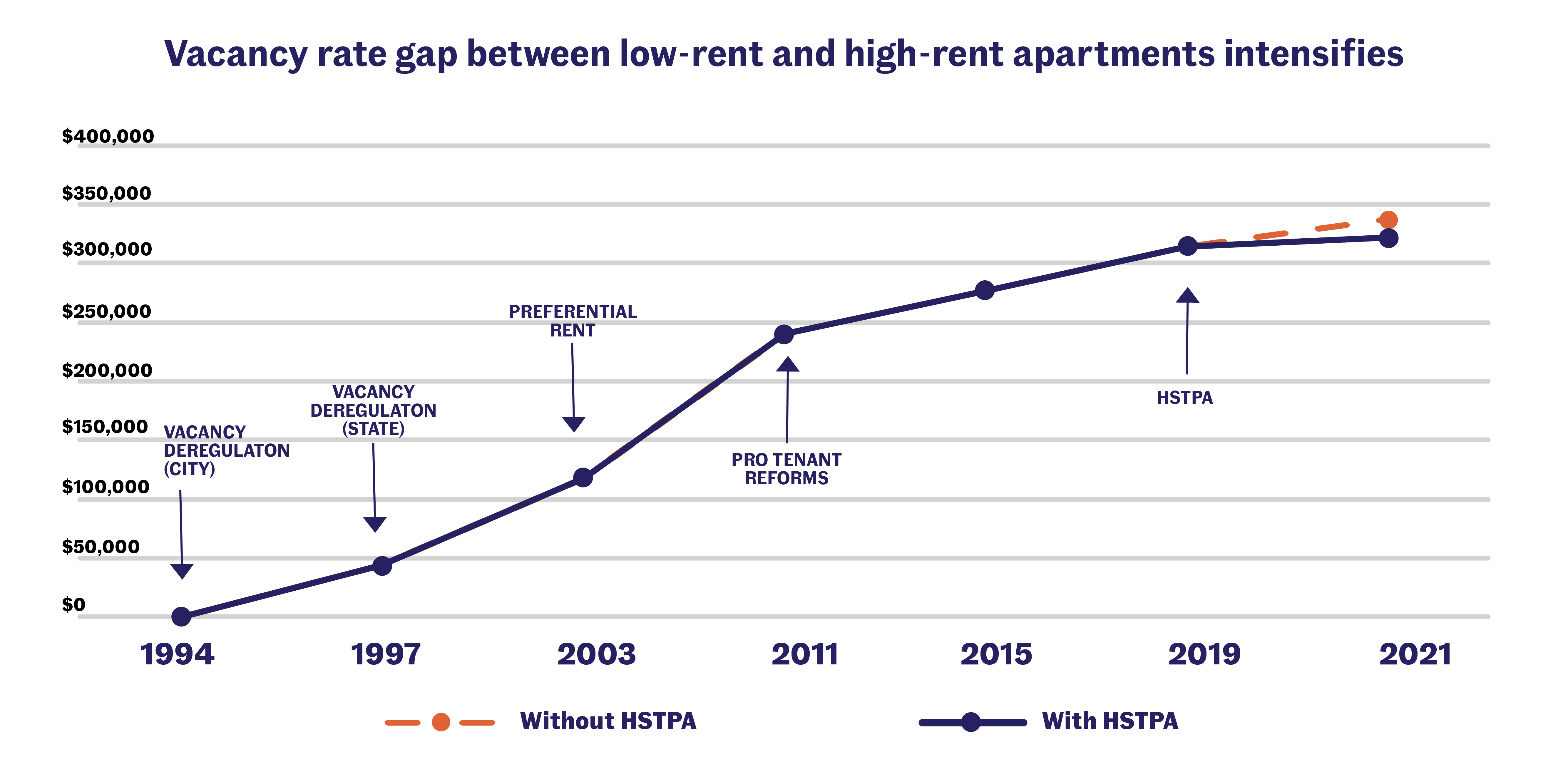
In 2019, New York State passed the Housing Stability and Tenant Protection Act (HSTPA), the most important, far-reaching, and comprehensive protections for tenants in about a half-century. The law closed loopholes, introduced by real estate-friendly legislatures in the 1990s, which allowed landlords to use apartment and building improvements, as well as tenant turnover, as pretenses for steep rent hikes and deregulation.
2011 reforms that raised the high vacancy threshold and made small changes to Major Capital Improvement rent increases began to slow the rate of deregulation in the city, and the 2019 HSTPA finished the job. Between 2020 and 2021, HSTPA saved 15,670 apartments from deregulation, reversing a trend started with pro-landlord reforms that weakened the State’s rent regulation system over the past few decades.
Further, the 2019 law kept rents in 37,040 apartments that turned over at the median rent of $1,500. That is $300 lower than it would have been without HSTPA.
Historical overview of New York City’s Rental Crisis
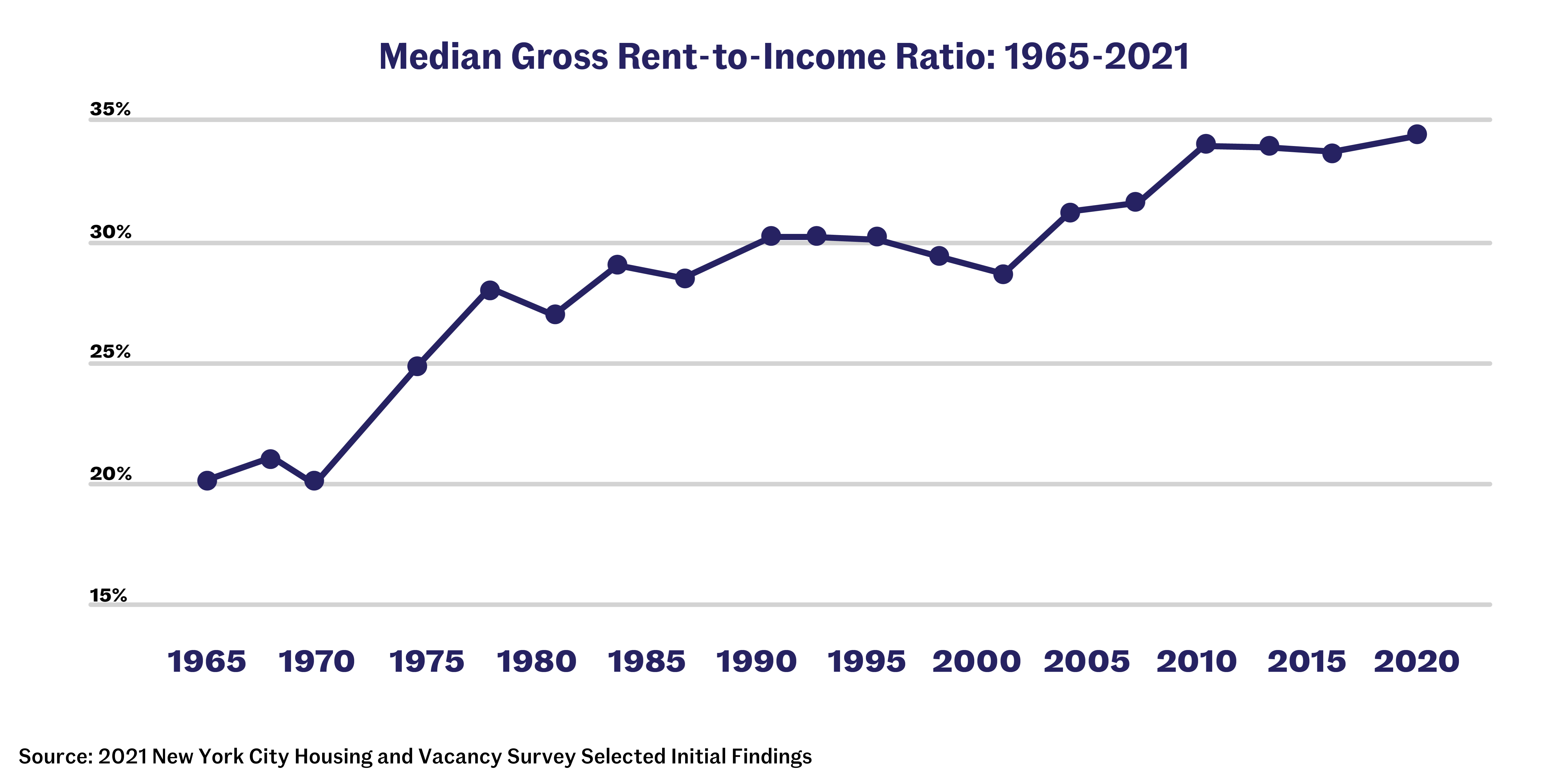
Since 2011, most of the city’s private market tenants have been rent burdened, paying more than 30 percent of their income in rent. In 2021, nearly one million households (53 percent) were rent burdened, while 600,000 households (32 percent) were severely rent burdened or paying more than 50 percent of their income in rent.
The rental crisis impacts poor renters the most, and Black and Latino/a/x tenants are more likely to be rent burdened than white or Asian tenants. Severe rent burdens were a near universal experience for poor households in the private rental market without a subsidy: 85% of households earning less than $25,000 were severely rent burdened. Black and Latino/a/x households (36 percent) were more likely to be severely rent burdened than white or Asian households (28 and 29 percent). Overall, Latino/a/x households had the highest share of rent burdens, with 59 percent paying more than 30 percent in rent.
New Yorkers’ high rent burdens today are a result of real estate investment and housing policy decision over the past 50 years. The U.S. had a price and rent control system in place during WWII, which many states immediately phased out in the late 1940s. In New York State, a coalition of tenant, consumer, and labor groups pressed the state to continue controlling rents. However, by the late 1960s, the state government had implemented decontrol measures leading to the decline of rent regulation across the state. The impact was severe: vacancies dropped to 1.2 percent and median rents increased by 27 percent.
The city responded with the Rent Stabilization Law of 1969, which was quickly undercut by a series of state laws in 1971 that limited municipal control over rent regulation and allowed landlords to deregulate units upon vacancy. The state’s laws led to both increased landlord harassment and a spike in rents, as landlords tried to push out tenants to deregulate units. The historical overview of rent-to-income ratios below shows a sharp jump in the median rent burden in the 1970s. (See chart below.)
The rent burden ratio hovered around 30 percent through the 1980s and 1990s, but began climbing again in the 2000s, when speculative investors begun to purchase 100,000 units (about 10 percent) of the city’s rent stabilized housing stock. As rent regulated landlords grew more sophisticated, investors weaponized the rent law loopholes, developing complex revenue generating strategies predicated on systematic rent increases above the annual rent guidelines, driving the rent burden up even further.
Too much of the housing stock’s gains are in units unavailable for rent
The city’s housing supply grew by approximately 175,000 units between 2017 and 2021, a rate HVS Initial Findings author Elizabeth Gaumer characterizes as “slow but steady.” There was, however, a “substantial” growth in buildings with more than 100 units (9% growth, or 65,000 units), as well as a big increase in buildings with 6-19 units (11% growth, or 42,700 units).
But even as the city added a substantial amount of new housing, it continued to struggle with the problem of intentional emptiness. The number of units that were both vacant and unavailable for sale or rent went up by 43 percent, from 248,000 to 353,400. This significant increase was likely driven by four intersecting market dynamics:
- the overproduction of high rent units only accessible to wealthy households;
- the exodus of wealthy renters from New York City during the start of the pandemic, including some who may have switched their primary residence from their city apartment to their “country home;”
- the ongoing practice of turning full apartments into permanent short-term rentals; and
- owners of rent stabilized housing withholding apartments from the market in the hopes of forcing legislators to weaken the 2019 rent laws.
The largest grouping of intentionally empty apartments were units held off the market for occasional, seasonal, or recreational use. The number of such apartments in the city have gone up by 37 percent to 102,900 since 2017, and have nearly doubled since 2014.
135,700 of units off the market in 2021 were either coops or condos. The number of vacant and off-market coops and condos more than doubled since 2017, when there were roughly 63,000 units. Co-ops and condos also represent a larger share of the total vacant, off-market units, from 26 percent in 2017 to 38 percent in 2021. These figures are likely a result of both long-term overproduction of luxury condos/co-ops as investment vehicles and the short-term impact of the pandemic on the high-end rental market.
Conditions are worsening across the board, and in public housing in particular
The 2021 HVS shows a disturbing trend: the city’s housing stock is becoming both more expensive and more rundown. Almost all the markers of maintenance deficiencies tracked by the survey got worse since 2017 (with the exception of heating problems and broken toilets). This could signal landlord disinvestment and neglect, but it could also be a result of the survey’s timing, as building maintenance may have been deferred due to pandemic-related safety and supply chain issues.
24 percent of New York City buildings had rodent infestations in 2021. 18 percent of apartments had leaks, and 17 percent had cracks in their ceilings or floors. Perhaps relatedly, 16 percent need more heat in the winter and 10 percent saw their heat shut off in the winter, which can lead to a dangerous reliance on space heaters or open ovens. 16 percent of buildings with elevators had elevator breakdowns. 9 percent of apartments had mold issues.
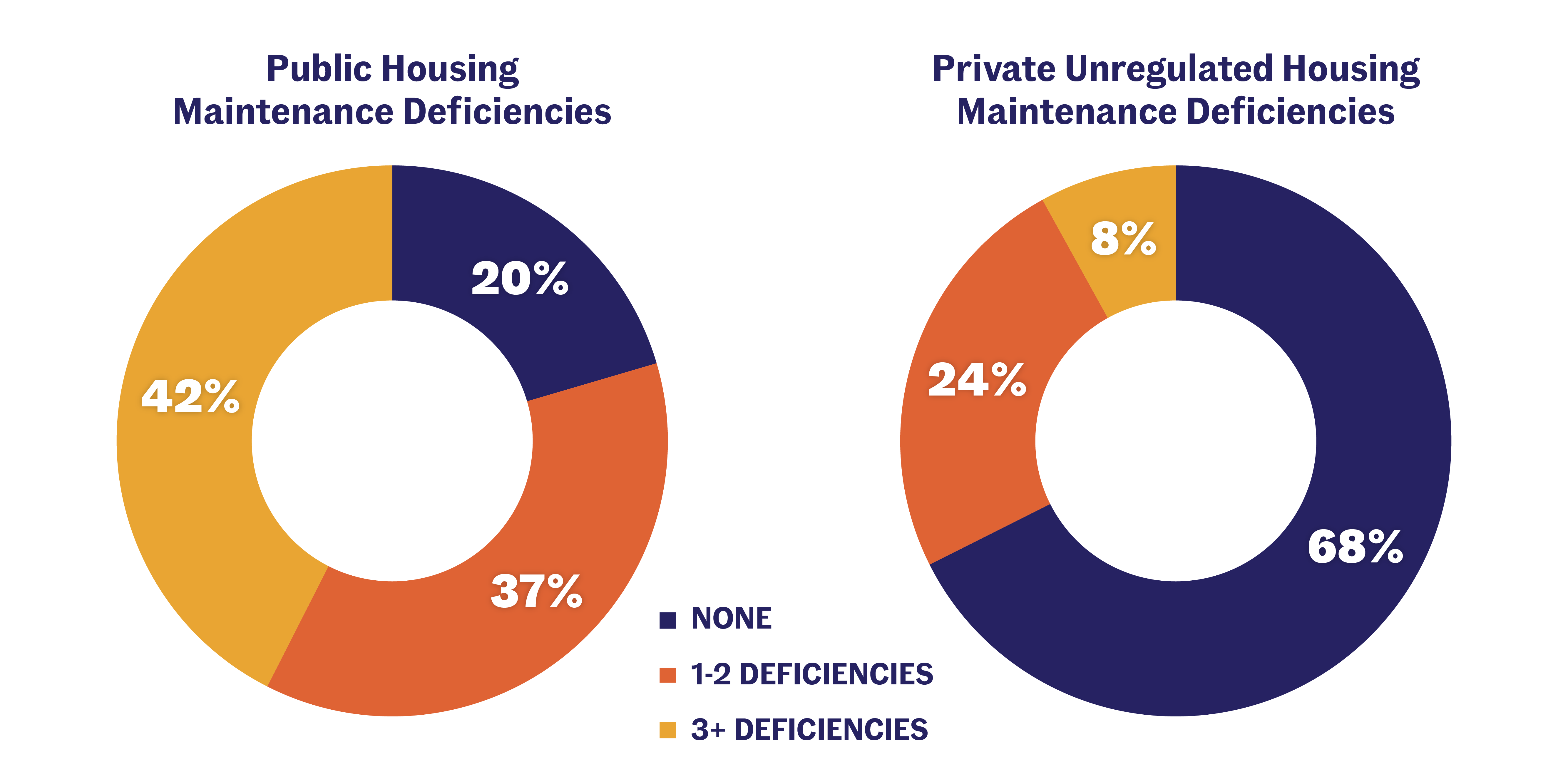
While we will have to wait for the 2021 HVS microdata to do a historical analysis of conditions by housing type, New York City’s public housing stock showed the greatest levels of disrepair. Only one fifth of the New York City Housing Authority’s stock had no maintenance issues, whereas 43 percent had more than three issues. Public housing is the only housing type in New York City where more tenants have three or more maintenance deficiencies than had one or two deficiencies.
26 Percent of Families with Kids Live in Overcrowded Apartments
With extremely low vacancy rates in affordable apartments, many New York City households remain crowded into apartments too small for their households. 8 percent of New York City households lived in overcrowded housing, with two or more people per bedroom. These numbers were higher for immigrant households, with 12 percent living in crowded conditions. The rate of crowding for families with one or more children was extremely high at 26 percent, or 174,900 households.
Somewhat surprisingly, overcrowding does not taper off as household incomes rise. Households earning less than $25,000 had a 5 percent rate of overcrowding, while 9 percent of all other households lived in overcrowded housing. This issue merits a closer look once HVS microdata is released.
Low-Income Tenants – Not Rich Swindlers – Struggled to Pay the Rent
As of the summer of 2021, when the HVS was conducted, 13 percent of renters had missed at least one month’s rent over the course of the previous year. Of those, 29 percent still had outstanding arrears at the time of the survey. In our annual Unheard Third survey, also fielded in the summer of 2021, we found that a roughly similar share of tenants, one in four, had rent arrears.
While some of those households may have since had their rents covered by the state’s Emergency Rental Assistance Program, still others may be waiting for assistance. 15 percent of tenants – about 330,000 households – had to use savings, borrowed money, credit or the sale of personal items to pay the rent.
Throughout the pandemic, landlords and their representatives claimed that wealthy tenants were cheating the system by failing to pay rent during the eviction moratorium. The 2021 HVS shows that any such cases were exceptional. By far the vast majority of tenants who fell behind on rent were low-income households with high rent burdens. When the survey was conducted, 38 percent of extremely low-income tenants who had previously owed rent were still unable to pay it; the number of households earning $100,000 or more with outstanding rent debt was too small for the HVS to even report. These findings correspond with our research into eviction trends in New York City over the past decade. The vast majority of extremely low-income people are severely rent burdened and are thus most vulnerable to accumulating rent arrears and being evicted for non-payment of rent. Moderate income people are increasingly susceptible to evictions, as rents rise. High-earners, however, rarely face non-payment evictions.
Lacking Food, Mounting Debt, and Dwindling Savings
This year’s pandemic-timed HVS included a new battery of questions about resident hardships, giving us a stronger picture of the difficulties facing New Yorkers. The questions focus on food insecurity, student debt, and emergency savings.
Low-income tenants are struggling with food insecurity, or difficulty affording enough food to regularly feed their families. This problem was especially acute for public housing residents, 18 percent of whom reported food insecurity. Altogether, 15 percent of tenants with incomes below the median ($50,000) – nearly 200,000 households – had difficulty affording food on a regular basis.
While mounting debt of various kinds is a problem for many tenants, the HVS initial findings reports specifically about the toll student debt is taking on households. The class dynamics of student debt, however, are somewhat different than that of many other hardships facing tenants. Unlike most other markers of distress, the percentage of households with student debt rises with incomes and is higher for people without rent burdens than people with them. The percentage of owners with student debt is higher than the percentage of renters with student debt (though the number of renters with student debt is higher than the number of owners with student debt). Student debt is lower for public housing residents than private or rent state stabilized tenants. Still, 14 percent of people with missed rent payments in the past year also have student debts.
While it is true that households with student debt are more likely to have higher incomes, our 2021 Unheard Third Survey shows that more than a quarter of households in poverty also had student loan debt and that low-income Black and Latina/o/x households were more likely to be encumbered by it. Since a majority of low-income New Yorkers with student debt do not have a four-year college degree, they often struggle to repay lower levels of debt and become delinquent without the prospects for higher earnings. These borrowers are more likely to experience increased economic hardship, including experiencing difficulties in meeting basic needs like food or clothing, and often forced to skip paying other bills to make student loan payments.
To measure tenants’ financial security, the HVS asks respondents whether or not they could cover a $400 emergency expense. The answer tracks closely with other markers of vulnerability, including missed rent, rent burden, and low income, as well with CSS’s Unheard Third findings about New Yorkers’ rainy day savings. Owners reported the highest confidence in their ability to pay; public housing residents reported the lowest. Whereas more residents of Manhattan and Staten Island were confident they could cover such an expense, a large percentage of tenants in the Bronx said they could not. Severely rent burdened tenants and residents of means-tested housing – especially public housing – were significantly less likely to be able to shoulder such a burden.

See more analysis of 2021 HVS data in "Conditions, Crowding, and Cash on Hand: Key Points from Selected Initial Findings of the 2021 New York City Housing and Vacancy Survey."