Low-Income New Yorkers Are an Inch Away from Eviction
How to Address Rent Debt and Eviction Pressure to Keep Them Housed
Oksana MironovaSamuel Stein

Context
Many New Yorkers are still facing deep housing hardships, even as parts of the economy show signs of recovery. The federal and state eviction moratoria and direct pandemic relief helped hold back a sharp increase evictions and homelessness. However, rents continued to increase for low-income New Yorkers, who bore the brunt of pandemic-related economic losses: according to our 2021 Unheard Third survey—the longest running scientific survey of low-income communities in the nation— 41 percent of low-income respondents lost employment income in their household during the pandemic, compared to 29 percent of those with moderate to higher incomes. Low-income New Yorkers also clearly expressed that higher wages and affordable housing were the two keys to their advancement toward a more secure future. In this brief, part of the series Whose Recovery? Addressing the Needs of Low-Income New Yorkers, we focus on New Yorkers who have fallen behind on rent and are at risk of eviction when the state’s moratorium expires on January 15, 2022. The brief includes new findings from our 2021 Unheard Third survey, which shows that an alarming number of tenants–many of whom are people of color–are at risk of eviction, homelessness, and broad housing and economic insecurity. It is critical that the city and state governments take bold and immediate action to secure tenants’ rights and to provide direct relief.
Key Findings
- More than one in four low-income tenants are behind on their rent during the pandemic, with Black and Latinx tenants – and particularly women – at greatest risk for long term consequences as a result of rent debt.
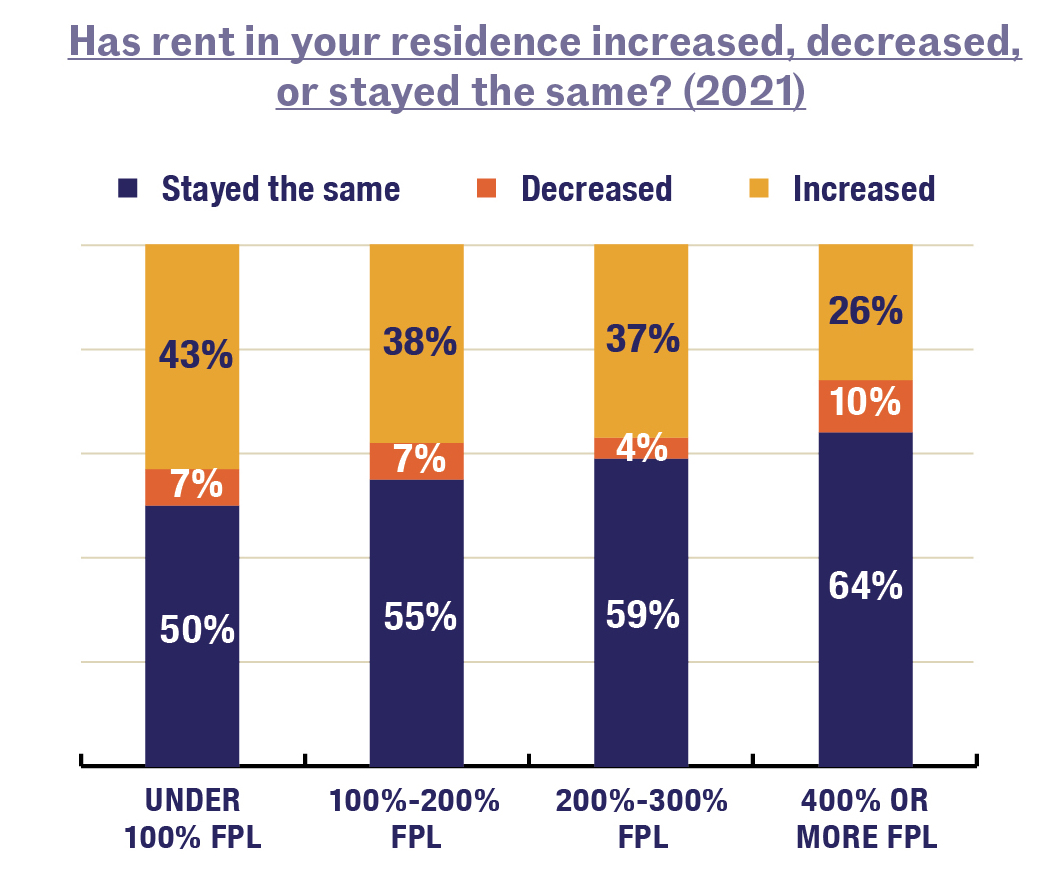
- In the past year, rents increased for 43 percent of tenants below the federal poverty line.
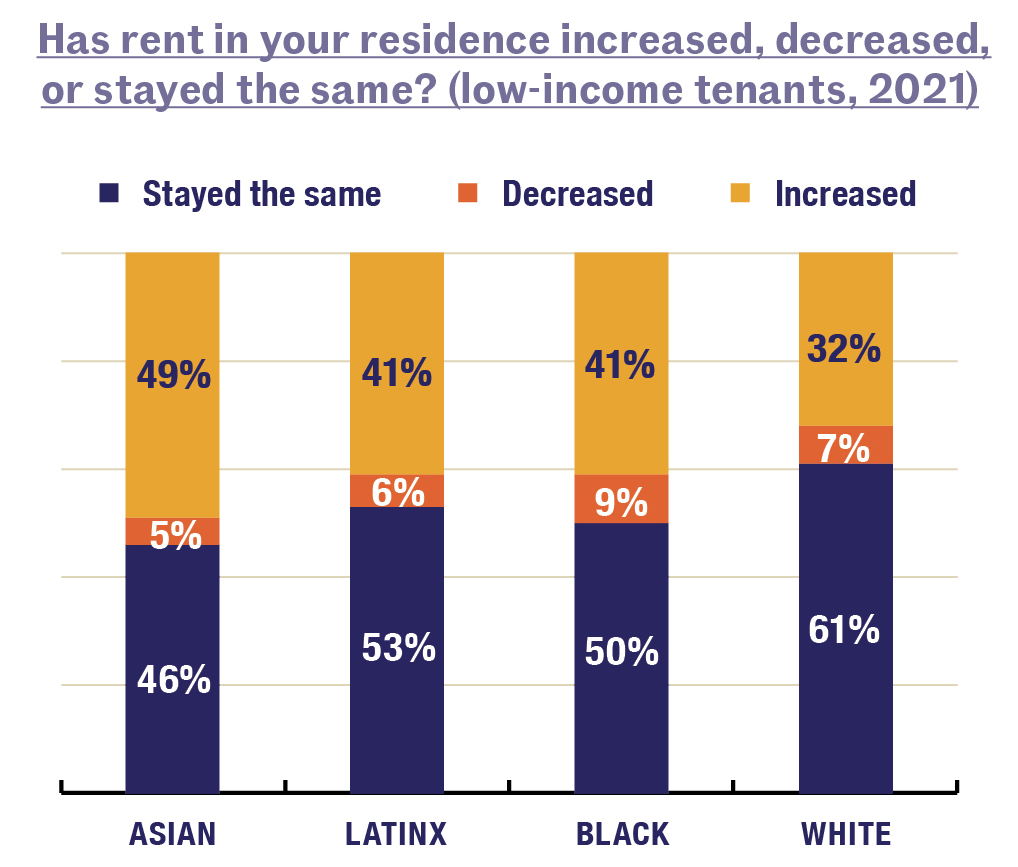
- Rents rose at a higher rate for low-income tenants of color than for low-income white tenants: 49 percent of Asian tenants and 41 percent of Black and Latinx tenants experienced rent increases, compared to 32 percent of white tenants.
- More than one third of low-income tenants reported that they were worried they would be evicted or forced to move when the eviction moratorium ends.
Summary of Recommendations
- The legislature should pass bold new statewide tenant protection laws, including Good Cause eviction protections and statewide Right to Counsel, which will help tenants remain in their homes.
- The state should create new means for direct assistance to both low-income tenants and homeless New Yorkers in need of permanent housing, including passing the proposed Housing Access Voucher Program (HAVP) and increasing funding and expanding the scope of the Housing Our Neighbors with Dignity Act (HONDA).
Introduction
New York State’s eviction moratorium will expire on January 15th, 2022, leaving thousands of tenants vulnerable to eviction and homelessness. This is an emergency that the legislature and the governor cannot ignore. Our findings show that over one in four low-income tenants (27 percent) owe back rent, with Black and Latinx tenants – particularly women – at the greatest risk. Far more people are behind on rent than were assisted through the Emergency Rental Assistance Program (ERAP), and there are already 192,000 nonpayment eviction filings in the court, waiting to be processed upon the end of the moratorium.
We know, however, that public intervention can work: our data showed a marked decline in housing hardships in 2020, despite all the economic impacts of the pandemic. This decline can be attributed to the federal and state eviction moratoria, as well as forms of direct pandemic relief, including expanded unemployment assistance, rent relief, and stimulus checks. But, lagging unemployment and rising infection rates indicate that the economic and public health impacts of the pandemic are continuing. The state must enact permanent housing measures, including Good Cause eviction protections and the Housing Access Voucher Program (HAVP). Legal protections against evictions, coupled with rental assistance, keep New Yorkers housed.
Rising Rents for Poor Tenants and People of Color
For much of the last year, a common narrative circulated in the press: rents are declining as New Yorkers flee the city during the pandemic. However, today, as one Wall Street Journal writer put it, “pricing power has swung back to the landlords.”
Even during the height of the pandemic, rents rose for many tenants. A plurality (43 percent) of tenants who earn less than the federal poverty line experienced rent increases over the past year, 17 points more than higher-income tenants.
When asked whether they were able to get their rents reduced at any point since the pandemic began, just 7 percent of low-income tenants and 6 percent of moderate or high-income tenants within the private rental market reported being able to secure a reduction. However, moderate and higher income renters reported greater levels of success when they requested reductions (12 percent). Among low-income tenants who received rent delays or reductions, 67 percent live in public or subsidized housing, where rents are tied to income, and tenants can petition for their rents to fall when their incomes drop or disappear. These kinds of “social rent” mechanisms, combined with public ownership and oversight, make the delivery of emergency support (such as rent reductions) far more efficient and widespread.
Rates of rent increases were significantly higher for low-income tenants of color compared to low-income white tenants. Specifically, 32% of low-income white respondents experienced rent increases, while 41% of low-income Black and Latinx tenants and 49% of low-income Asian tenants faced increases. Clearly, market pressure on neighborhoods with high shares of Black, Latinx, and Asian tenants did not ease during the pandemic.
Falling Behind – Incomes Fall as Rents Rise for Low-Income Tenants
During the pandemic, rents continued to rise for many tenants –particularly for low-income tenants of color – while wages fell: 38 percent of Black and 35 percent of Latinx respondents reported loss of employment income in their household since the start of the pandemic, compared to 29 percent of white respondents. As a result, many households fell behind on their rent.
In our survey, more than one in four low-income renter households (27 percent) reported having debt from back rent. While the Unheard Third focuses on New York City, we know that this is a problem with statewide resonance. According to PolicyLink’s analysis of the U.S. Census Household Pulse survey, 591,000 households owe nearly $2 billion in back rent in New York State.[1] Of that total, roughly 408,000 households owe $1.45 billion in New York City, with an average of $3,500 in back rent per household.[2]
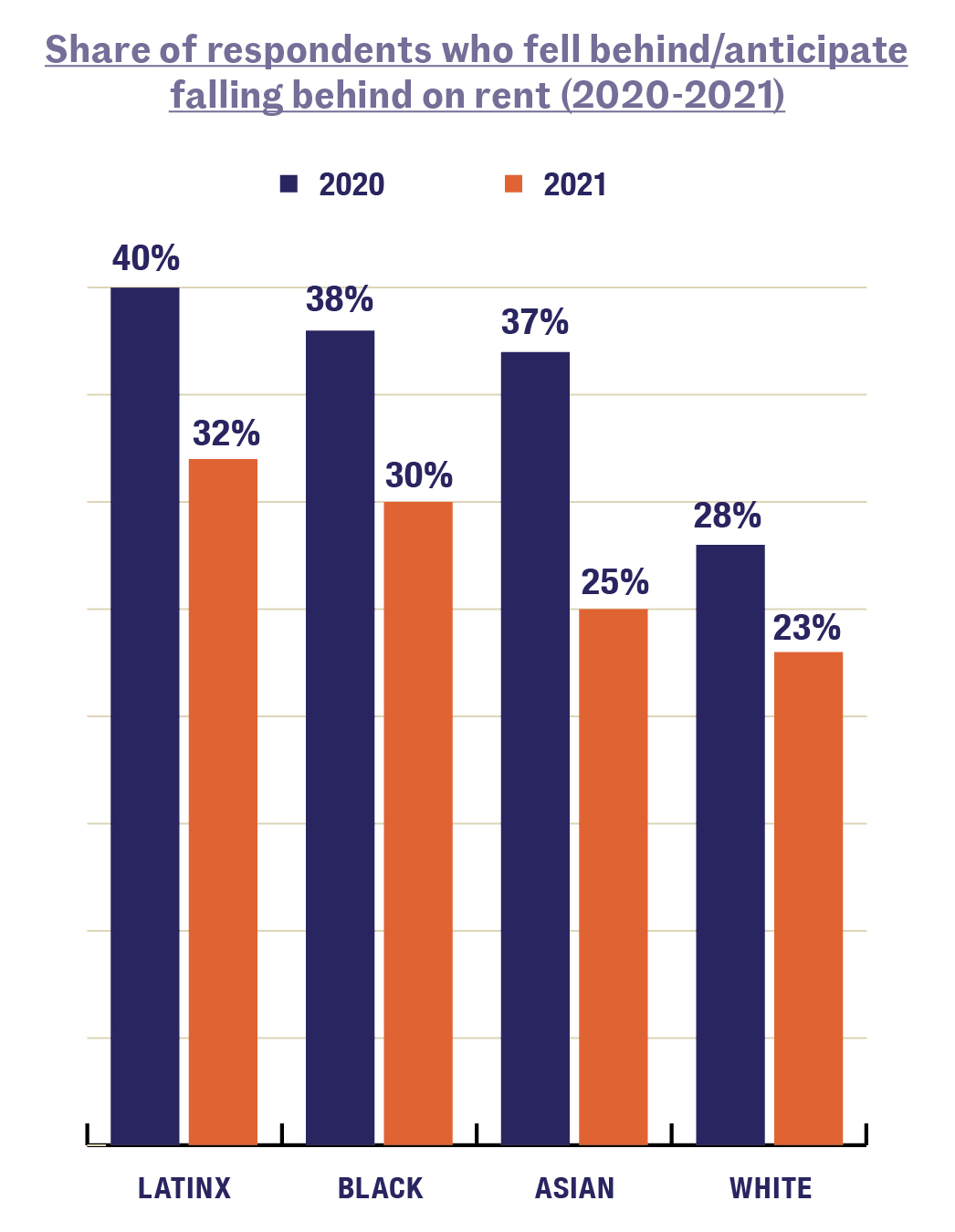
While all tenants have more confidence about making the rent in 2021 compared to 2020 – a testament to the effectiveness of public rent relief efforts, which we discuss below – a gap between white and Latinx (-9%) and white and Black (-7%) tenants persists. According to PolicyLink’s analysis of statewide Census data, 72 percent of tenants behind on their rent were people of color.
These findings are not specific to the realm of housing, but rather reflect the ways structural racism is embedded within the housing, lending, and job markets (as indicated by 2021 UHT findings above), subjecting people of color to more risk and less favorable conditions.
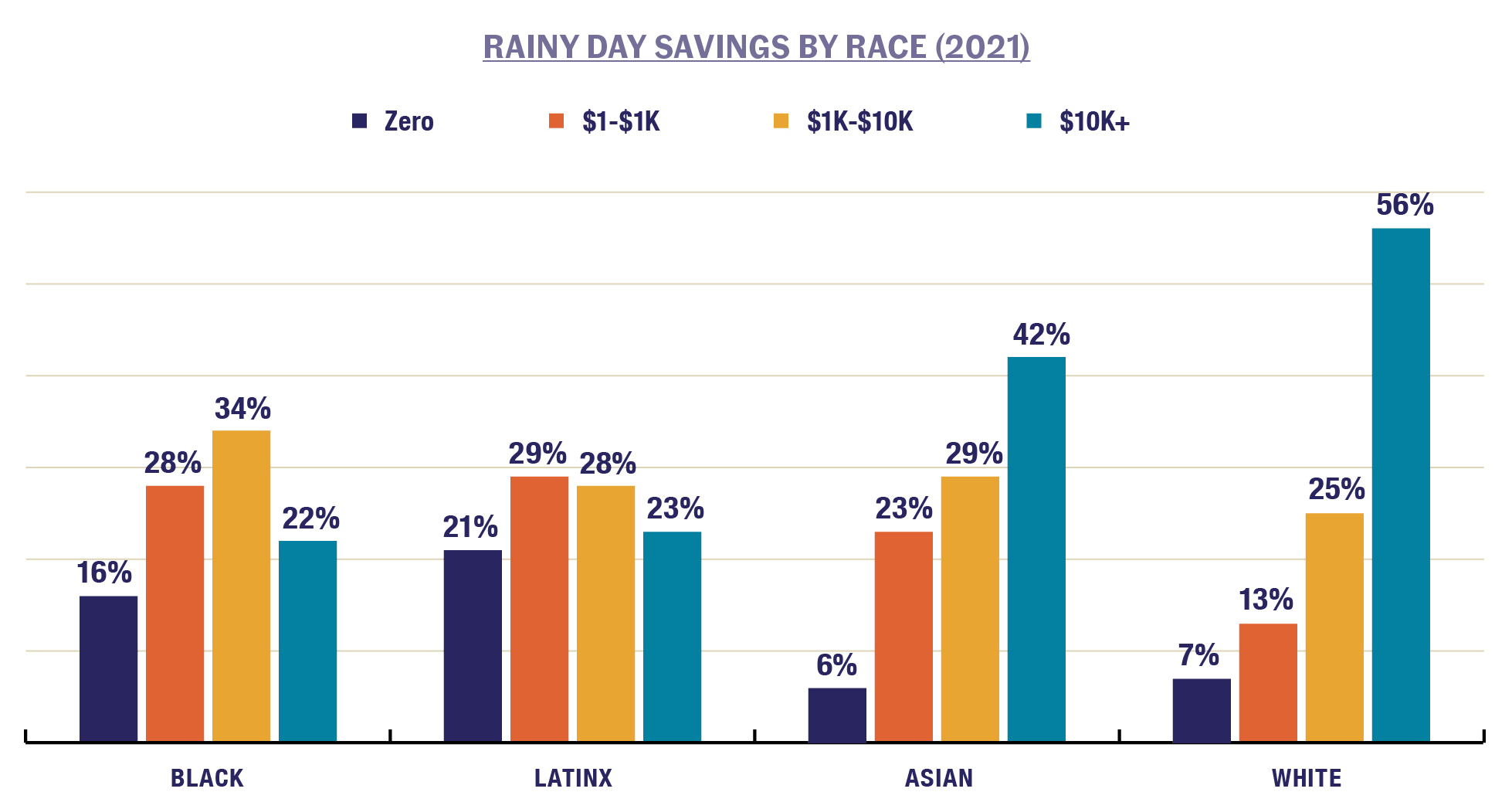
Compared to white and Asian respondents, Black households were more than twice as likely – and Latinx respondents were three times as likely – to have no rainy-day savings, a symptom of the racial wealth gap. While the literature on the racial wealth gap tends to focus on exclusion from homeownership, rent arrears are another way structural racism manifests within housing and lending policy.[3]
Public Assistance: Crucial, but Waning

Temporary pandemic assistance and stimulus programs impacted New Yorkers’ lives, as our figures above demonstrate: tenants’ confidence about making their rent improved from 2020 to 2021.
The impact of pandemic aid can also be seen in our long-term data on low-income New Yorkers’ housing-related hardships. The share of low-income tenants moving in with other people for financial reasons, experiencing eviction attempts and utility shut-offs stayed fairly consistent in the years leading up the pandemic. There was a clear decline in all three hardship measures in 2020, however, a testament to the combined impact of the eviction moratorium, the Emergency Rental Assistance Program (ERAP), pandemic unemployment assistance, and other temporary social measures. The pandemic and its devastating economic effects are not yet over. Covid-related assistance should continue, as it would have a significant impact in helping low-income tenants out of rent debt and into economic security.
Fears for the Future
The temporary nature of covid assistance programs, compared to the long-term effects of the pandemic on jobs, wages, and education, caused housing insecurities to shoot back up to roughly pre-pandemic levels in 2021.[4] This has tenants significantly worried.
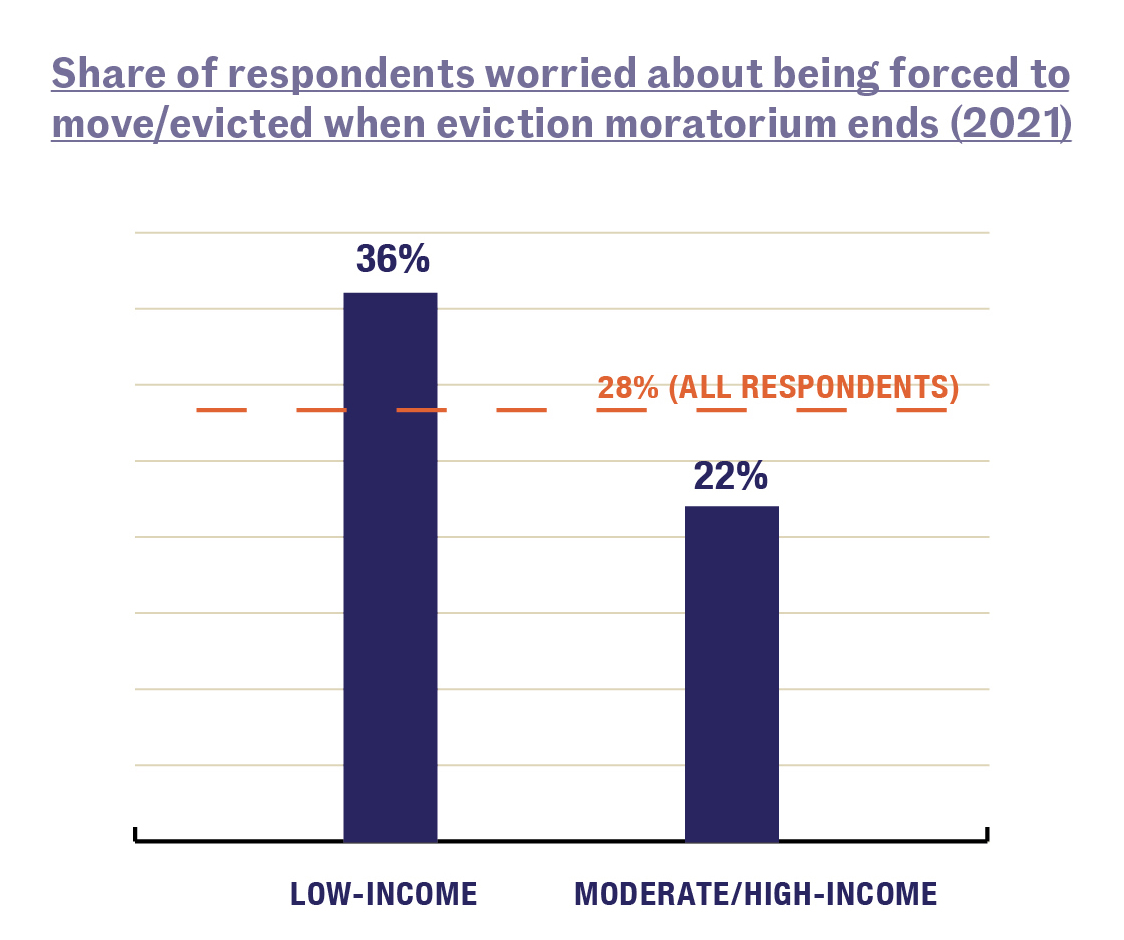
One major source of concern is the expiration of New York State’s eviction moratorium on January 15th, 2022. More than one in three (36 percent) low-income respondents and one in five (22 percent) moderate- or high-income respondents said they were concerned about losing their home when the moratorium expires.[5]
Between the summer 2020 and the summer 2021, during which time local and federal eviction moratoria were in effect, 14 percent of low-income respondants say they were threatened with eviction. Nearly one in five single moms reported facing illegal eviction threats.
As of December 2021, there were 214,000 active eviction cases in New York City, 192,000 of which were non-payment cases.[6] Of the non-payment cases, approximately 140,000 are paused pre-pandemic filings; 51,000 were filed since the pandemic began. Further, many more landlords are likely waiting to file their evictions when the moratorium expires on January 15th, 2022. This pattern has already been established in other states. Princeton University’s Eviction Lab recorded a national eviction spike at the end of August 2021, when the federal eviction moratorium expired.[7] Locally, landlord lobby groups that have long challenged New York State’s rent regulation and tenant protections in court have sued the State for extending its own eviction moratorium, and have been calling for housing courts to reopen immediately.
All indications suggest that if the eviction moratorium expires, housing courts reopen, and no additional eviction protections and rent relief are passed, the impacts will be most severely felt by low-income tenants and communities of color. About one in four low-income tenants owe back rent, increasing their vulnerablity to eviction. Before the pandemic, our research on New York City evictions corroborated national findings showing a relationship between eviction rates and neighborhoods with high shares of Black or Latinx renters, particularly in households led by women, controlling for poverty levels. Researching eviction filings during the pandemic, Eviction Lab found the same pattens: “the threat of eviction is concentrated among those for whom displacement was an all-too-common risk before the pandemic began.”[8]
Housing Insecurity’s Long-Term Effects
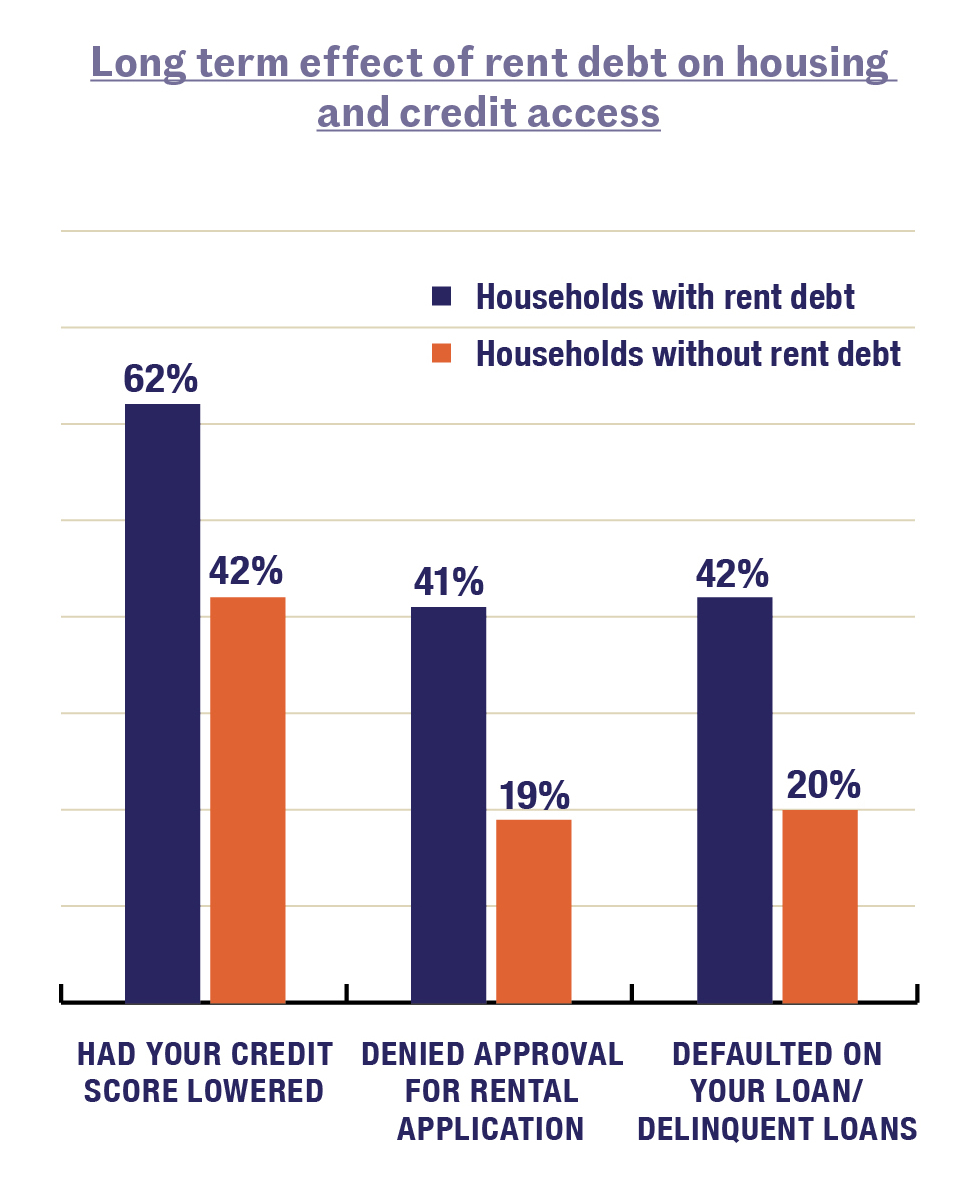
Eviction is not only a one-time event, but a process with a long shadow. A 2018 study analyzing New York City’s housing court data found that evicted low-income households experienced higher long-term likelihood of homelessness, longer shelter stays, and more frequent emergency room visits, compared to households who avoided being evicted.[9] Automated tenant screenings have become routine for owners of both market-rate and subsidized apartments, meaning that eviction records follow tenants indefinitely. This has a broader impact on access to housing and credit. Compared to those without rent arrears, Unheard Third respondents whose households carry housing debt were 20 points more likely to experience credit core reductions, 22 points more likely to have been denied approval for a rental application, and 22 points more likely to have defaulted on a loan.
Recommendations: From Temporary Relief to Permanent Solutions
Temporary measures like the eviction moratorium and the Emergency Rental Assistance Program (ERAP) provided crucial relief during the first year of the pandemic. As these short-term programs expire, New Yorkers need permanent, comprehensive solutions to the housing crisis–ranging from tenant protections to material aid–to prevent a wave of evictions from washing over the city. The most direct path to long-term eviction prevention is:
1. The state should pass bold new statewide tenant protections, which would expand tenants’ rights to remain in their homes. The key components of such protections are:
- Good Cause eviction, which would grant nearly all tenants the right to a lease renewal and would cap maximum annual rent increases to a reasonable percentage. Good Cause is already law in Albany, Hudson, Newburgh, and Poughkeepsie.
- Statewide Right to Counsel, which would entitle tenants around the state to free legal representation when they are brought to court by their landlord. Right to Counsel is a highly successful law in New York City.
- Winter eviction moratorium, which would make the eviction moratorium permanent for the months when landlords are required to provide heat. This would ensure that no one goes homeless at a time when death from exposure is a real threat in many parts of New York State. This law exists in several cold-weather countries around the world, and was passed last year in Seattle.
2. The city and state should create new means for direct assistance to both low-income tenants and homeless New Yorkers in need of permanent housing. These include:
- Housing Access Voucher Program (HAVP), which would create a new, easy to use housing voucher modeled on the federal Section 8 program. HAVP would be targeted to both homeless households and tenants at risk of eviction.
- Housing Our Neighbors with Dignity Act (HONDA), passed in June 2021, funds non-profits to convert distressed commercial buildings (such as hotels) into permanently affordable and supportive housing, targeted to homeless and low-income New Yorkers. Its funding should be expanded, and the program should be amended to enable New York City to more easily conform its commercial and residential building and zoning codes for HONDA conversions.
- CityFHEPS eligibility expansion: the city should revise the eligibility standards for its primary housing voucher, CityFHEPS, in order to allow people who earn up to 50 percent of the Area Median Income to qualify. In addition, the city should waive work requirements for people who receive public assistance.
The pandemic and its economic impacts will continue to shape our city for a long time, exacerbating the impacts of structurally racist practices within the housing and lending markets that expose people of color to more risk through rent debt and eviction pressure. Leaders at the city and state levels should heed the lesson learned during the pandemic to begin to rethink our housing system: expanding tenants’ rights and providing direct rent relief helps reduce housing hardships and enhances public health.
Footnotes
1. The National Equity Atlas, produced by PolicyLink and the USC Equity Research Institute (ERI). For more information and data tables, see https://nationalequityatlas.org/rent-debt.
2. The US Census Household Pulse Survey is a 20-minute online survey studying how the coronavirus pandemic is impacting households across the country from a social and economic perspective at biweekly intervals.
3. See, for example, Brookings; Examining the Black-white Wealth Gap, and Economic Policy Institute’s The Racial Wealth Gap.
4. The wording of the eviction question changed in 2021, though this should not have affected the outcome.
5. Our Unheard Third poll was conducted during the summer of 2021, at which time the eviction moratorium was set to expire in August.
6. See The Housing Data Coalition’s Eviction Tracker.
7. See The Eviction Lab’s Preliminary Analysis: A Year of Eviction Moratoria.
8. See The Eviction Lab’s Preliminary Analysis: Who is being filed against during the pandemic?
9. Collinson, R. & Reed, D. (2018) The Effects of Evictions on Low-Income Households.