Conditions, Crowding, and Cash on Hand: Key Points from Selected Initial Findings of the 2021 New York City Housing and Vacancy Survey (HVS)
Samuel SteinOksana Mironova
This brief summarizes what the HVS reports about housing conditions and tenant hardships. In Part 1 of our analysis, we looked at the patterns of rents and vacancies reported in the Initial Findings of the 2021 HVS.
Once every three years, the New York City Department of Housing Preservation and Development (HPD) sponsors the preparation of the New York City Housing and Vacancy Survey (HVS). The survey is a byproduct of the city’s rent regulation system and its primary purpose is to determine the city’s vacancy rate. The continuation of rent stabilization in NYC is contingent on a continuing “housing emergency,” quantified with a vacancy rate of lower than 5 percent.
In our last brief on the 2021 HVS’s initial findings, we focused on vacancy rates, affordability, and housing production. The trends were clear: New York City’s housing stock is becoming less affordable to most New Yorkers. There is very little available housing at low rents, but a lot available at rents most New Yorkers couldn’t possibly pay. At the same time, more and more apartments are going unused, not because nobody wants them – clearly there’s plenty of demand for housing – but because their owners are keeping them as pieds-a-terre, Airbnbs, investment properties, or warehoused rentals.
In this brief, we focus on the condition of New York City’s housing stock and the hardships facing tenants. The HVS’s findings are in line with much of what we have reported from our annual Unheard Third Survey over the past four years, but they add a great deal of detail and they sample a larger population. While the 2021 microdata won’t be available until later this summer, initial HVS findings show that:
- Housing conditions are worsening, even as rents are rising. One example: rodent infestations were reported in almost a quarter of NYC buildings.
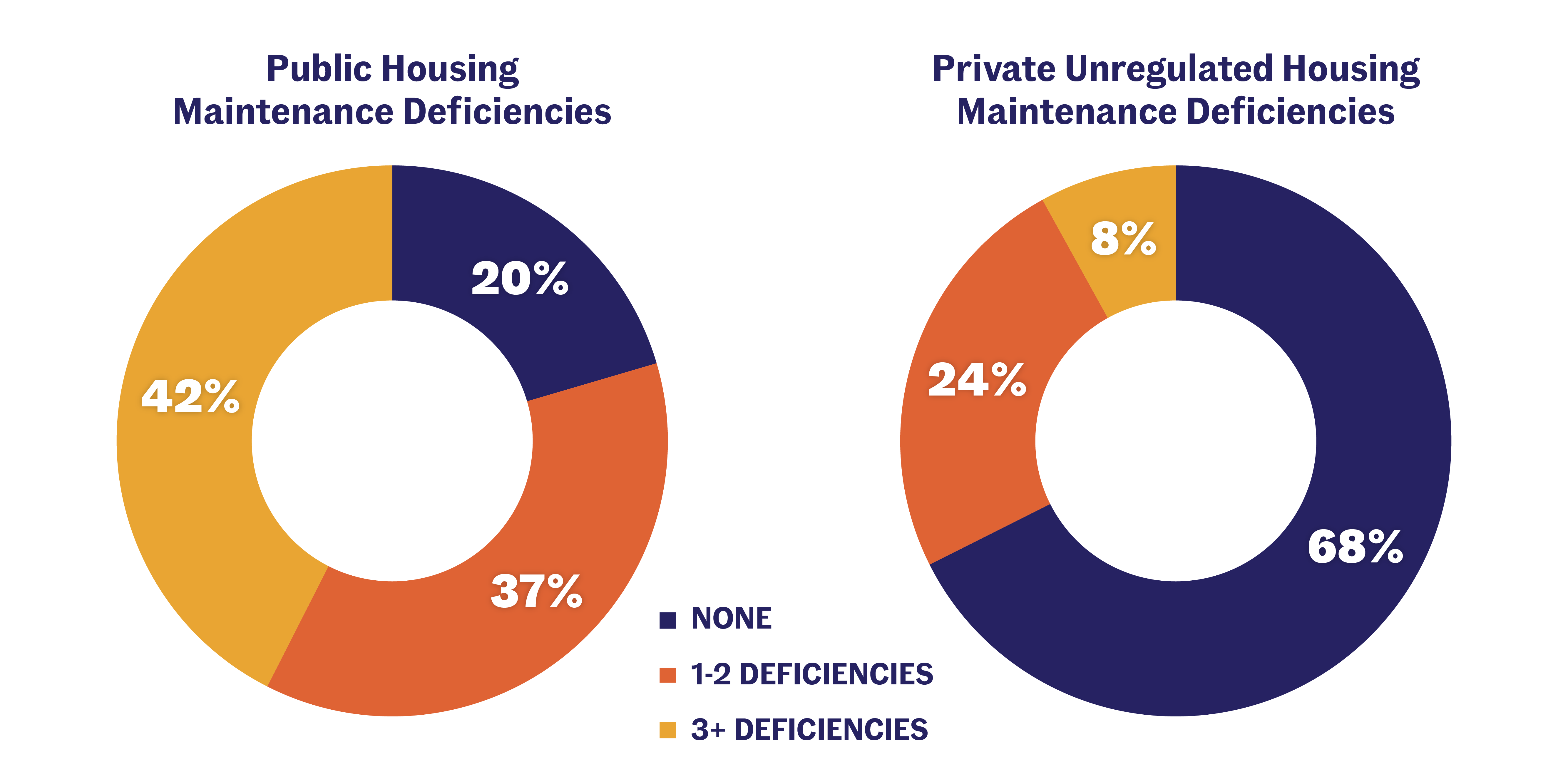
- While conditions are generally worse in lower-rent apartments than higher-rent housing, conditions in public housing are particularly dire, with a plurality of public housing residents experiencing three or more maintenance problems.
- 26 percent of families with kids are living in overcrowded conditions, with immigrant households facing higher levels of overcrowding than U.S.-born households.
- Contrary to popular landlord narratives, those who missed rent during the pandemic were overwhelmingly low-income tenants, not rich people working the system.
- Food insecurity is worst for public housing residents, with 18 percent reporting difficulty affording enough food to feed their families.
Conditions are worsening across the board, and in public housing in particular
The 2021 HVS shows a disturbing trend: the city’s housing stock is becoming both more expensive and more rundown. Almost all the markers of maintenance deficiencies tracked by the survey got worse since 2017 (with the exception of heating problems and broken toilets). This could signal landlord disinvestment and neglect, but it could also be a result of the survey’s timing, as building maintenance may have been deferred due to pandemic-related safety and supply chain issues.
24 percent of New York City buildings had rodent infestations in 2021. 18 percent of apartments had leaks, and 17 percent had cracks in their ceilings or floors. Perhaps relatedly, 16 percent need more heat in the winter and 10 percent saw their heat shut off in the winter, which can lead to a dangerous reliance on space heaters or open ovens. 16 percent of buildings with elevators had elevator breakdowns. 9 percent of apartments had mold issues.
While we will have to wait for the 2021 HVS microdata to do a historical analysis of conditions by housing type, New York City’s public housing stock showed the greatest levels of disrepair. Only one fifth of the New York City Housing Authority’s stock had no maintenance issues, whereas 43 percent had more than three issues. Public housing is the only housing type in New York City where more tenants have three or more maintenance deficiencies than had one or two deficiencies.
26 Percent of Families with Kids Live in Overcrowded Apartments
With extremely low vacancy rates in affordable apartments, many New York City households remain crowded into apartments too small for their households. 8 percent of New York City households lived in overcrowded housing, with two or more people per bedroom. These numbers were higher for immigrant households, with 12 percent living in crowded conditions. The rate of crowding for families with one or more children was extremely high at 26 percent, or 174,900 households.
Somewhat surprisingly, overcrowding does not taper off as household incomes rise. Households earning less than $25,000 had a 5 percent rate of overcrowding, while 9 percent of all other households lived in overcrowded housing. This issue merits a closer look once HVS microdata is released.
Low-Income Tenants – Not Rich Swindlers – Struggled to Pay the Rent
As of the summer of 2021, when the HVS was conducted, 13 percent of renters had missed at least one month’s rent over the course of the previous year. Of those, 29 percent still had outstanding arrears at the time of the survey. In our annual Unheard Third survey, also fielded in the summer of 2021, we found that a roughly similar share of tenants, one in four, had rent arrears.
While some of those households may have since had their rents covered by the state’s Emergency Rental Assistance Program, still others may be waiting for assistance. 15 percent of tenants – about 330,000 households – had to use savings, borrowed money, credit or the sale of personal items to pay the rent.
Throughout the pandemic, landlords and their representatives claimed that wealthy tenants were cheating the system by failing to pay rent during the eviction moratorium. The 2021 HVS shows that any such cases were exceptional. By far the vast majority of tenants who fell behind on rent were low-income households with high rent burdens. When the survey was conducted, 38 percent of extremely low-income tenants who had previously owed rent were still unable to pay it; the number of households earning $100,000 or more with outstanding rent debt was too small for the HVS to even report. These findings correspond with our research into eviction trends in New York City over the past decade. The vast majority of extremely low-income people are severely rent burdened and are thus most vulnerable to accumulating rent arrears and being evicted for non-payment of rent. Moderate income people are increasingly susceptible to evictions, as rents rise. High-earners, however, rarely face non-payment evictions.
Lacking Food, Mounting Debt, and Dwindling Savings
This year’s pandemic-timed HVS included a new battery of questions about resident hardships, giving us a stronger picture of the difficulties facing New Yorkers. The questions focus on food insecurity, student debt, and emergency savings.
Low-income tenants are struggling with food insecurity, or difficulty affording enough food to regularly feed their families. This problem was especially acute for public housing residents, 18 percent of whom reported food insecurity. Altogether, 15 percent of tenants with incomes below the median ($50,000) – nearly 200,000 households – had difficulty affording food on a regular basis.
While mounting debt of various kinds is a problem for many tenants, the HVS initial findings reports specifically about the toll student debt is taking on households. The class dynamics of student debt, however, are somewhat different than that of many other hardships facing tenants. Unlike most other markers of distress, the percentage of households with student debt rises with incomes and is higher for people without rent burdens than people with them. The percentage of owners with student debt is higher than the percentage of renters with student debt (though the number of renters with student debt is higher than the number of owners with student debt). Student debt is lower for public housing residents than private or rent state stabilized tenants. Still, 14 percent of people with missed rent payments in the past year also have student debts.
While it is true that households with student debt are more likely to have higher incomes, our 2021 Unheard Third Survey shows that more than a quarter of households in poverty also had student loan debt and that low-income Black and Latina/o/x households were more likely to be encumbered by it. Since a majority of low-income New Yorkers with student debt do not have a four-year college degree, they often struggle to repay lower levels of debt and become delinquent without the prospects for higher earnings. These borrowers are more likely to experience increased economic hardship, including experiencing difficulties in meeting basic needs like food or clothing, and often forced to skip paying other bills to make student loan payments.
To measure tenants’ financial security, the HVS asks respondents whether or not they could cover a $400 emergency expense. The answer tracks closely with other markers of vulnerability, including missed rent, rent burden, and low income, as well with CSS’s Unheard Third findings about New Yorkers’ rainy day savings. Owners reported the highest confidence in their ability to pay; public housing residents reported the lowest. Whereas more residents of Manhattan and Staten Island were confident they could cover such an expense, a large percentage of tenants in the Bronx said they could not. Severely rent burdened tenants and residents of means-tested housing – especially public housing – were significantly less likely to be able to shoulder such a burden.
More HVS Analysis
This brief summarizes what the HVS reports about housing conditions and tenant hardships. In Part 1 of our analysis, we looked at the patterns of rents and vacancies reported in the Initial Findings of the 2021 HVS.