Essential or Expendable? A Profile of Essential Workers and their Hardships Battling the Pandemic and Recession
Debipriya ChatterjeeEmerita Torres
"It’s bad enough flipping burgers for minimum wage; now we’re flipping bodies and putting ourselves at risk for minimum wage.”
-Anthony, African American hospital worker, 52 years old
Anthony is one of thousands of essential, front-line workers who has put his life on the line in the healthcare sector during the height of the pandemic, earning just $15 an hour. When COVID-19 survival rates improved in his hospital, Anthony was laid off. Like many workers, Anthony was praised for being “essential” to New York’s recovery, but actions by his employer made clear he was expendable.
New York City is home to over 4 million workers. 2.5 million of them serve in “essential” sectors, and over one million who are considered “frontline” workers within those sectors.[1] Essential workers continue to risk their lives and the lives of their family and household members to report to duty, including keeping the city running during extended periods of lockdown. From providing healthcare to collecting garbage, from delivering groceries to providing childcare, essential workers are indispensable in ensuring New Yorkers can survive the pandemic.
This post, fifth in the series A Roadmap to an Inclusive Recovery: Assessing COVID-19’s Impact on Low-Income New Yorkers, based on CSS’s annual Unheard Third survey (UHT) of low-income New Yorkers,[2] seeks to fill a gap by providing a profile of essential workers and describing the hardships they faced, especially during the pandemic.[3] Our survey, fielded during summer of 2020, included questions on health, employment, housing security, public benefits, and hardships, as well as the respondents’ opinions on taking public transit and feeling safe at their workplaces.
The city’s essential workers are disproportionately people of color, with a majority working in low-wage industrial sectors (e.g., retail, and personal services). Although essential workers were less likely to experience temporary or permanent job losses compared to workers in non-essential industries (e.g., entertainment industry), essential workers experienced greater rates of housing instability, food insecurity, and financial hardship.
Essential workers comprise over 60 percent of the city’s workforce.
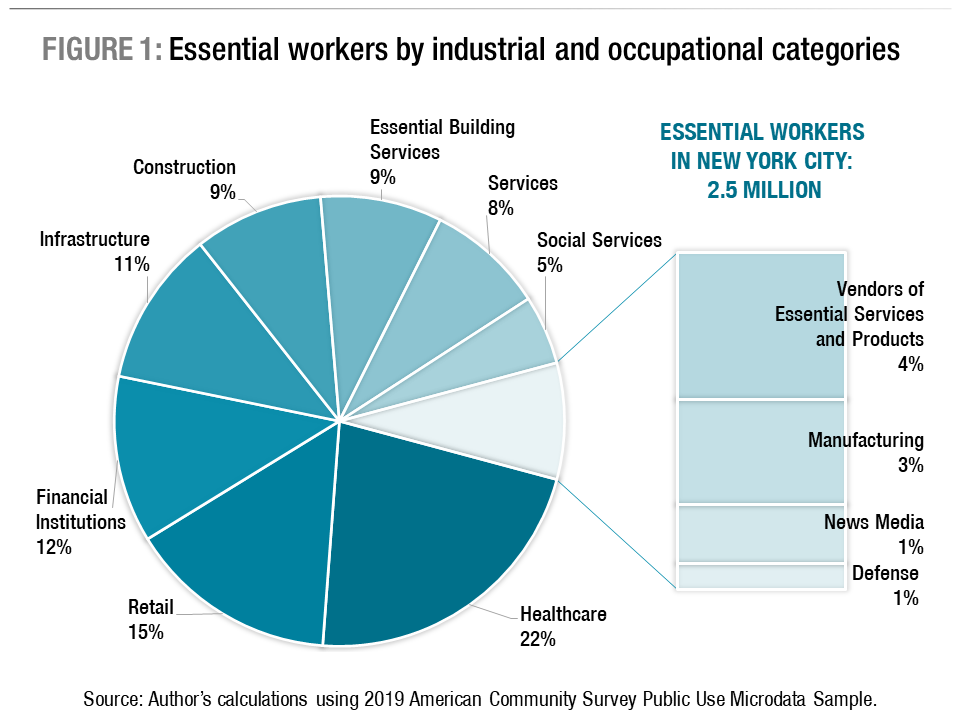
Among the estimated 2.5 million essential workers in the city, around half a million are hospital workers, accounting for over one-fifth of all essential workers. Retail workers, including grocery and convenience stores, is the second-largest category, making up about 15 percent of all essential workers. Figure 1 shows the composition of the essential workforce by industrial categories.
Essential workers are more likely to be people of color.
Here is a demographic profile of essential workers:
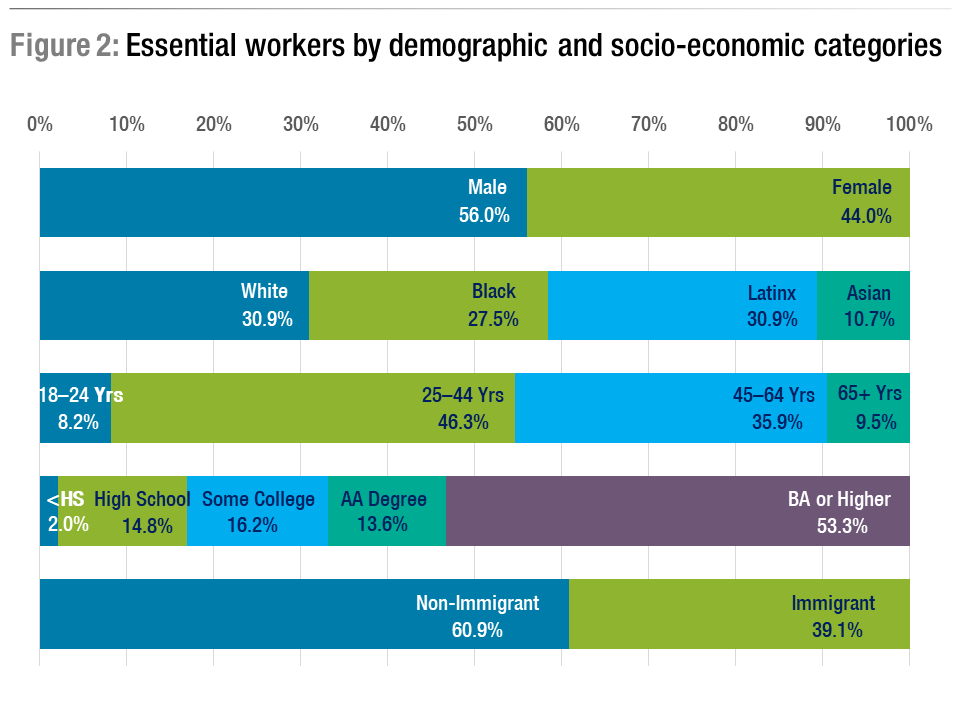
- Almost 70 percent of essential workers are people of color (Latina/o/x, Black or Asian).[4]
- Approximately 40 percent of seniors reported themselves as essential workers (data not shown), although they comprised only 9.5 percent of all essential workers.
- By educational attainment, over 60 percent of workers with two-year college degrees were essential workers, followed by 47.5 percent of high school graduates. However, 53 percent of essential workers overall had bachelor's degrees or more.
- Finally, immigrants make up 40 percent of the essential workforce.
Essential workers are more concerned about coronavirus exposure at work.
Essential workers face a much higher risk of COVID-19 because of the nature of their work, which often requires face-to-face interactions.[5] In our survey, around 70 percent of essential workers expressed that they were somewhat or very concerned about being infected with the coronavirus at the workplace, compared to 66 percent of non-essential workers. Inadequate worksite protection for essential workers puts them and their communities at risk of infection.
The only recourse available to workers who find themselves in unsafe work conditions is to file a complaint with the Occupational Safety and Health Administration (OSHA). But the National Employment Law Project points out that “despite legal petitions and calls to OSHA from legislators, OSHA has so far not issued a standard with mandatory protections that employers must implement to protect workers from COVID-19.”[6] Lack of enforceable workplace safety standards has left millions of New Yorkers at risk of being infected and/or losing their livelihood.
Both essential and non-essential workers expressed concern— around 75 percent each—about being exposed to the coronavirus while on the subway. While non-essential workers continued to express the same level of concern about COVID-19 exposure while commuting via bus, the share of essential workers who reported being somewhat to very concerned was slightly lower at 68 percent.
Essential workers are more likely to work for large employers and in the public sector.
Among the essential workers who did not report being self-employed or business owners, about 40 percent worked for large employers (defined as having five hundred or more employees). A majority of workers in the government sector (71 percent) were designated as essential. The opposite was true in private and non-profit sectors where essential workers comprised around 40 percent and 34 percent of the workforce, respectively.
Among those surveyed, essential workers reported higher rates of coverage under employer-sponsored benefits (paid vacations/sick leaves/family leaves, health insurance, and retirement contributions) — probably a reflection of better workplace protections secured by unionized workforce in the public sector. Essential workers also reported greater awareness of the city’s paid sick leave policy: 58 percent of essential workers had “some” to “a lot” of awareness regarding the policy, compared to 38 percent of their non-essential counterparts.
However, essential workers were 40 percent of those who reported being self-employed or working as independent contractors. Over a quarter of essential workers were app-based gig workers, as opposed to only 16 percent of non-essential workers. These workers, while engaged in work that is critical in keeping the city running, continue to be excluded from critical job protections and full benefits provided to employees in public and private sectors. These include job-protected paid sick leave or traditional unemployment insurance,[7] the guaranteed right to a workplace free from health and safety hazards, and access to employer-provided health care if they contract the virus.
Essential workers are more likely to experience hardships than non-essential workers.
Navara, a 40-year-old African American woman, was employed part-time by Fresh Direct during the pandemic, packing groceries in a warehouse for delivery across the city to ensure New Yorkers were stocked and fed. She prepared food deliveries despite her own health challenges, including severe chest pains that occurred on the job. When she requested a salary bump during the pandemic, Fresh Direct provided just a $75 bonus, which Navarra said was largely eaten up by taxes. Hoping for full-time work, she transitioned to Amazon, where she again put her life at risk. Individuals tried several times to steal her packages, and after numerous robbery attempts and even chasing her perpetrators, she decided risking her life for a minimum wage was not worth it. She now works full-time in housekeeping.
This is just one example of the many dimensions of hardships that thousands of essential workers are facing during the pandemic.
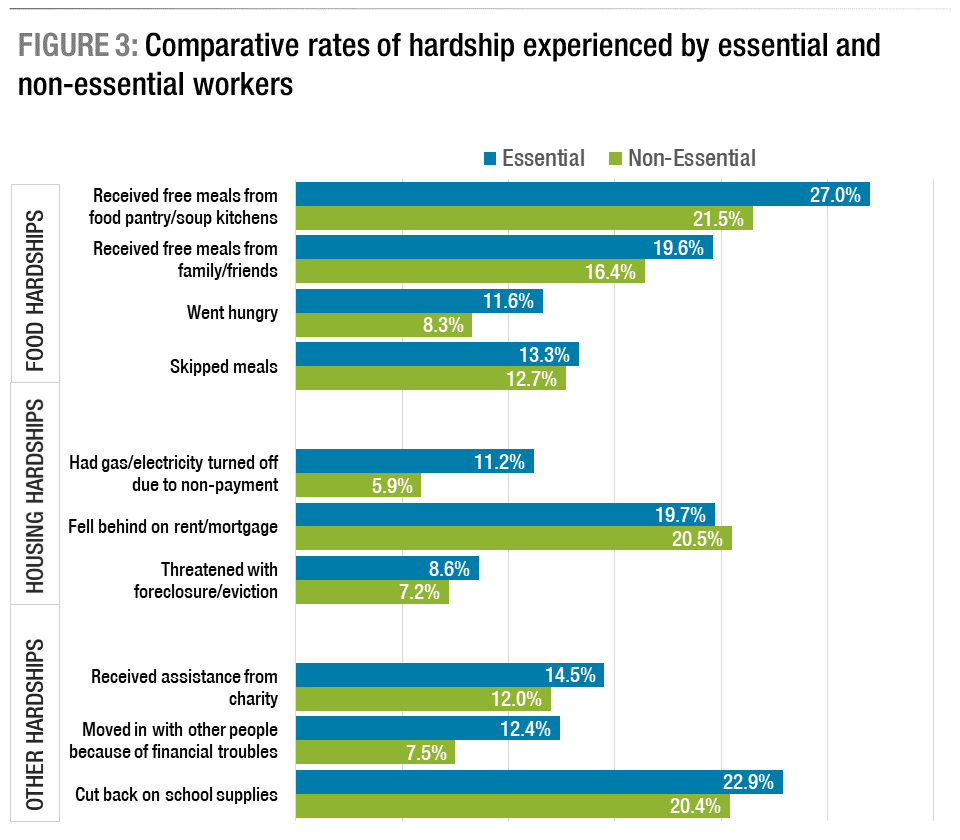
Figure 3 depicts the comparative rates of hardship in food, housing, and other dimensions between essential and non-essential workers.
27 percent of essential workers reported receiving food from food pantries, soup kitchens, or meal programs and 20 percent reported receiving food assistance from family and friends. For non-essential workers, the rates were 21 percent and 16 percent, respectively. Even as essential workers delivered groceries and food to New Yorkers, those same workers and members of their household went hungry (12 percent) or were forced to skip meals (13.3 percent). The experience of food insecurity imposes an immense physiological and psychological toll and contributes to poor health outcomes. The consequences are especially pernicious for children, whose physical growth and mental development might get stunted by inadequate nutrition.
Essential employees worked through the pandemic in vital infrastructure and utility sectors, but 11 percent of those surveyed reported that their utilities had been turned off due to non-payments of bills. The share of non-essential workers who reported the same was 6 percent. Although essential workers were less likely to have lost employment and income during the pandemic, they reported being behind on rent/mortgage at the same rate as non-essential workers (around 20 percent). Approximately 8 percent of workers (both essential and non-essential) reported being threatened with foreclosure and eviction. Essential workers reported moving in with other people because of financial troubles at almost double the rate (12 percent) of their non-essential peers (7.5 percent). Housing instability has been shown to increase the odds of worsened health and mental health outcomes (e.g., chronic depression) among both adults and children. In addition, children’s reading and math proficiency skills have been shown to suffer by instances of repeated moves and/or experience of homelessness.
Finally, 23 percent of essential workers surveyed reported that they had to cut back on purchase of school supplies and clothing while only 20 percent of non-essential workers reported the same. Hardships experienced in providing adequate educational supplies for children implies adverse consequences for long-run educational attainment as well as earnings later in life in these households.
Implementing hazard pay for frontline essential workers is critical to ensure an inclusive and equitable recovery.
Now a full year into the pandemic and over 30,000 lives lost in New York City, it is time to recognize the increasing risks essential workers have taken to keep the city functioning.
Instituting hazard pay for frontline essential workers like Anthony and Navarra would provide them with necessary compensation given the increasing risks they take, from working under immense stress and physical strain, separation from loved ones, and sporadic access to personal protective equipment. As revealed in our survey, the majority of essential workers are people of color and hazard pay would be an important first step in combating the inequities perpetuated by the pandemic and the related recession.
Congress came very close to passing these measures recently but did not succeed. The House passed $200 billion in hazard pay as part of the HEROES Act in May 2020, but the Senate removed such a provision in the final version of relief package that were passed.[8] During his campaign, President Joe Biden also advocated for premium pay for essential workers, but it has yet to materialize.[9] In his recently announced American Rescue Plan, President Biden included retroactive hazard pay as part of the $1.9 million stimulus package.
Congress must also take steps to strengthen workplace safety protection and standards. Specifically, Congress should enact legislation to strengthen OSHA to oversee and enforce workplace protection standards, extend their coverage to include public workers on the frontlines, and protect them from facing retaliation in the events of employer non-compliance.
Elected officials in New York State have already proposed several measures to improve workplace protections and provide hazard pay to the essential workers—measures that we strongly believe would alleviate hardships and economic pain for these workers.[10]
Notes
1. Estimates of essential workers are based on 2019 American Community Survey Public Use Microdata using the classification issued in Governor Cuomo’s Executive Order.
For estimates of frontline workers, we have used the classification scheme provided in this report published by the NYC Comptroller’s Office.
2. For a reference family of 2-adults and 2-children, this would imply a total family income in between $52,400 and $104,800. https://aspe.hhs.gov/2017-poverty-guidelines#threshholds
3. The UHT survey included a question on whether respondents were essential workers, on which respondents self-reported. Since the survey did not collect information on the specific industrial sector the respondents worked in and/or the nature of their occupation, we cannot verify their essential worker status. Demographic profiles based on self-reported classification might be slightly different from those developed using estimates from larger surveys fielded by the Census Bureau.
4. While the UHT survey does not ask respondents about the industry in which they work (or worked, for those who were not employed at the time of the survey), data from the 2019 American Community Survey shows that Blacks, Latinx, and Asians were more likely to be employed as essential workers in relatively low-wage sectors like retail, personal services, and social services. On the other hand, white workers were disproportionately represented in relatively higher-wage sectors like healthcare, finance, and news media.
5. A study published in the Journal of American Medical Association’s Internal Medicine estimated that up to 74 million Americans nationwide were at heightened risk of becoming infected, either because they were essential workers themselves or shared households with someone who was.
6. “Protecting Worker Safety & Health in the COVID Crisis: A State & Local Model Policy Response”, Policy Brief, April 2020, National Employment Law Project.
7. Pandemic unemployment assistance temporarily extended unemployment benefits to gig workers during the pandemic until the end of 2020.
8. https://docs.house.gov/billsthisweek/20200511/BILLS-116hr6800ih.pdf
9. https://joebiden.com/joe-bidens-4-point-plan-for-our-essential-workers/
10. To date, the following bills relating to essential workers have been filed for the 2021-2022 session of New York State legislature: (1) Senator Liu and Assembly member Rozic have proposed a comprehensive legislation called the Essential Worker Bill of Rights (A761/S640); (2) Senator Gounardes and Assembly Member Rozic have proposed instituting hazard pay for essential workers (A757/S519); (3) Assembly Member Hevesi has proposed a bill to provide relief to essential workers who are human service providers by authorizing incentive pay and other measures (A3606); (4) Senator Ramos has proposed to classify exposure to the novel coronavirus as an occupational hazard (S8266); (5) Senator Sanders has proposed establishing a scholarship program for children of essential workers who lost their lives to the pandemic (S8458); and (6) Senator Kaplan has proposed that federal essential workers be made eligible for unemployment insurance during any period of federal government shutdown.