The Case for Expanding the Child Tax Credit
Debipriya ChatterjeeEmerita Torres
The COVID-19 pandemic and the recession that followed have pushed millions into poverty—including children—at a moment when child poverty was already pervasive and widespread, with over 12 million children living in poverty in the United States.[1] The pre-pandemic poverty rate among children in New York State was 18.1 percent, 1.3 percentage points higher than the national rate (16.8 percent). In New York City, more than 20 percent of children live in poverty, with significant variation across neighborhoods and among different racial and ethnic groups. Using the official federal poverty measure, Figure 1 shows the 2019 rates of child poverty by race in the United States, New York State, and New York City.
President Biden’s American Rescue Plan, a $1.9 trillion stimulus relief proposal, includes a measure to support families with children by expanding the Child Tax Credit (CTC) to make it fully refundable and increasing the amount of the credit to $3,000 for children ages six to 17 years old and $3,600 for children under six years old.

The need to alleviate child poverty goes beyond a desire to ease the immediate suffering and hardship of the pandemic for families with children. Children who grow up in poverty have been shown to have worse socioeconomic and health indicators as adults; from physical and mental health to educational attainment and access to good-paying jobs.[2] Expanding support for children facing economic deprivation now would increase their likelihood for long-term success across a variety of indicators. Additionally, an expanded CTC would increase economic resilience for families, especially in the face of catastrophic events, including financial shocks facing so many communities during the pandemic. CSS strongly supports expanding the CTC to address the hardships brought on by the pandemic and to dramatically improve long-term outcomes for children and families.
This post argues that the expanded, fully refundable CTC is a necessary and critical tool to lift millions of children out of poverty and improve their long-term outcomes.
The current Child Tax Credit leaves out a significant number of children in low-income families, especially Black and Latina/o/x children
Presently, the CTC provides a tax credit of $2,000 per child under the age of 17 who can be claimed as a dependent and maintains a Social Security number.[3] Since it is a tax credit, it lowers the tax liability of the filer(s) by the benefit amount, provided that they have a large enough tax bill. In two-adult, two-child families, this condition implies that parents need to earn $36,000 per year to qualify for the full credit, and a single parent of two needs to earn $30,000 to fully qualify.[4] Analysis of tax returns has shown that the CTC tends to be received by middle-to high-income families, and less so by low-income families who need the credit the most. Of the 4.3 million federal taxable returns filed from individuals that received the CTC in 2018, two-thirds earned incomes upwards of $100,000, while families who earned less than $30,000 were not eligible at all for the credit, and families earning between $30,000 and $100,000 were among just one-third of those who received it.[5]
Research from Columbia University’s Center for Poverty and Social Policy shows that under the current tax code, more than a third of children are ineligible for the credit because their parents’ earnings are not high enough. For Black and Latina/o/x low-income families, more than half of children are ineligible for the full credit. The share of children left out of the full CTC in New York’s 15th District, the poorest congressional district in the country, is a staggering 68 percent.[6] Eliminating the earnings requirement would especially help single-parent families headed by women, 70 percent of whom do not receive the full credit. Children under 6 years old, children in larger families, and children in rural areas are also left out of the full CTC at higher-than-average rates.
An expanded CTC will drastically reduce child poverty, especially for single mothers and Black and Latina/o/x families
A 2019 report from the National Academy of Sciences found that providing an annual $3,000 allowance per child—as proposed by the Biden Administration—is the most effective way to reduce child poverty. The measure would cut the national child poverty rate from 13.5 percent to 8.2 percent, a 40 percent reduction.[7] Analysis of the proposal’s impact on the State of New York shows an estimated reduction in pre-pandemic child poverty by 36.5 percent, from 15.9 percent to 9.5 percent. By providing the benefit to more low-income families, the proposal reduces the rate of deep poverty (defined as the proportion of families with resources less than 50 percent of the poverty threshold) by nearly 50 percent in the nation and by 43.5 percent in New York State.
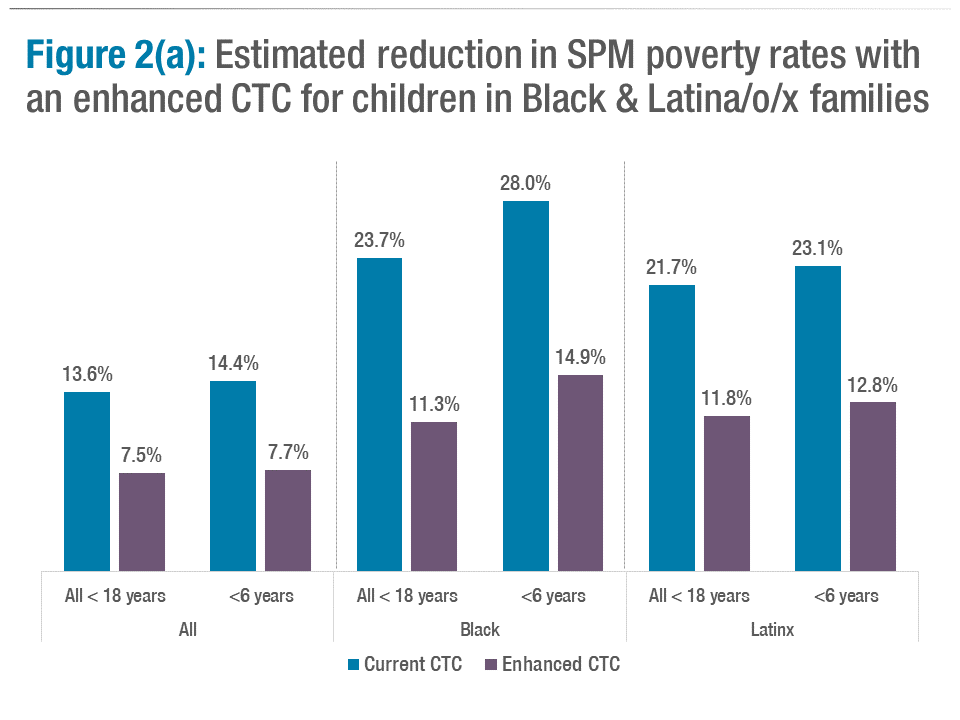
The enhanced CTC would especially help children in families of color and single-parent households. Figure 2, panels (a) and (b) show the reductions in the national pre-pandemic child poverty rate—based on the Supplemental Poverty Measure—that would be achieved under the proposal across a variety of households.[8] Panel (a) shows that for children in Black and Latinx families, the proposal would reduce their poverty rates by 12.4 percent and 9.9 percent, respectively. Poverty in young children would fall by almost 50 percent—from 28 percent to 14.9 percent among Blacks and from 23.1 percent to 12.8 percent among Latina/o/x families.
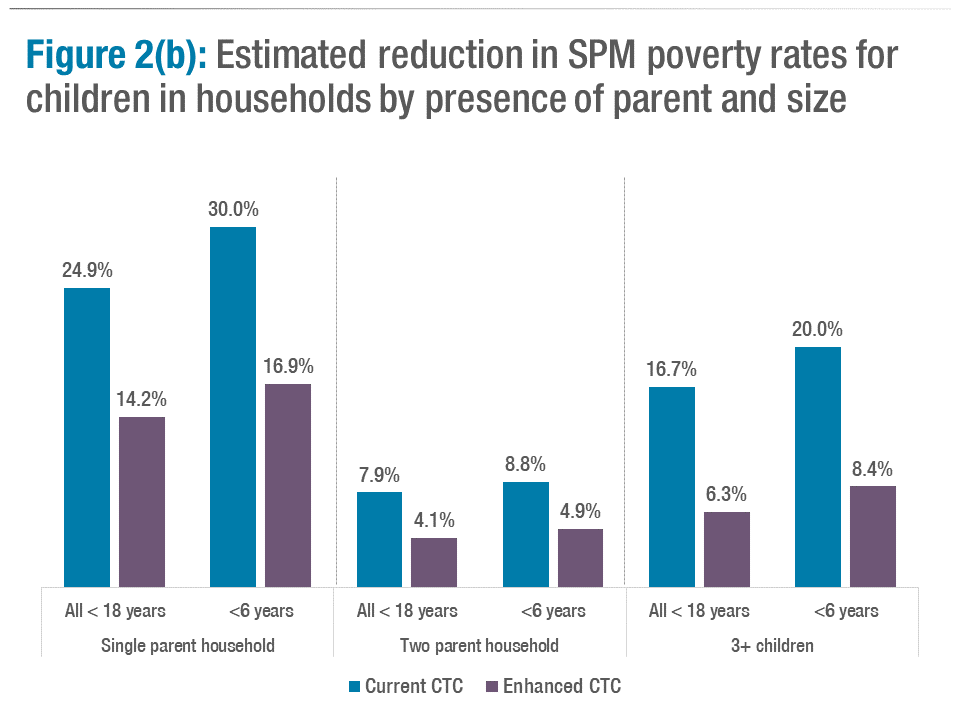
Panel (b) depicts the reduction in poverty among children by parental status and by number of children. Single-parent households, 25 percent of which are in poverty, would see their poverty rate fall by over 10 percent. Young children in these families would benefit even more—their poverty rate would be nearly cut in half, from 30 percent to 16.9 percent. Children in large families would also benefit, as their poverty rate would fall by close to 10 percentage points to 6.3 percent. As in the case for single-parent families, the poverty rates among young children in these large families are higher than the rate for all children (20 percent) and would be reduced by more (11.6 percentage points) under the enhanced and fully refundable CTC.
Conclusion: Investing in the CTC now will improve child outcomes for generations
Child poverty is solvable. Expanding the CTC is one of the most effective ways to do so, and there is no time more urgent than now to act. The reformed CTC under Biden’s American Rescue Plan will not only support children and families through the disastrous financial repercussions of the pandemic, but it will have a significant impact on the economic resilience of low-income families, especially during turbulent economic periods.
The enhanced CTC will also boost the economy through increased spending and improve the long-term socio-economic indicators for children. Finally, the value of increased investment in children from the federal government under the proposed CTC reforms far outweighs the initial expenses. The societal benefits are estimated to be $810 billion—over eight times the cost of the initial $100 billion investment —from increased future earnings, improved health and life expectancy, reduced need for future transfers and expenditures on social safety net programs, and reduced healthcare expenses of parents and children.
It is imperative that Congress reform the CTC by increasing the benefit and making the credit fully refundable. CSS strongly recommends that Congress considering making this reform permanent, as doing so would be a critical tool for addressing structural inequities facing children while investing in their future human capital.
Notes:
[1] Estimate based on the official poverty measure using the American Community Survey 2019 data. Using the Supplemental Poverty Measure, which is broader than the official poverty measure and takes into account the government assistance programs as well as the increases in expenses for shelter, food, utilities, and other miscellaneous expenses, the national child poverty rate was around 18.7 percent in January and is estimated to have increased to 20.4 percent by September of 2020, despite the support provided by the early rounds of stimulus and relief packages. (See: https://static1.squarespace.com/static/5743308460b5e922a25a6dc7/t/5f87c59e4cd0011fabd38973/1602733471158/COVID-Projecting-Poverty-Monthly-CPSP-2020.pdf)
[2]There is a large body of literature spanning multiple disciplines documenting the effect of childhood poverty on long-term adult outcomes. It argues that providing financial assistance to low-income families that would alleviate poverty would also improve the long-term outcomes of the children by (a) allowing parents to access and invest adequate resources and (b) by promoting a more positive, less stressful environment, suitable for better cognitive and socio-emotional development.
[3] To qualify, the child must be related to the filer and live with them for at least six months during the year. The credit begins to phase out at $400,000 for joint filers, and at $200,000 for single or head-of-household filers.
[4] While some low-income families do receive the Additional Child Tax Credit, refundable up to $1,400, these families also need earned incomes of at least $2,500 to qualify and receive the credit.
[5] IRS Tax Statistics SOI Tax Stats - Individual Statistical Tables by Size of Adjusted Gross Income (See: https://www.irs.gov/statistics/soi-tax-stats-individual-statistical-tables-by-size-of-adjusted-gross-income).
[6] New York’s 15th Congressional District (CD) has one of the highest poverty rates in the country (34.4 percent) with a child poverty rate of 45.5 percent. Since the Child Tax Credit is designed to primarily reach families that have high enough earnings, it should be of no surprise that in its current form the credit leaves out more than two-thirds of the children in CD 15.
[7] The poverty rate referred to here is based on the Supplemental Poverty Measure—a broader metric than the official poverty measure which is capable of evaluating the impacts of taxes, transfers and other social safety net programs. (See: https://www.nap.edu/catalog/25246/a-roadmap-to-reducing-child-poverty)
[8] The height of the bars in Figure 2, panels (a) and (b) correspond to the share of the sub-population that is estimated to have resources less than the SPM threshold. (See: https://static1.squarespace.com/static/5743308460b5e922a25a6dc7/t/600f2123fdfa730101a4426a/1611604260458/Poverty-Reduction-Analysis-American-Family-Act-CPSP-2020.pdf)