Testimony: Amending the New York City Salary Range Law
Debipriya Chatterjee
NYC Council Hearing of the Committee on Civil and Human Rights
Thank you, Chair Williams, and committee members, for the opportunity to testify today. My name is Debipriya Chatterjee, and I am a Senior Economist at the Community Service Society of New York (CSS), a nonprofit organization that works to promote economic opportunity for New Yorkers. We use research, advocacy, and direct services to champion a more equitable city and state, including addressing racial and gender-based inequities in compensation.
We have championed workers’ rights and poverty alleviation, for 175 years. Most recently, we worked to pass paid sick leave laws statewide and in New York City, secured half-price transit fares for New Yorkers in poverty and made rent-relief available through the Emergency Rental Assistance Program, or ERAP. We also advocated, alongside our partners, for the passage of the package of bills that strengthened financial stability and improved workplace protections for food delivery workers.
My testimony today will focus on Int. 0134-2022—a bill that purports to amend Local Law 32, the Salary Range Transparency law that was passed last year. Int. 0134-2022 would effectively render the legislation toothless and thus undo years of work by policymakers and advocates towards achieving pay parity along racial, ethnic and gender lines.
Before we delve into the issues with Intro. 0134, let us remind ourselves of the broader context in which this discussion is situated. Gender and racial pay gap continues to persist—women in New York still make 86 cents on the dollar relative to men, women of color make even less—making their path to economic security even harder. Even before the pandemic, in 2019, the median Latina/x woman in New York City earned $28,284, almost a third of the wages earned by a median white male ($75,760).[1] The pandemic and the recession have worsened these inequities as women have borne the brunt of job and income losses and hardship. CSS’s annual survey of low-income New Yorkers, The Unheard Third, shows that even among those women who continued working since the onset of the pandemic, a third reported that their households experienced loss in employment income.
In this context of ever-present and ever-widening gaps, the passage of the City’s salary range transparency law symbolized a transformative step in the right direction. A rich body of multi-disciplinary literature backs up the claim that establishing clear and transparent compensation guidelines that reduce room for discretion overwhelmingly help women as well as all employees from other marginalized groups (Black, Latino/a/x, LGBTQIA+, immigrants, non-native English language speakers etc.). Ensuring that remuneration falls within a pre-announced interval significantly reduces the major deleterious effects of implicit bias in hiring. This is not an alien concept—most corporations, non-profits, and most importantly, the City of New York almost always provide salary range information. Studies have also shown that greater transparency in salary ranges reduces pay inequities- typically by empowering women, especially women of color, to negotiate better wages.
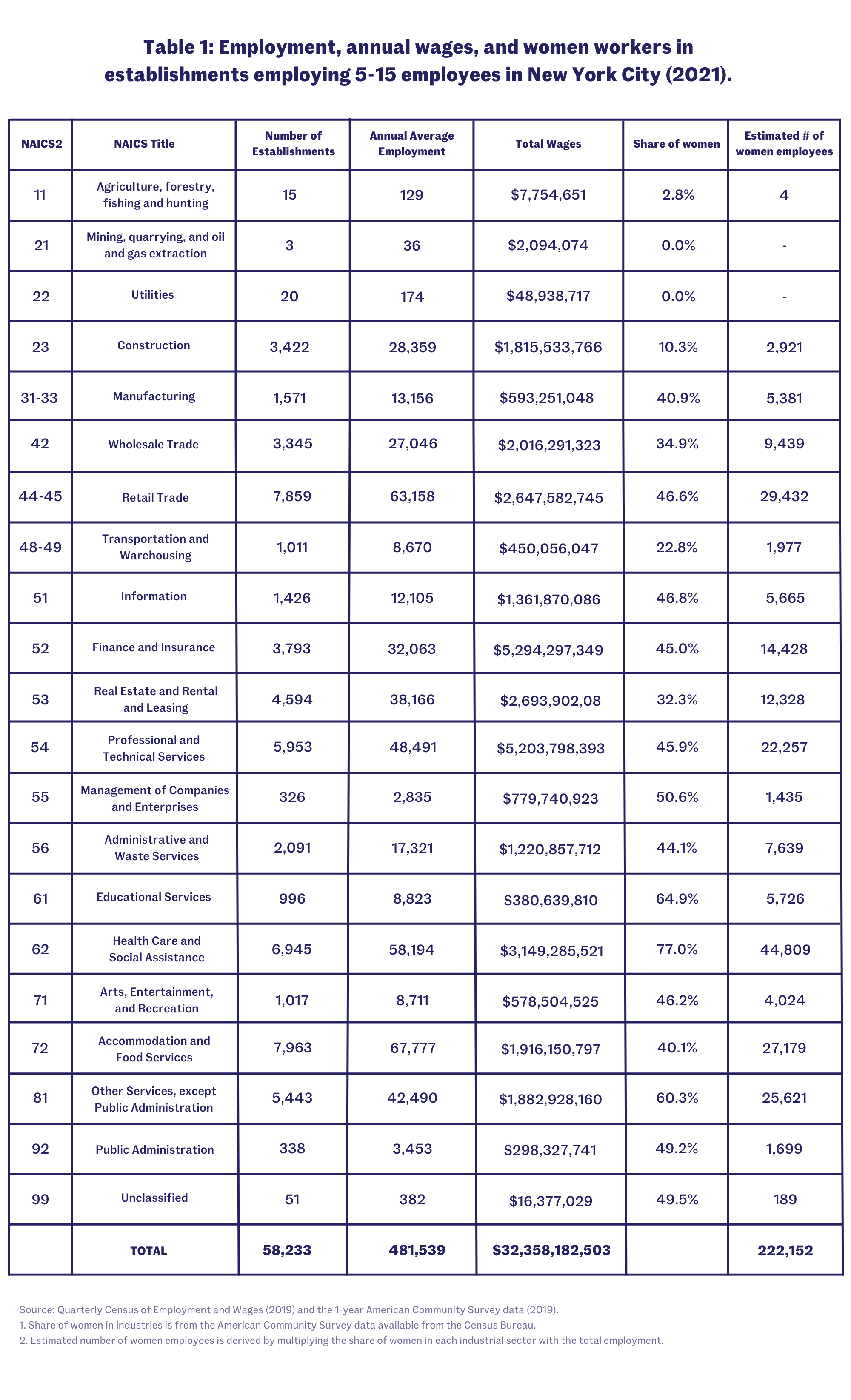
Intr. 0134 seeks to exclude employers with 5 to 15 employees from declaring the salary range when they post jobs. In the name of helping struggling businesses, the current bill is impeding progress towards pay parity. There are about 58,000 of these businesses, per data from the New York State’s Department of Labor. Table 1 provides a detailed decomposition of these businesses across industrial sectors. These businesses employ around half a million workers and have an average annual payroll of $550,000. Although a majority (45 percent) of these businesses are in Manhattan, both Queens and Brooklyn have approximately 12,000 and 14,000 establishments that would now be exempt.[2] By excluding these businesses, the city would imperil over 222,000 women workers, who would, once again have to apply for jobs without any idea about salary. This bill takes us several steps back from leveling the playing field for women and other marginalized workers.
Opponents of the salary range transparency law say that requiring businesses to post ranges and thereby tie themselves to a defined range would be anti-competitive and might hurt employers’ changes of attracting talent. However, the bill requires employers to post only salary ranges, leaving enough room for adding perks, stock options, and bonuses to attract suitable employees. Additionally, an employer can simply provide a wide enough range of salary and, as is typical of most job postings, add a caveat that says ‘exact compensation would be commensurate with experience and qualifications’ to ensure that they are able to provide an overall remuneration package that is appropriate given the candidates’ profile.
Small business owners are suggesting that in the current ‘tight’ labor market, it would be harder to attract talented employees if a rigid salary range is declared in the job posting, even though most of them typically already advertise salary ranges in their job postings. These apprehensions are unfounded for two reasons: First, most employees seek out information regarding compensation before accepting an offer, and thus all employers run the risk of losing their preferred hire if the initial offer is low enough. Second, a tight labor market is when workers have true bargaining power and even if the salary ranges are not declared in the job posting, workers will almost surely negotiate to improve their pay rates. The law only makes it easier for historically disadvantaged and marginalized people to find a stronger footing on which to base their negotiations.
Critics of the law say it would make it harder for multinational corporations to hire and operate in New York, especially since a large share of the workforce is now working remotely. But the truth is that corporations have long offered compensation packages tethered to location of work and have adhered to local labor laws, including paid family leave law in the state of New York. The law is also quite clear on the provision that it only applies to job postings intended for employees who would be based in New York.
It is more important than ever to address pay parity, as the city embarks on a trajectory of economic recovery. And a tight labor market, is precisely when workers can hope to make gains and thus, we recommend that the Committee and the City Council, therefore, reject Int. 0134 and allow NYC to be a pioneer in addressing gender wage gap.
Thank you and please feel free to reach out to me at dchatterjee@cssny.org for more information or if you have questions.
Notes
1. Source: American Community Survey Public Use Microdata Sample, 2015-2019.
2. Source: County Business Patterns, 2019 data, available from the Census Bureau. The County Business Patterns data provides data on establishments employing- less than 5, 5 to 9, 10 to 19, 20-49, 50-99 and so on.