Housing is Health Care: Tenants’ Struggle for Affordability Amidst Recession and Pandemic
Samuel SteinTheo HamVictor Bach
COVID-19 has made painfully clear the wisdom in the slogan “Housing is health care,” which has been chanted at rallies and imparted in testimonies for decades. From the beginning of this pandemic, public health experts’ primary advice has been to stay at home as much as possible to limit viral exposure and slow the spread of this deadly disease. In so doing, they have reinforced the importance of housing as a matter of individual and collective health and wellbeing, and the dire consequences of a housing system that leaves tens of thousands homeless, thousands more overcrowded, and a majority paying too much of their income toward their shelter. In April 2020, Community Service Society housing analyst Tom Waters, before his tragic death from COVID-19, reminded us in his final research report with Oksana Mironova: “COVID-19 is the latest stressor that exposes a rolling, structural crisis in our housing provision system.”
The economic havoc wreaked by the pandemic and the measures necessary to contain it have hit renters hard and low-income renters the hardest. With unemployment still at record levels, tenants—who make up two-thirds of New York City residents1—are struggling to keep up with paying rents. In many cases, they are making deep sacrifices just to avoid debt and the threat of eviction. Meanwhile, homelessness has hit record highs, reaching 63,839 persons in the Department of Homeless Services shelter system and as many as 79,000 overall in 2019.2
This post marks CSS’ third post in A Roadmap to an Inclusive Recovery: Assessing COVID-19’s Impact on Low-Income New Yorkers, our special series highlighting key findings from our 2020 Unheard Third survey3 on the inequitable impact of COVID-19 in New York City. As the only regular public opinion poll of low-income households in the United States, The Unheard Third is an annual survey that tracks the hardships of New York City's low-income residents and their views on what policies would help them get ahead.
Low-Income Renters Were Hit Hardest by Job and Income Loss
While job and income loss have been widespread throughout New York, those with the lowest incomes and least assets were most deeply affected. As discussed in a previous blog post, New Yorkers of color were hit harder by pandemic-related job loss than white New Yorkers.4 Low-income residents were much more likely to lose their jobs: a startling 57 percent of low-income residents reported that at least one member of their household had been furloughed, temporarily laid off, or lost their job permanently during the pandemic, compared with 36 percent of moderate- and high-income residents.
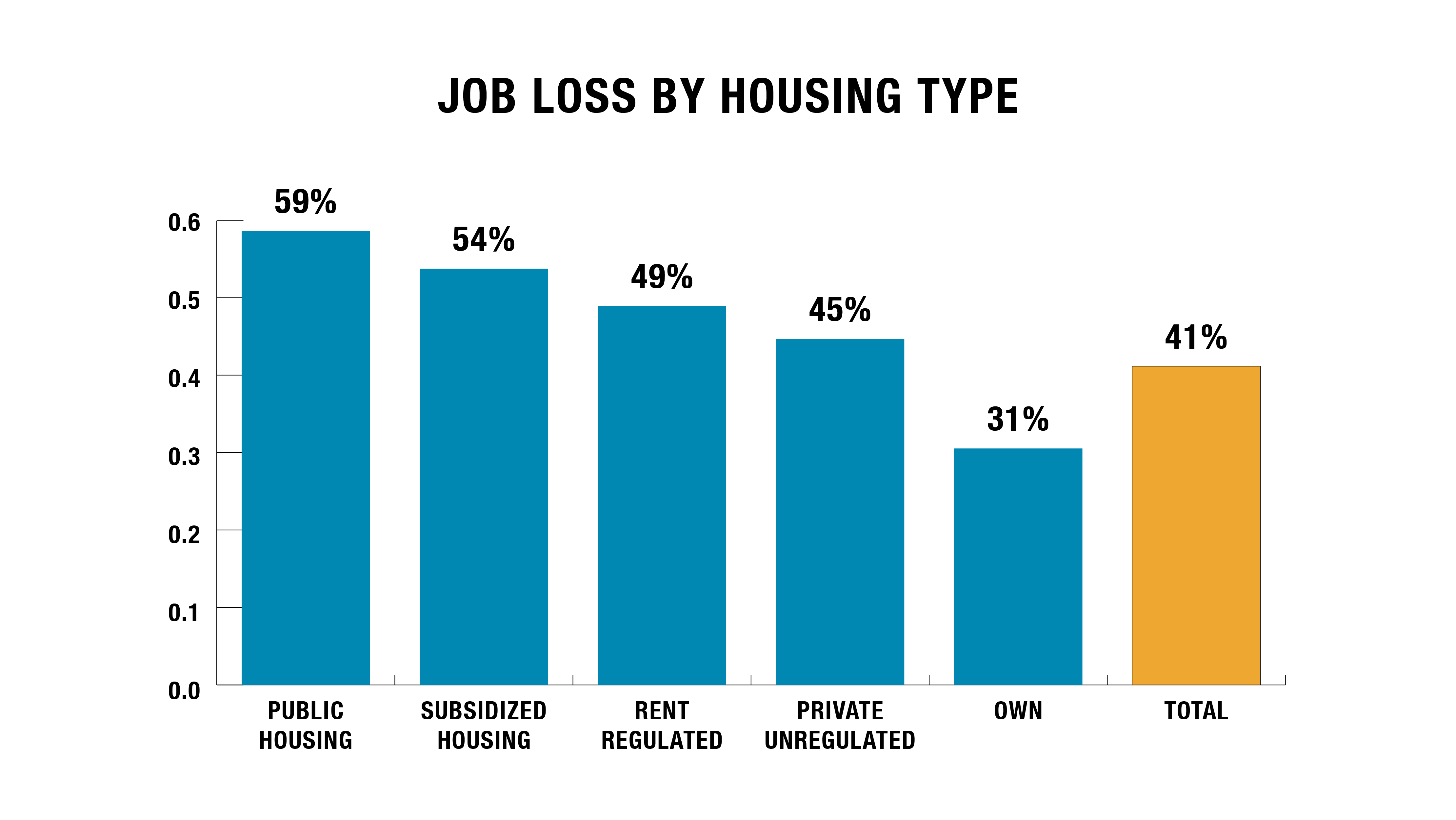
Considering low-income New Yorkers disproportionately rent (81 percent),5 job loss is also a tenant issue. Job loss disproportionately affected those in income-based affordable housing: a majority of public housing residents (59 percent) and subsidized housing residents (54 percent) faced job loss compared to 45 percent of tenants in private, unregulated housing and 31 percent of owners. Another tenant issue is income loss: 43 percent of renters had their hours or earnings reduced, compared to 25 percent of owners.
Lost Income Means Tenants Cannot Afford Rents
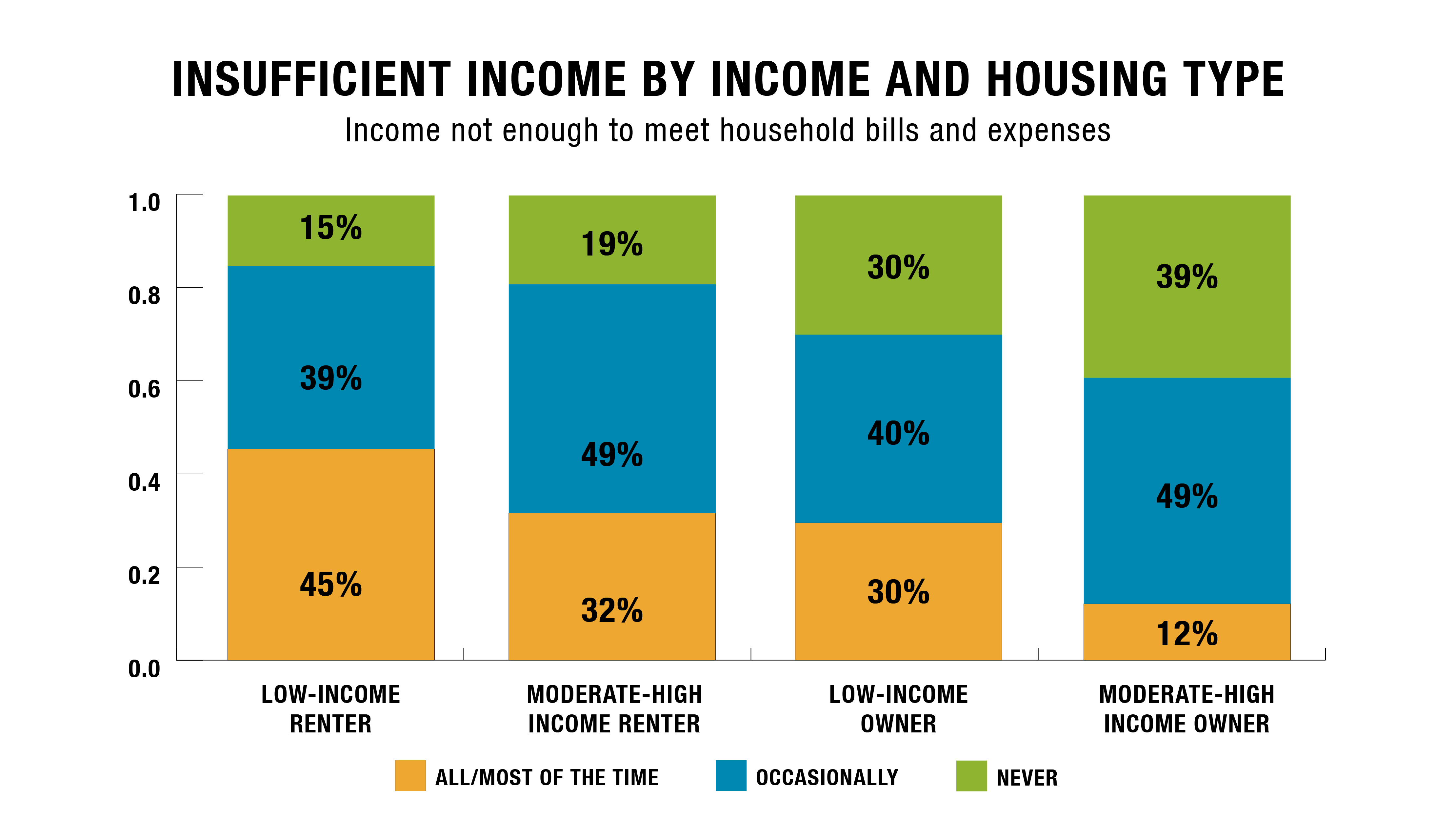
These job and income losses translate to a struggle paying for necessities. Nearly half of low-income renters spend all or most of their time worrying about not meeting their household expenses and bills, compared to 32 percent of higher-income renters, 30 percent of low-income owners, and just 12 percent of moderate- and high-income owners.
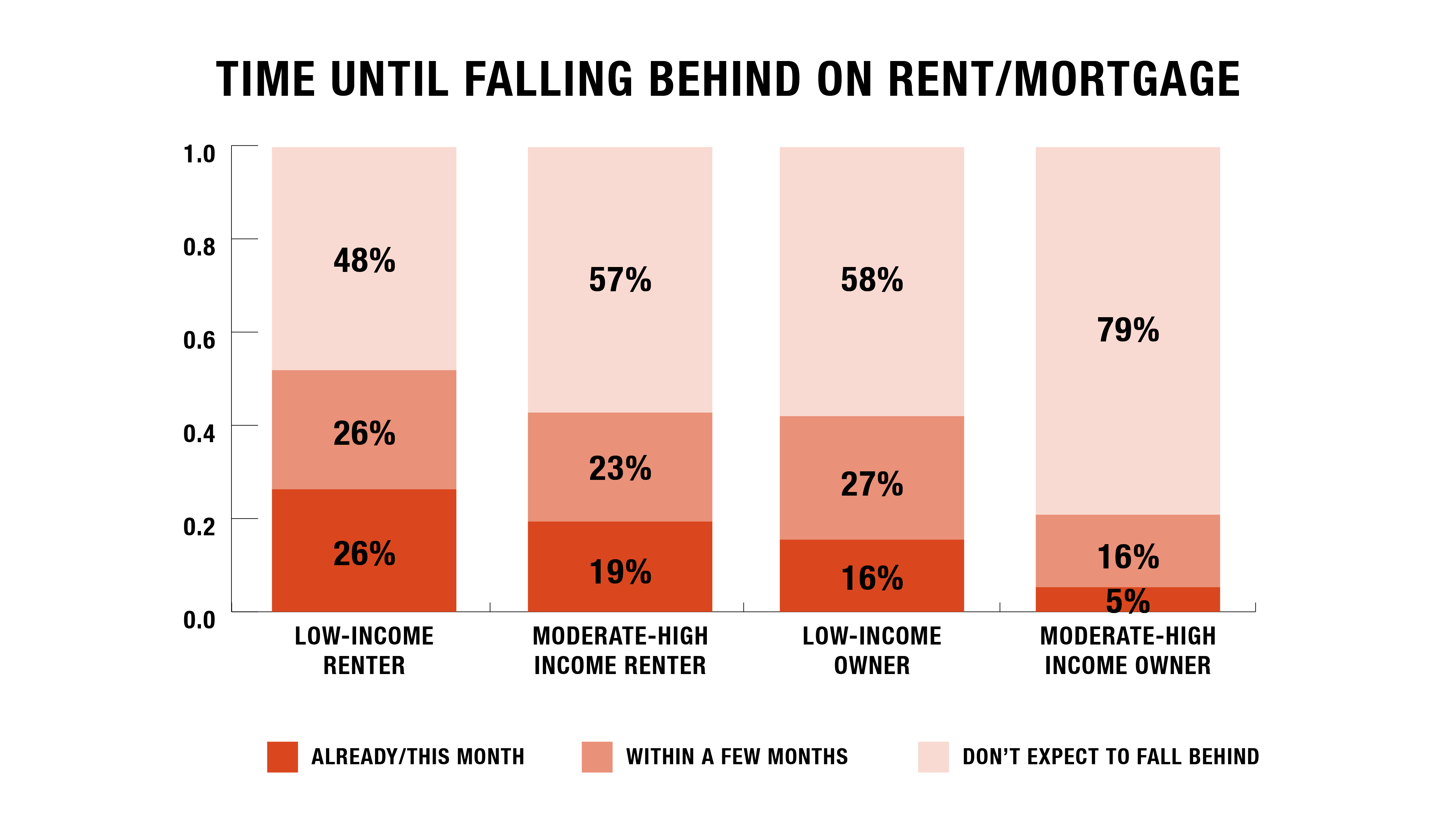
During the pandemic, as low-income renters were disproportionately impacted by job loss, they also faced the most residential vulnerability. As incomes dropped, rent arrears rose. In July and August, 16 percent of tenants reported that they had already fallen behind on rent, and an additional 31 percent expected to fall behind in short order. These results correlated strongly with tenure and income: a majority (52 percent) of low-income renters missed payments or expected to soon, compared to 21 percent of moderate- and high-income homeowners. Among renters in general and, among low-income renters in particular, Latinx New Yorkers faced rent shortfalls at elevated rates. Distressed tenants who are still paying their rent may be foregoing other necessities, such as food and medicine, or going deeper into debt to prevent displacement.
Rent Relief Has Been Hard to Secure
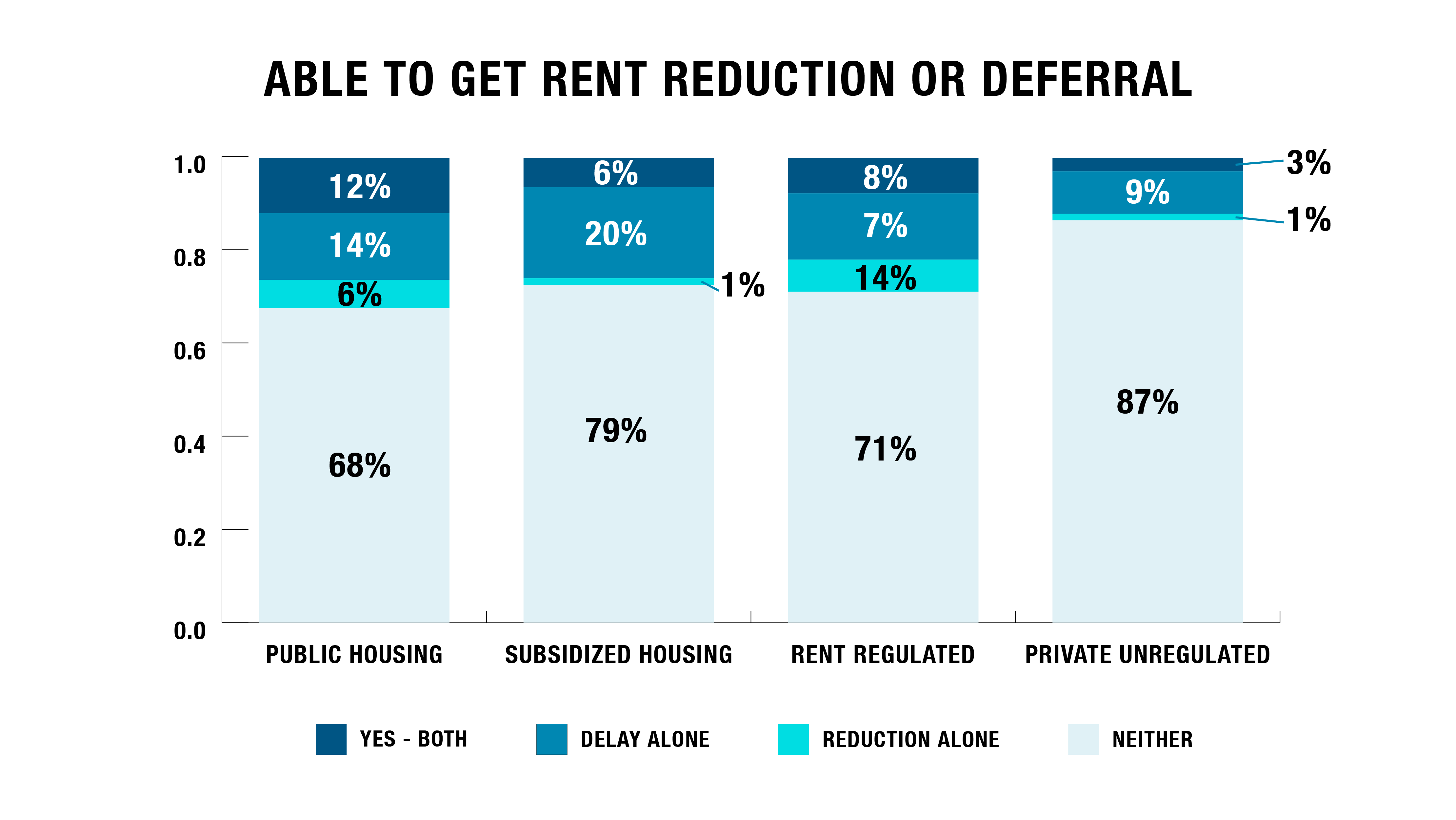
Despite facing high rates of unemployment and difficulty paying rent, low-income tenants have been offered few opportunities for relief. As discussed in our last blog post, low-income New Yorkers and New Yorkers of color were less likely to receive pandemic-related stimulus checks or unemployment benefits. Across housing types, a majority of low-income renters (74 percent) were unable to secure either rent reductions from their landlords or allowances for rent delays. Of those who did, low-income tenants in private unregulated housing saw the least success, with just 13 percent getting any form of relief from their landlords.
This finding likely reflects the dearth of protections for tenants in unregulated units. In all housing types,6 rent delays were far more common than rent reductions, suggesting a mounting rent debt crisis even for those who were able to secure a modicum of relief.
Meanwhile, state action on rent relief has been both limited in scope and difficult to access. The primary rent relief program was only designed to bring selected tenants’ rent burdens back down to pre-pandemic levels. Even within those limited parameters, relief was only offered to 16 percent of applicants, leaving $60 million in federal housing aid unspent as of December. That program’s application deadline was recently extended with loosened eligibility requirements, but its fundamental terms have not been meaningfully improved.
A new round of federal stimulus appears imminent, but its benefits are limited in terms of size and duration, with diminished unemployment benefits extended for less than three months and CDC eviction guidelines extended by one month. The proposed $25 billion in federal rental relief is welcome, but only adds urgency to calls at the state level for equitable and accessible programs to help tenants and homeless New Yorkers.
New York City and State must take stronger action to protect tenants during these difficult days, and the federal government must provide more resources immediately and moving forward. New York State should pass a comprehensive eviction moratorium to ensure that tenants who have lost work are not pushed into homelessness, which would not only destabilize individual lives but expand the public health emergency dramatically. The State should also institute programs that would permanently, safely, and affordably house the homeless and help prevent evictions (such as the Housing Access Voucher Program), and should consider new approaches to acquisition and social housing conversions considering the likelihood of economic distress and foreclosure in multi-family buildings.
If housing is indeed health care, then a major part of our response to this pandemic must be to take on the housing crisis, one of our city’s most serious preexisting conditions.
1. ACS 2019 5-year
2. Stewart, Nikita, Jefferey C. Mays, and Matthew Haag. “Facing Homeless Crisis, New York Aims for 1,000 Apartments a Year.” New York Times, December 12, 2019.
3. The 2020 Unheard Third survey was designed in collaboration with Lake Research Partners, who administered the survey by phone using professional interviewers. It was conducted from July 7 through August 4, 2020, and reached a total of 1,632 New York City residents, ages 18 or older. The sample included 1,002 low-income residents (up to 200 percent of federal poverty standards, or FPL), and 630 moderate- and higher-income residents (above 200 percent FPL). The data were weighted slightly by income level, gender, region, age, party identification, education, immigrant status, and race to ensure that it accurately reflects the demographic configuration of these populations. Interviews were conducted in English (1,475), Spanish (90), and Chinese (67). The margin of error for the entire survey is +/- 2.42 percent, for the low-income component is +/- 3.09 percent, and for the higher income component is +/- 3.9 percent, all at the 95 percent confidence interval.
4. “Job Loss” refers to respondent who reported that they or someone in their household was furloughed, temporarily laid off or suffered permanent job loss.
5. IPUMS USA, University of Minnesota, www.ipums.org. Calculated using ACS 2019 1-year.
6. “Subsidized Housing” refers to housing built under Mitchell-Lama, Section 8, LIHTC, and other forms of privately-owned government-assisted housing.