The Missing Recovery: Government Relief Out of Reach for New Yorkers Who Need it the Most
Irene Lew
Emergency relief, such as the one-time stimulus payments and expanded unemployment benefits authorized through the federal CARES Act in late March 2020, were meant to help ease the economic pain of millions of Americans who have lost their jobs or faced pay cuts due to the COVID-19 pandemic. But the federal government’s outdated financial infrastructure for distributing the stimulus payments, combined with the high demand for unemployment benefits that has overwhelmed NY state systems, has made it difficult for many to receive this aid on a timely basis, if at all. At the beginning of the pandemic in mid-March, the New York state unemployment website crashed in response to the surge in jobless New Yorkers applying for unemployment benefits; and state Department of Labor staff struggled to handle the deluge of calls to the state unemployment hotline.
As of early November 2020, more than two million New York City residents—25 percent of the city’s population—have filed for unemployment since the start of the pandemic in mid-March.1 Yet, with technological and administrative blunders at both the federal and state levels, it remains unclear how many low-income New Yorkers and other residents hit hardest by COVID-19-related wage and job loss have received either federal stimulus payments or unemployment insurance benefits. This post marks CSS’ second post in A Roadmap to an Inclusive Recovery: Assessing COVID-19’s Impact on Low-Income New Yorkers, our special series highlighting key findings from our 2020 Unheard Third survey2 on the inequitable impact of COVID-19 in New York City. As the only regular public opinion poll of low-income households in the US, the Unheard Third is an annual survey that tracks the hardships of New York City's low-income residents and their views on what policies would help them get ahead.
Low-income New Yorkers and New Yorkers of color were less likely to receive government relief
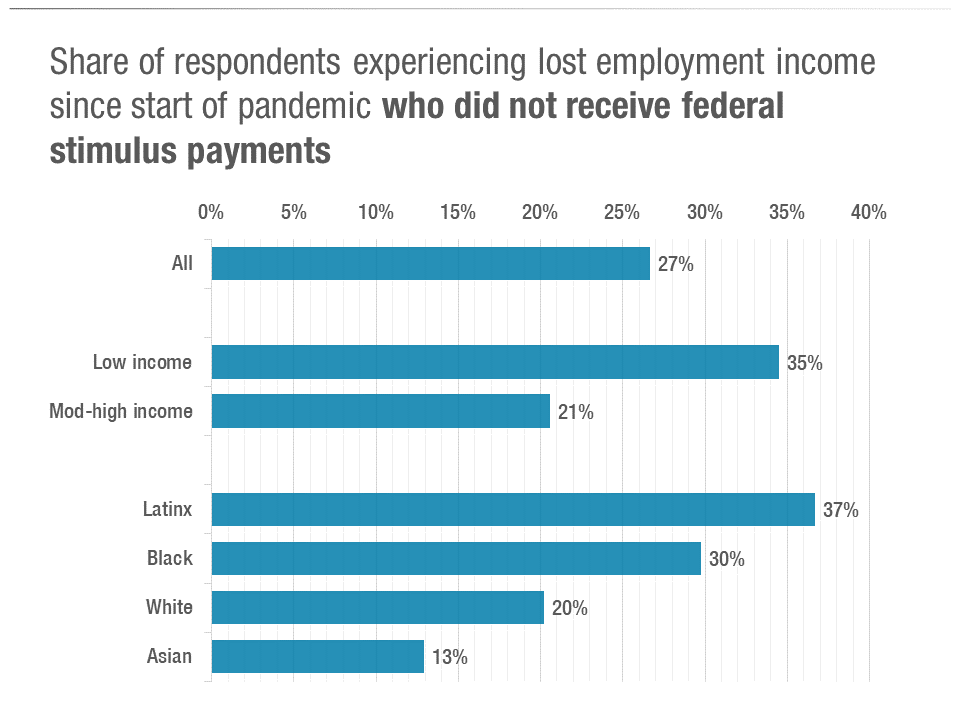
While a little over 70 percent of New Yorkers who lost employment income3 since the start of the pandemic said that they had received federal stimulus payments, 27 percent did not, and low-income New Yorkers were even less likely to receive these stimulus payments. Disturbingly, 35 percent of low-income New Yorkers did not receive financial relief, compared to 21 percent of those with moderate to higher incomes. Latinx and Black residents were the least likely to receive federal stimulus payments—37 percent of Latinx and 30 percent of Black New Yorkers did not get this relief, in contrast to only 20 percent of white residents. These findings are in line with recent research that found these disparities were likely due to not having a recent tax return on file, lack of internet access,4 and being unbanked. It is crucial to note that many people living below the federal poverty line are not required to file tax returns, and the unbanked population likely could not receive the stimulus because it was sent via direct deposit to a bank account. These factors made it more difficult, if not impossible for low-income New Yorkers to receive the stimulus. Other New Yorkers may also have been ineligible because they or their spouse were undocumented.5
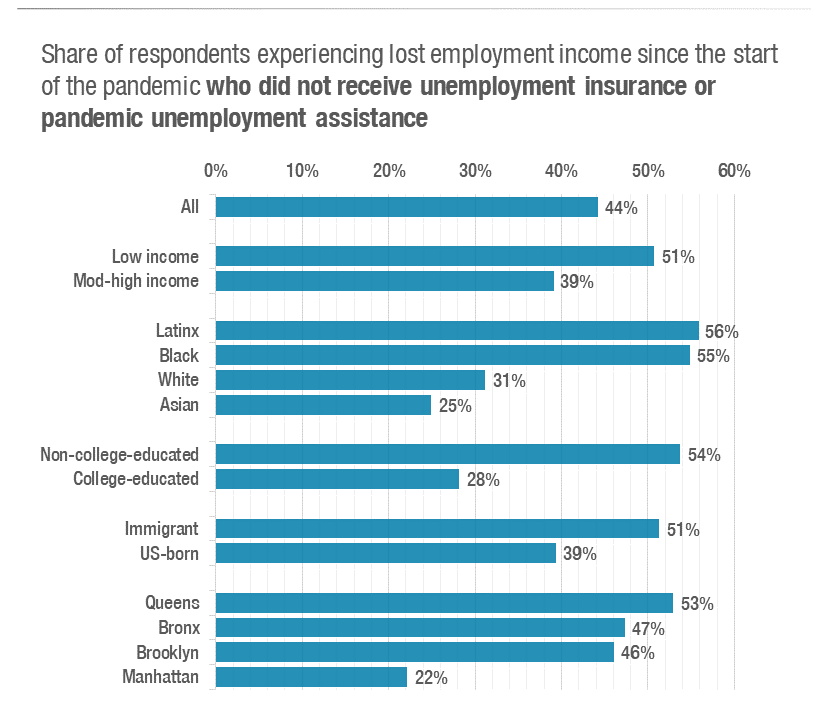
Despite an expansion of unemployment benefits through the federal CARES Act, including an additional $600 in supplementary aid and Pandemic Unemployment Assistance (PUA) for gig and other self-employed workers, our Unheard Third survey shows that this relief was not reaching the New Yorkers most impacted by job loss. Although wage and job loss were more prevalent among low-income New Yorkers, over half didn’t receive unemployment benefits or PUA, compared to 39 percent of those with moderate to higher incomes. Latinx and Black New Yorkers were among the communities of color hardest hit by COVID-19-related loss of income, but they were far less likely to receive unemployment insurance or PUA: 56 percent of Latinx and 55 percent of Black residents did not receive this aid, in contrast to about a third of white residents. Nationwide, Black and Latinx workers had their unemployment claims rejected at disproportionately higher numbers compared to white workers. Less-educated New Yorkers who lost employment income also struggled to access unemployment benefits. More than half of New Yorkers without a four-year degree failed to receive unemployment insurance or PUA, compared to only 28 percent of those with a college education. Immigrants and outer-borough residents who lost employment income were also far less likely to receive unemployment benefits.
Low-income New Yorkers who lost employment income since the pandemic—either personally or in their household—are twice as likely to experience multiple hardships
Many low-income New Yorkers were already living paycheck to paycheck even before the pandemic hit. Faced with the absence of a financial buffer for emergencies and challenges with accessing government relief, low-income New Yorkers who lost their paychecks have been forced to make difficult sacrifices, often having to cut back on groceries, forgo medical care, and miss housing payments. Sixty-seven percent of low-income residents who lost household employment income said that they have experienced three or more hardships since the start of the pandemic -- more than double the share of those who were spared from wage and job loss. Low-income New Yorkers affected by COVID-related wage and job loss in their household were twice as likely as those who didn’t lose income to experience housing instability, such as falling behind on their rent or mortgage, doubling up with others, having their utilities shut off due to nonpayment, or being threatened with eviction or foreclosure. Low-income New Yorkers with COVID-19-related income and job loss were also two times more likely to face hardship related to loss of health coverage and affording the cost of necessary health care and prescriptions.
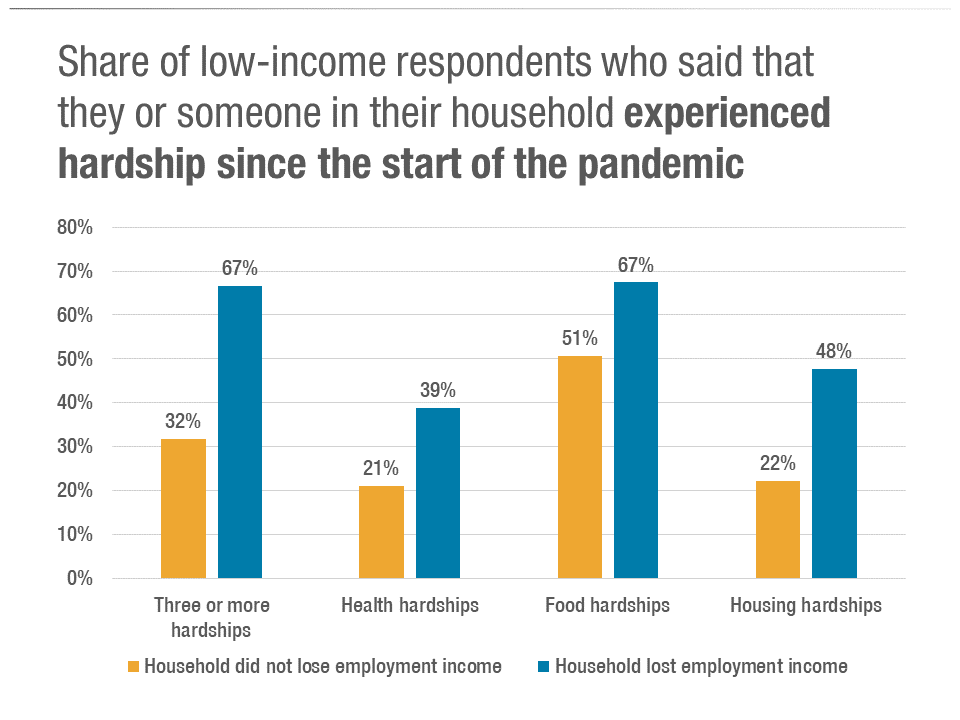
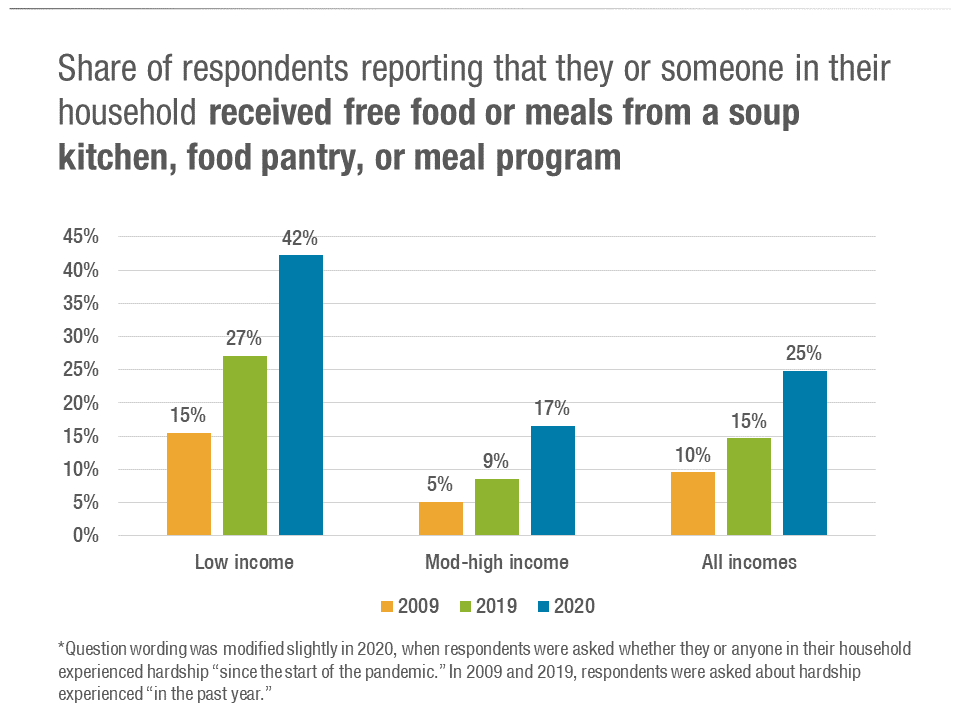
Food insecurity was the most common type of hardship among low-income New Yorkers who lost employment income in their household, with 67 percent reporting that they received free food or meals from a food pantry, family or friends, went hungry, or often skipped meals. Food insufficiency has spiked across incomes since the Great Recession: 42 percent of low-income New Yorkers and 17 percent of those with moderate to higher incomes said that they used a food pantry, soup kitchen, or meal program since the start of the pandemic, triple the rates in 2009.
Government relief has failed to reach New Yorkers who have been hardest hit by COVID-19-related wage and job loss – especially Latinx and Black communities. Such inequitable distribution of relief has led to increased hardship for many low-income New Yorkers. Food and housing insecurity will only continue to grow if a compromise cannot be reached immediately on a new federal relief package that reaches those most in need. At the local level, we must continue to prioritize the expansion of programs such as Fair Fares and Right to Counsel that will help cushion the blow of the pandemic. At the state level, we must pass a genuine eviction moratorium that keeps people in their homes. The disparities in access to unemployment benefits among immigrant New Yorkers also illustrate the need to create a separate state-funded unemployment or wage replacement program to provide weekly payments to undocumented workers who don’t qualify for regular unemployment benefits.6 New York State should also modernize its unemployment insurance technology to make the system more user-friendly for low-wage workers and workers of color.
1. The 25 percent figure is based on CSS’s analysis of the 1-year 2019 American Community Survey data.
2. The 2020 Unheard Third survey was designed in collaboration with Lake Research Partners, who administered the survey by phone using professional interviewers. It was conducted from July 7 through August 4, 2020, and reached a total of 1,632 New York City residents, ages 18 or older. The sample included 1,002 low-income residents (up to 200% of federal poverty standards, or FPL), and 630 moderate- and higher-income residents (above 200% FPL). The data were weighted slightly by income level, gender, region, age, party identification, education, immigrant status, and race in order to ensure that it accurately reflects the demographic configuration of these populations. Interviews were conducted in English (1,475), Spanish (90), and Chinese (67). The margin of error for the entire survey is +/- 2.42%, for the low-income component is +/- 3.09%, and for the higher income component is +/- 3.9%, all at the 95% confidence interval.
3. Loss of employment income refers to respondents who reported that they were furloughed, temporarily laid off, or suffered permanent job loss.
4. People who have not filed taxes during the past two years could enter their information into an online portal provided by the IRS. But one in five low-income people who did not receive a check reported that they did not have internet access at home.
5. An estimated 360,000 undocumented workers live in New York City.
6. California created a $125 million emergency relief fund to support undocumented adults impacted by the pandemic but this assistance has already run out. More information here.