To Fight Homelessness, House the People (Part 2): A deeper dive into the costs, benefits and savings of CityFHEPS reform and expansion
Debipriya ChatterjeeSamuel SteinOksana MironovaJennifer Hinojosa
Key Findings
- There are about 483,500 low-income, severely rent-burdened households in New York City. We estimate that under current conditions approximately 39,000 of these households per year will face eviction. Of those, at least 8,000 households are likely to enter the shelter system.
- Over the next five years, expanding CityFHEPS to housing-insecure households facing eviction will cost the city $8.6 billion, while saving the city $5.6 billion in avoided shelter and rehousing costs. The net cost would be $3 billion cumulatively over five years.
- By avoiding housing instability, thousands of households will reap extensive social benefits, including higher wages, lower healthcare costs, and higher educational and workforce prospects for children.
- Reforming CityFHEPS will not make it harder for people experiencing homelessness to find housing. It will, in fact, expand the universe of housing available to them.
Introduction
On May 25, 2023, the New York City Council voted to approve a package of bills that dramatically improves the city’s voucher program, CityFHEPS. The bills will expand housing options for people experiencing homelessness and keep more tenants housed. They include:
- Intro 878 (Councilmember Diana Ayala) ends the “90-day rule,” which forces people to go into the shelter system and stay there for three months before becoming eligible for rental assistance. City Council staff estimates that this alone would save the city $402 million annually.
- On June 16th, the mayor signed an executive order ending this onerous burden.
- On June 16th, the mayor signed an executive order ending this onerous burden.
- Intro 893 (Councilmember Pierina Sanchez) expands CityFHEPS eligibility, making it accessible to a broader range of income-eligible households facing eviction.
- Intro 894 (Councilmember Pierina Sanchez) ends punitive work requirements and codifies income-eligibility at 50 percent of Area Median Income (AMI), making the voucher available to a broader share of low-income New Yorkers.
- Intro 229 (Councilmember Tiffany Cabán) revises the “utility allowance” rule, which reduces rental support for voucher holders whose landlords do not include utility costs in their rent.
Even though these four bills will have a transformative impact on the lives of thousands of low-income New Yorkers, they have received pushback. The primary challenge to the City Council’s expansion of CityFHEPS have been:
- It will cost the public too much money over time.
- It will imperil current voucher holders’ chances at accessing housing.
In its current form, CityFHEPS already costs the city a significant amount of money every year—from providing individuals and families experiencing homelessness with shelter to supporting their transition to permanent housing and subsidizing the resulting rents. Program expansion costs will be offset by savings from reduced shelter costs, resulting from shortened shelter stays and prevented evictions. There will also be long-term savings from keeping people housed in less expensive apartments than market units they may move into after spending months or years in shelter. By expanding housing access and keeping tens of thousands of people in their homes, the CityFHEPS reform and expansion package marks a significant step toward addressing the city’s housing and homelessness crisis.
The Costs and Benefits of Expanding CityFHEPS[1]
The City Council’s expansion of CityFHEPS will benefit two groups of people:
- households facing eviction, and
- households in shelter seeking to move to permanent housing.
To calculate the impact of the program’s expansion we consider the costs of housing both groups.
First, we have to define the pool of New Yorkers most vulnerable to entering the shelter system. Households with incomes below 50 percent AMI who are currently severely rent-burdened (paying more than 50 percent of their household income on rent) are at the highest risk for homelessness. Table 1 shows that in 2021, there were over 483,500 such households in the city, including around 871,000 individuals and 340,000 children.
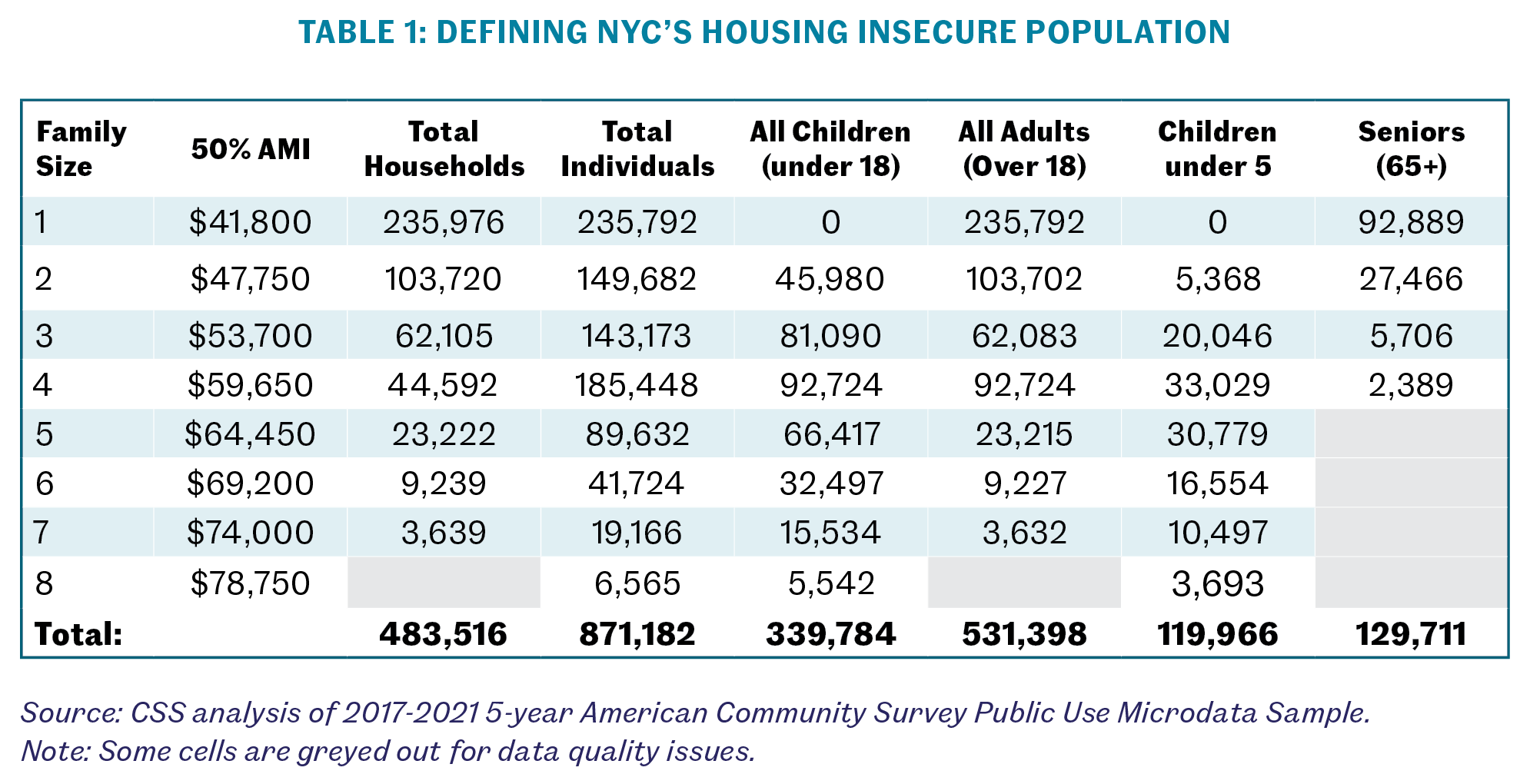
CityFHEPS expansion savings: Next, we calculate the cost of sheltering the share of housing-insecure households that are likely to be evicted and enter the shelter system. It is important to note that our calculation depends on assumptions, resulting from a scarcity of hard data. We assume an 8 percent eviction rate among our defined population, 483,516 households, in any given year, including Marshal-executed evictions and self-evictions following a rental demand.[2] Approximately 20 percent of those evicted would enter the shelter system.[3] Finally, we ground our calculation in an average shelter stay of 500 days for individuals and 700 days for families. By expanding CityFHEPS to income-eligible households in danger of entering shelters, the city would keep about 8,000 households from facing homelessness, saving an estimated $772 million in FY2024 and a total of $4 billion over 5 years.
CityFHEPS expansion costs: Next, we consider the cost of providing CityFHEPS vouchers to housing-insecure households who are on the brink of eviction in a given fiscal year. To estimate the cost of providing vouchers, we first calculate the rental assistance that each household needs. Per CityFHEPS’ rules, households with vouchers are required to contribute 30 percent of their income towards rent. For the housing insecure sub-population, the mean rental assistance amount is estimated at $15,520 per year and the median rental assistance is estimated at $13,660 in FY 2024.
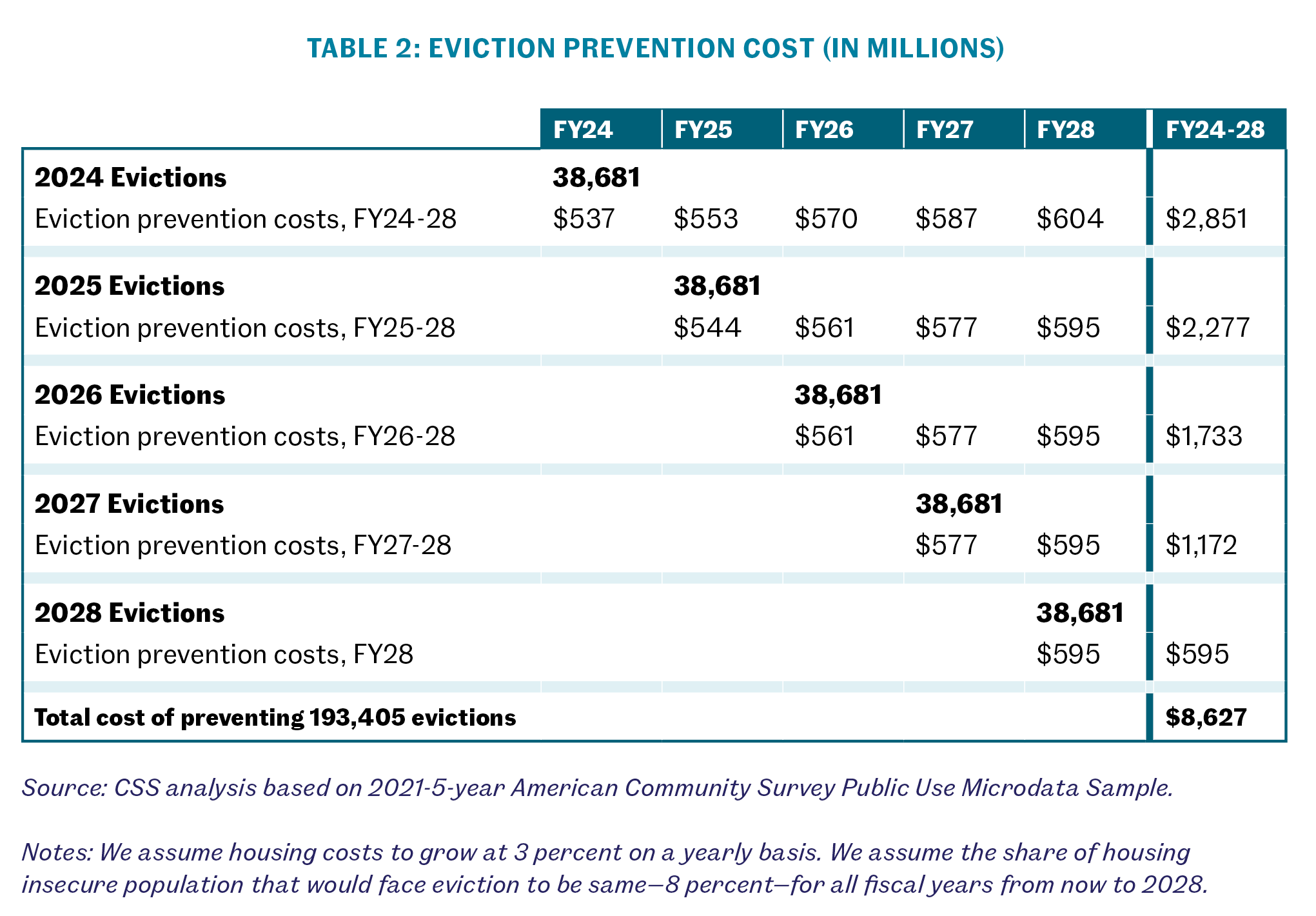
We then grow these annual costs at a yearly rate of 3 percent, to reflect rising housing costs in the city.[4] Assuming an 8 percent eviction rate among severely rent-burdened low-income households (the population defined in Table 1) the cost of providing eviction-prevention vouchers would total $2.8 billion cumulatively over 5 years.
Without meaningful change to tenant protection laws and eviction prevention programs like Right to Counsel, we assume a constant eviction rate among our defined population over the next five fiscal years. We can extrapolate that CityFHEPS expansion would prevent 193,405 evictions for 348,000 people, costing a cumulative $8.6 billion.
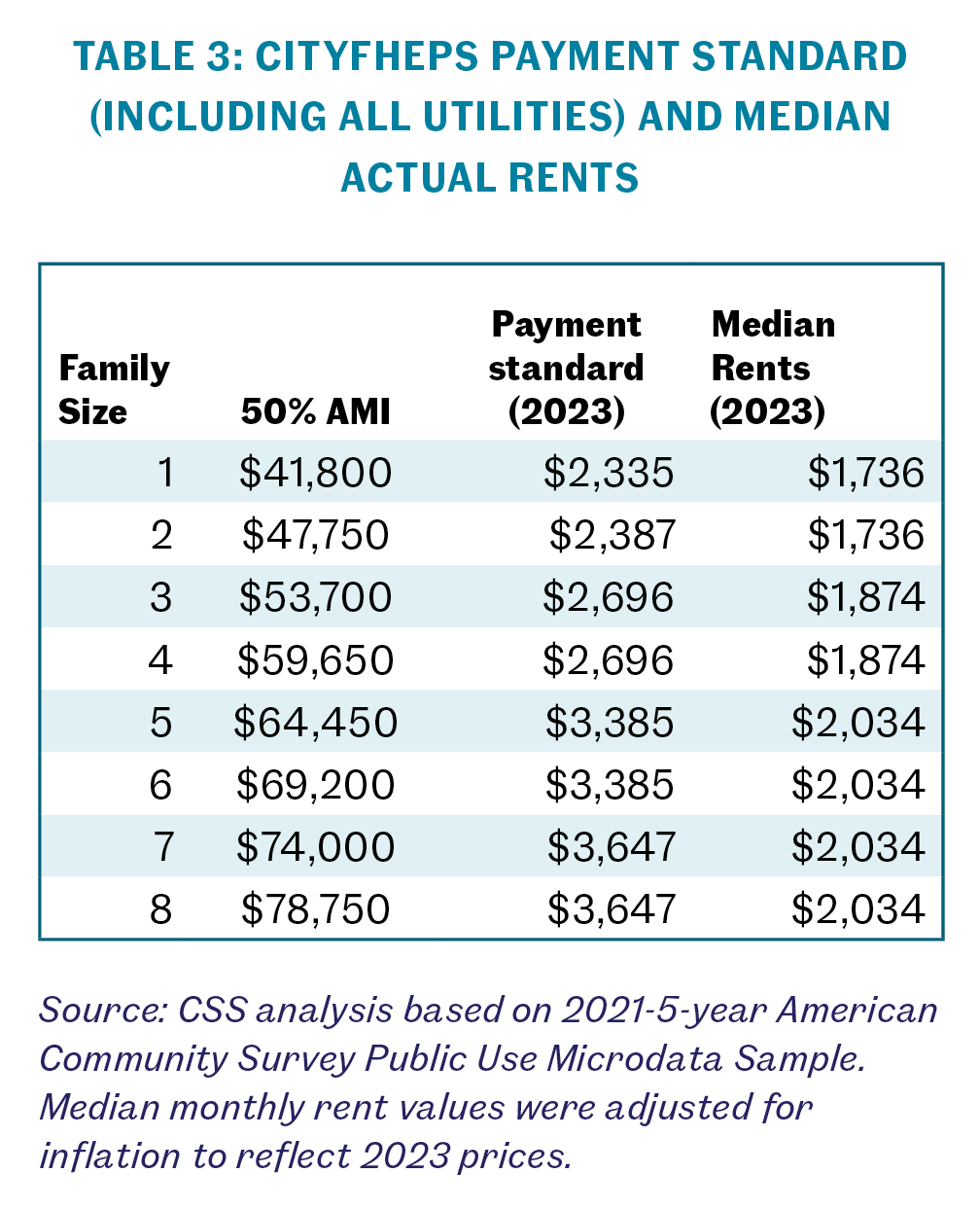
Rehousing costs for households moving out of shelter: In addition to calculating costs and savings of keeping housing-insecure households out of shelter, the CityFHEPS extension captures the cost savings built into long-term tenancy. Today’s CityFHEPS payment standards reflect the high average asking rents in New York City, or the amount landlords seek for a vacant apartment. Asking rents are significantly higher than actual rents paid by housing-insecure New Yorkers, especially since 59 percent of low-income New Yorkers in private rental housing live in rent stabilized apartments.[5] As a result, there are meaningful savings from using rental assistance to keep the same household housed where they live, rather than paying to first house them in a shelter, and then contribute towards a much higher asking rent in another apartment.
To calculate these savings, we used data provided by the Department of Social Services (DSS) through a Freedom of Information Law (FOIL) request showing that in FY 2022, 78 percent of households who moved out of shelters did so with CityFHEPS vouchers.
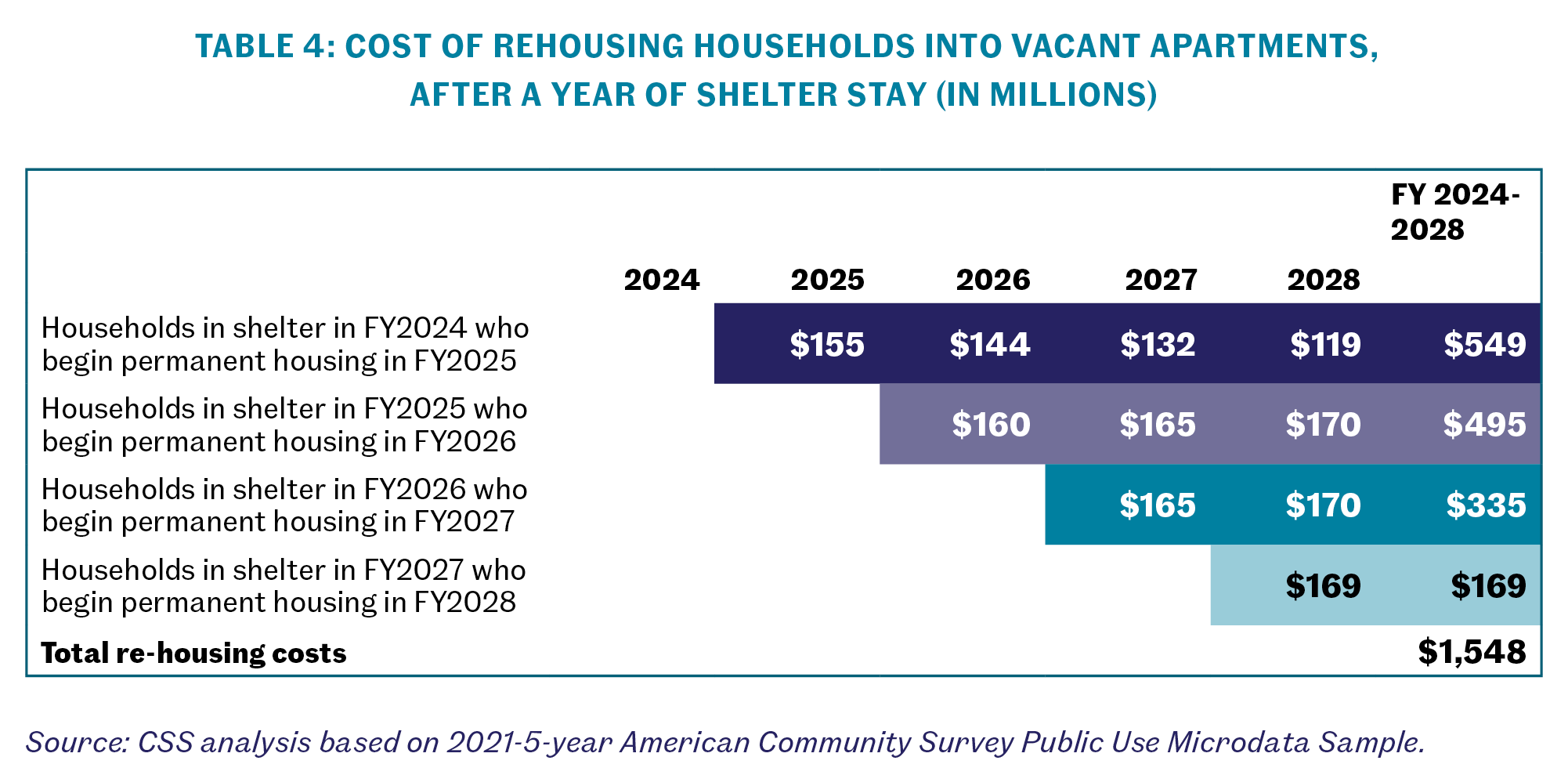
To estimate the number of households that the city would rehouse at the current CityFHEPS standard, we multiplied the estimated number of housing-insecure households we expect would be evicted and become homeless without expanded rental assistance by 78 percent, yielding approximately 6,000 households. It is important to note that these households would still contribute up to 30 percent of their income toward rent.
Table 4 lays out the annual costs of rehousing households after they have spent a year in shelter. We assume that a household that is currently in shelter is likely to be rehoused in FY 2025. Five years of coverage would cost the city $549 million by FY 2028. Using the same framework for future years, the city will save $1.5 billion cumulatively in rehousing costs.
Net Cost of Expansion: The city will spend over $4 billion in shelter costs and around $1.5 billion in rehousing costs—a total of $5.6 billion—over the next five years. Expanding the eligibility for the CityFHEPS program to households that have been served an eviction notice but are yet to move into shelters will cost a total of $8.6 billion. Thus, the net cost of this expansion is $3 billion over 5 years.
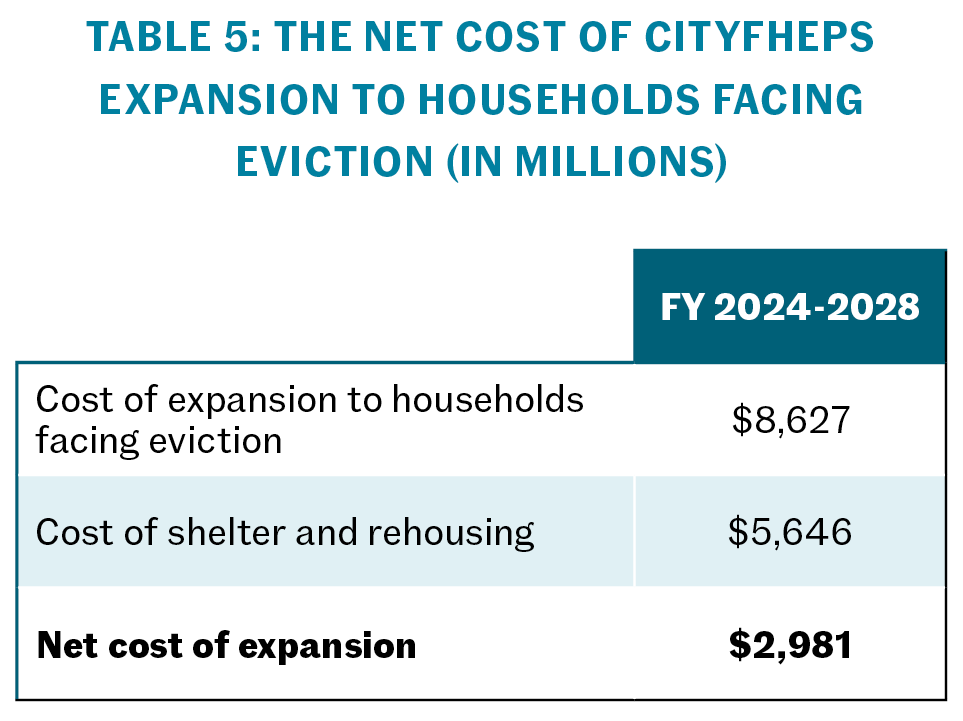
Table 5 shows the net cost of CityFHEPS expansion to households facing eviction relative to the cost of routing these same households through the shelter system and then rehousing them in vacant apartments at a higher rent cost.
Taken together, our model predicts that:
- The cost of expanding CityFHEPS vouchers to housing-insecure households facing eviction would be $8.6 billion over 5 years.
- In the system as it exists today, the cost of housing 20 percent of those same households in the shelter system would be $4 billion; the cost of using rental vouchers to rehouse those households would be $1.5 billion.
- The net additional increase in cost for using CityFHEPS as an eviction-prevention tool is $3 billion cumulatively over five years, or approximately $600 million per year.
Social benefits of CityFHEPS expansion: Numerous studies have demonstrated the social and economic benefits of paying for housing instead of paying for shelter, including: rising incomes for those who access permanent housing ($10,000 in additional income, $12,000 in taxpayer savings), lowering healthcare costs (by reducing hospitalization and emergency room visits), and raising children’s educational prospects and future wages (increasing 31 percent on average).
An analysis by HR&A for the New York Housing Conference found that a large-scale voucher expansion (in this case making Section 8 available to all who qualify for it) would create a twofold increase in residential income for voucher-holders, and $7,680 of new spending in the local economy per voucher-holder per year. This would ultimately result in an over $300,000 increase in lifetime earnings and a 32% increase in college attendance.
Shelter savings will go a long way toward defraying the cost of providing eviction-prevention vouchers, but the public money it still costs to keep people housed is ultimately money well spent.
Current voucher holders will benefit from CityFHEPS’ expansion
The mayor’s spokespeople and some editorial boards have argued that the City Council’s expansion of CityFHEPS will make it more difficult for existing voucher holders to compete for available apartments in a tight rental market. While some of this pushback is rooted in a mathematical miscalculation,[6] our analysis shows that by preventing evictions and expanding the universe of apartments available to voucher holders, CityFHEPS will become more effective at housing New Yorkers currently living in shelters.
First, by preventing evictions (Intro 893) the expanded CityFHEPS program will reduce the number of households entering the shelter system long-term, creating less competition for those trying to use vouchers to move into permanent housing. The only way one could make the case that using vouchers to keep people housed creates more competition for people experiencing homelessness is if one hoped that families would get evicted so that there would be more vacant apartments for homeless people to move into.
Second, the expanded CityFHEPS program makes many more homes available to voucher holders seeking to move out of shelter (Intro 229). The city has regularly and unnecessarily denied CityFHEPS applications based on utility costs, forcing homeless New Yorkers to begin their housing search all over again.[7] This results in prolonged housing searches for people experiencing homelessness, and thus higher shelter costs for the city. By fixing the utility cost allowance process, people trying to exit the shelter system will have more homes available to them, reducing competition and leading to speedier housing placements.
Recommendations
The City Council’s expansion of CityFHEPS will prevent evictions, reduce the cost of shelter, and speed up shelter exits. It will not explode the city’s budget – though the city should adjust its budget to match the shifting need – and it will not add to the burdens of New Yorkers already experiencing homelessness.
To ensure the success of this program expansion, we recommend:
-
While the Mayor supports ending the 90-day rule, he should sign the City Council’s CityFHEPS bill package into law and work with agency staff on its implementation.
-
The mayor and the City Council should budget accordingly, adjusting the money dedicated toward rent relief, housing placement, and shelter services to match the current and projected needs.
-
The mayor and the City Council should work together to address other thorny issues relating to homelessness and vouchers, including the difficulty faced by some of the longest-term shelter stayers in our system: undocumented households who are excluded from federal programs.
-
To make the vouchers more effective, the mayor and the City Council should expand the enforcement resources available to the New York City Commission on Human Rights and to Housing Preservation and Development in order to combat source of income discrimination and to scale up building code enforcement.
-
Longer term, state and local elected officials should work to keep rents low for all tenants and increase wages for all workers. This will mean fewer people will need vouchers at all, and those who do will need less subsidy.
Notes
1. Our analysis builds on the Fiscal Analysis conducted by City Council staff of the four bills , which projected that the number of voucher holders would increase by 47,000, increasing the number to 192,470 by FY2030. The Council analysts project that ending the 90-day rule would save the city $402 million in annual shelter costs, while the cost of expanding the voucher (primarily to low-income rent-burdened tenants facing eviction) would cost $145 million in the first year, and would increase year by year thereafter, ultimately reaching $4 billion in Fiscal Year 2030. Our analysis expands on this work by calculating the savings associated with keeping people housed.
2. Without the availability of concrete data, our model assumption is based on CSS’s Unheard Third Survey and reporting by the NYC Office of Civil Justice. Data on residential evictions from 2013-2019 (pp. 12) shows that on average 22,552 households were evicted in any given year. This count is around 4 percent of the total size of the housing-insecure pool. Our model predicts that an equivalent number of people self-evict, or move out on their own before a Marshall's order.
3. Last year, a representative of the NYC Department of Social Services told City Limits that "Prior to the pandemic, from March 2019 to February 2020, about 10 percent of shelter entrants became homeless following an eviction." There is reason to believe that this may be an undercount: there are several other shelter systems in the city, and many people who enter shelter may do so one step after an eviction – for example, by living briefly with a friend or relative or living on the streets, and then entering into the shelter system shortly thereafter.
4. Three percent rent growth is a standard assumption in multifamily underwriting. The NYC Rent Guidelines Board rent increases have consistently been below 4 percent for the past decade.
5. 2021 New York City Housing and Vacancy Survey Selected Initial Findings.
6. Some of the pushback against voucher expansion in the media relies on an incorrect calculation that overstates the impact of the income threshold. Intro 894-A raises the eligible income threshold from 200 percent of the Federal Poverty Line to 50 percent of the Area Median Income. The day before the bills passed, The Daily News offered confusing statistics to make it seem like this was a big leap: “Bringing eligibility from 200% of the federal poverty level to 50% of area median income sounds like jargon-y tweaking, but in practice that means household income cutoffs go from $27,750 to $60,050 for a family of three in 2022 numbers, an enormous jump.” This might be considered “an enormous jump” if it were true, but it is not; 200 percent of the federal poverty level for a family of three would be $49,720, while 50 percent of AMI for that same family would be $63,550. The figures quoted by The Daily News would produce a 116 percent change in the threshold, whereas the actual increase is just under 28 percent.
7. See our factsheet on the problems with CityFHEPS utility cost deductions.