Testimony: The Rent Guidelines Board Should Reject Calls For Rent Increase
Oksana MironovaSamuel Stein
Thank you for the opportunity to speak about the RGB’s annual guidelines. This year’s deliberations come at a crucial time, with low-income rent stabilized tenants continuing to experience damaging long-term economic and health impacts of the pandemic, even as some sectors of the city recover.
Our names are Oksana Mironova and Samuel Stein, and we are housing policy researchers at the Community Service Society of New York (CSS). CSS is an independent nonprofit organization that addresses some of the most urgent problems facing low-income New Yorkers, including the effects of the city’s chronic housing crisis. Since 2002, we have administered our annual Unheard Third survey, the longest running scientific survey of low-income communities in the U.S.
I. For rent stabilized tenants, the fallout from the pandemic continues
While some sectors of New York City’s economy are seeing signs of recovery, others are stuck in what a Bloomberg reporter describes as a “Covid-induced malaise.” New York City’s seasonally-adjusted unemployment rate is currently twice the national average. Our jobs deficit is three times the nation’s and is concentrated primarily in lower-paying jobs. In the fourth quarter of 2021, the unemployment rate for Black New Yorkers – who make up 22 percent of the rent stabilized tenant population – was 15 percent.
Even before the pandemic, low-income rent stabilized tenants’ incomes did not keep up with rising rents. Among low-income renters in particular, inflation-adjusted rents increased by 26 percent since 2002. As a result, the median rent to income ratio – the share of income a household spends on rent – among low-income stabilized households increased from 40 percent in 2002 to 52 percent in 2017. By 2017, because of rent loopholes and high RGB rent adjustments, the rent burden gap between stabilized and unregulated low-income tenants essentially disappeared.
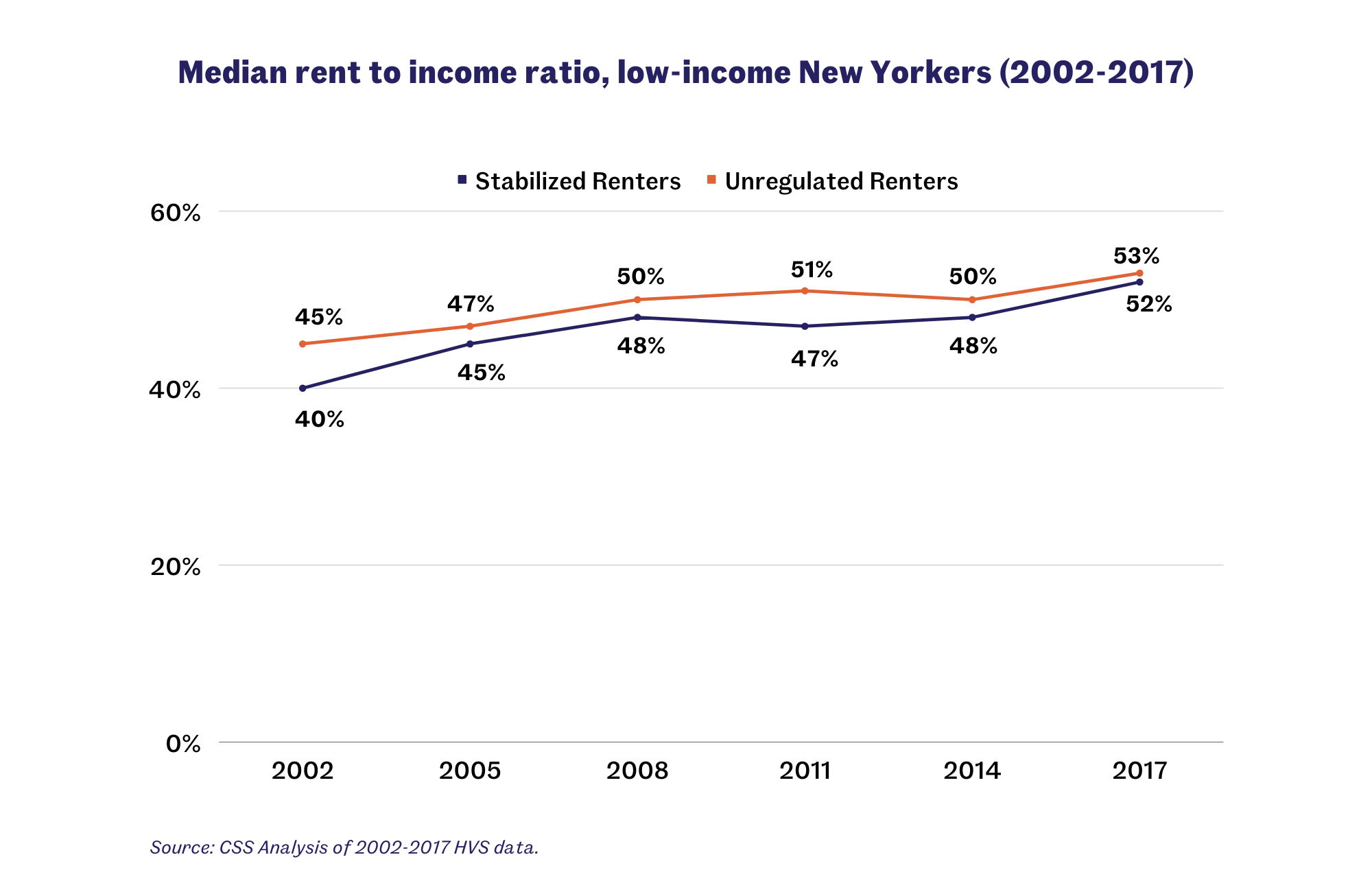
Our 2021 Unheard Third survey provides more recent data than the 2017 HVS and paints a bleak picture of rent stabilized tenants’ economic outcomes. We know that during the pandemic, low-income New Yorkers bore the brunt of economic loss. Among low-income rent stabilized tenants, 40 percent lost employment income in their household, according to our 2021 Unheard Third survey. Because of high living costs in New York, most low-income people are simply not able to save money for an emergency like a sudden loss of income. We found that 65 percent of low-income stabilized tenants have less than $1,000 in savings.
As low-income stabilized tenants lost work, rents continued to go up for many. Thirty-eight percent experienced a rent increase in 2021, even though there was a one-year lease rent freeze in effect for most of 2021. These increases likely included two-year lease renewals, illegal rent hikes, and rent increases associated with major capital improvements (MCIs). According to our survey, 37 percent of low-income rent stabilized respondents’ buildings underwent improvements. Despite a low rent adjustment in 2021, landlords continued to invest in building improvements.
II. Eviction cases mount as pandemic-era programs end
The federal and state eviction moratoria and direct relief helped hold back a sharp increase in evictions and homelessness during the height of the pandemic, but those temporary solutions have expired. The eviction moratorium ended on January 15th. The State awarded 142,299 emergency rental assistance (ERAP) payments, paying landlords $1.8 billion, but with no assurance that tenants will have the resources to pay even higher rents moving forward. An additional $919 million of federal and state funding is forthcoming, but it will cover only half of the 183,000 outstanding ERAP applications, leaving tenants in a vulnerable position.
The city, state, and federal government have failed to replace these temporary programs with permanent solutions, like an expansion of federal Section 8 vouchers (included in the stalled Build Back Better bill) or the state’s Housing Access Voucher Program (excluded from the final state budget).
Given the combination of untenable pre-pandemic rent burdens, the loss of employment during the pandemic, and the failure of all levels of government to repair a decimated social safety net, many low-income rent stabilized tenants are a step away from eviction. When we fielded our survey in the summer of 2021, one third of low-income rent stabilized tenants reported being worried they would be evicted or forced to move. Even before the moratorium expired, 13 percent of low-income rent stabilized tenants were threatened with eviction illegally in 2021.
Today, there are over 227,000 eviction filings in housing court, including nearly 205,000 nonpayment cases and over 22,000 holdovers. A little more than half of these are pre-pandemic evictions, though the share of new eviction filings is quickly increasing. The most recent U.S. Census Household Pulse Survey shows that as of April 11, nearly one in four of all New York households reported being behind on their rent. A portion of these households will face evictions, which will take time to make their way through the courts. We are likely to see a rolling increase in non-payment cases over the summer and into the fall, when RGB rent increases for this year will go into effect.
III. Rent regulation is key for keeping low-income New Yorkers in their homes
The guidelines this board enacts are some of the most important factors that determine the stability and well-being of low-income New Yorkers (those earning below 200 percent of the federal poverty threshold, or $43,000 for a family of three). According to the 2017 HVS, about 365,000 low-income households live in rent stabilized housing, roughly double the number of those living in public and subsidized housing combined. Seventy-six percent identify as Black, Hispanic, or Asian, and nearly half are immigrant households. Rent stabilized households are also more likely to be female-headed and include senior citizens than tenants in unregulated housing.
From the HVS, we also know that rent stabilized tenants make, on average, one third less in wages and salaries than tenants in unregulated housing. The percentage of tenants on public assistance is nearly twice as high in rent stabilized housing as it is private, non-regulated housing.
While rent stabilization is a means of regulating rents and tenancy rules, not a means-tested subsidy program, it is one of the most important housing resources available to low-income New Yorkers. Rent regulation mediates the severe power imbalance between tenants and landlords, which is exacerbated by tight housing markets. On the neighborhood level, rent regulation acts as a counterbalance to gentrification and as a bulwark against displacement and homelessness, helping residents stay in their apartments. On a city level, it provides the groundwork for other programs like the exceedingly effective–and currently embattled–Right to Counsel law, and helps promote integration without displacement.

While there are programs that help vulnerable rent stabilized tenants stay in their homes, like SCRIE and DRIE, they are underutilized. According to a NYC Department of Finance report, only 43 percent of the 175,050 households eligible for either SCRIE or DRIE were enrolled in 2017.
We know that legal service providers representing low-income New Yorkers in housing court are facing astronomical caseloads, with up to 80 cases per attorney. Due to the volume of evictions, and despite New York City’s Right to Counsel law, tenants facing new evictions in Manhattan, Brooklyn, Queens, and the Bronx right now do not have representation.
In a 2022 report, Coalition for the Homeless wrote: “…it is no surprise that the family shelter census dropped for a period concurrent with the eviction moratorium. But since it would be nothing more than wishful thinking to believe that the underlying conditions that have fueled family homelessness for decades magically disappeared during the moratorium, we can only assume that a surge of homelessness will occur in the months and years ahead...”
The RGB cannot set federal or state policy on evictions or homelessness, but you can ensure that rent stabilized tenants are not pushed into housing court and then the shelter system by a thinly justified rent increase. We encourage the Rent Guidelines Board to reject calls for a rent increase of any kind.