Testimony: NYC Needs a Rent Freeze
Oksana Mironova
New York City Rent Guidelines - Public Meeting
May 5, 2020
My name is Oksana Mironova and I am a housing policy analyst with the Community Service Society of New York. CSS is an independent nonprofit organization that addresses some of the most urgent problems facing low-income communities in New York City, including the effects of the city’s chronic housing crisis. Thank you for the opportunity to present our comments on the potential impact of the 2020 rent guidelines.
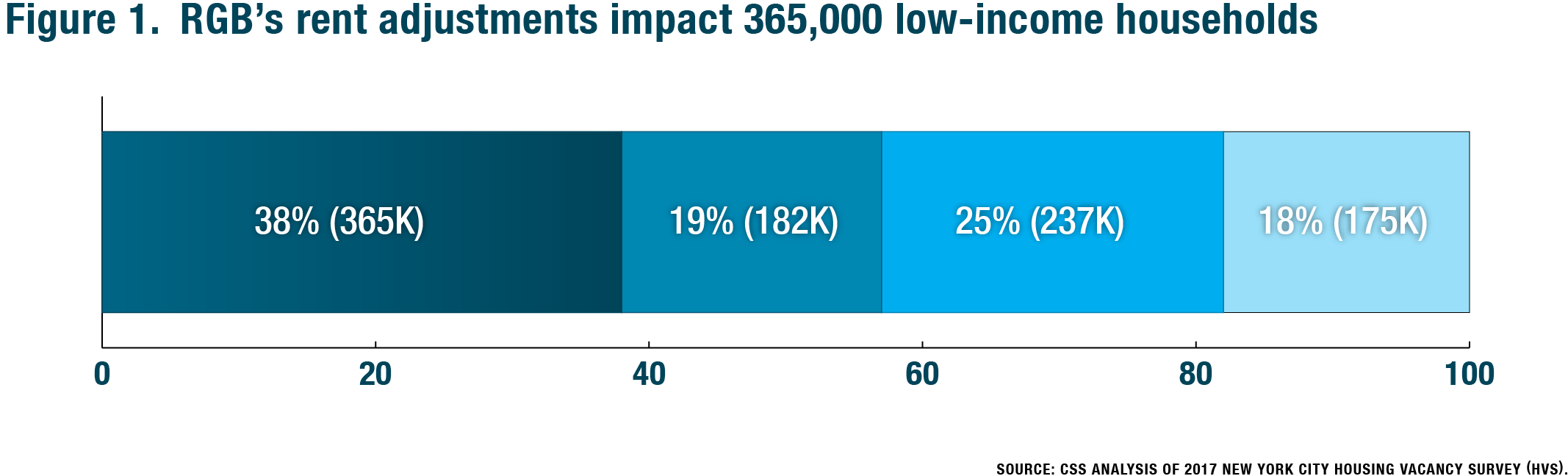
The decisions of the Rent Guidelines Board (RGB) are among the most important factors influencing the well-being of low-income New Yorkers.[1] About 365,000 low-income households live in rent regulated apartments in New York City, twice the number who live in public and subsidized housing combined.
Pre-pandemic needs among low-income regulated renters
Every year since 2002, CSS, in partnership with Lake Research Partners (a top public opinion polling firm), has conducted a survey called the Unheard Third.[2] We use the survey to track the evolving hardships of New York City's low-income residents and their views on what programs and policies would help them get ahead. Our data has consistently shown that many low-income regulated renters are on the edge of housing instability, and would have great difficulty bearing any major economic shock.
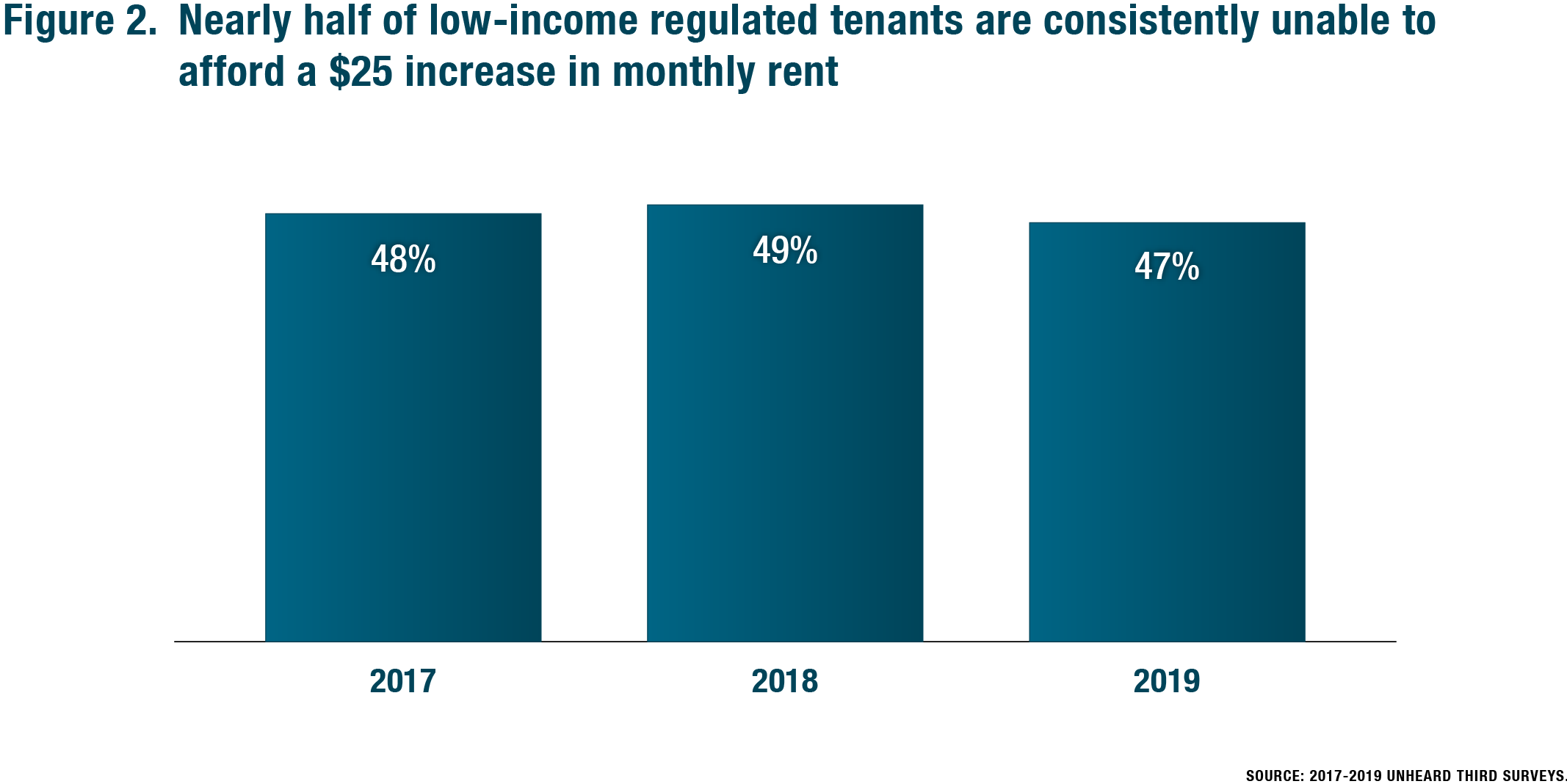
Our Unheard Third polling has shown that almost half of low-income rent regulated households (about 175,000) consistently reported being unable to afford a $25 increase in rent over the past few years. That is a 1.8 percent increase on the average stabilized rent of $1,400.
Since 2017, some low-income renters likely fell back on their rent and eventually lost their homes, while others had to make more and more difficult tradeoffs between rent, food, medical care, transit fares, and other necessities.
From the 2019 Unheard Third survey, we know that 55 percent of low-income rent stabilized respondents (that is a little over 200,000 households) had difficulty affording basic expenses. About one in three had difficulty affording a MetroCard or had to skip meals to save money.
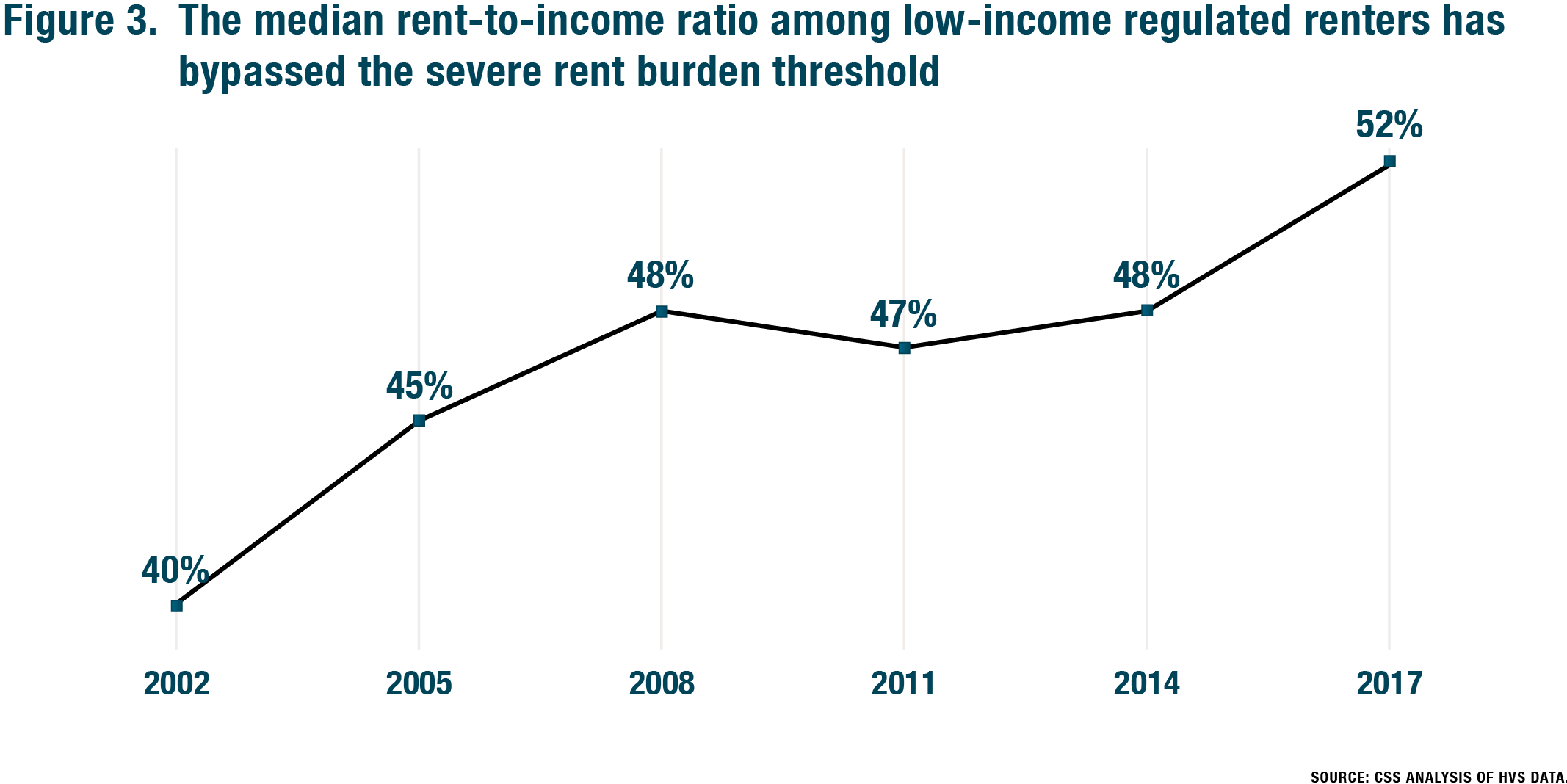
A simple reason for these high rates of hardship is that incomes have not kept up with rising rents. The median rent to income ratio–the share of income a household spends on rent–for low-income regulated households bypassed the severe rent burden threshold, increasing from 40 percent in 2002 to 52 percent in 2017.
The dual culprits for the rapid rise of stabilized rents over the past two decades were high RGB guidelines during the Bloomberg administration and the impact of rent law loopholes (most now abolished with the new rent laws), which allowed landlords to raise rents well above the annual guidelines.
While tenants’ real wages have stagnated over the past few decades, landlord incomes have continued to grow. Even though the NOI declined slightly since last year, it has grown significantly over a longer timeframe, increasing by 48.7 percent above inflation since 1990.
According to RGB’s analysis of 2018 data, landlords of stabilized buildings spent about 60.5 cents out of every revenue dollar on operations, thus generating 39.5 cents in income. Historically, operational expenditures have fluctuated from 59 to 65 cents. And, revenues continue to outpace building costs. Income is up by 40.8 percent above inflation since 1990, while costs are up 37 percent.
Given the high cost of housing, it is unsurprising that many renters have been unable to save money. The vast majority of low-income regulated renters–71 percent–had less than $1000 in savings for an emergency, like an unexpected loss of income or a hospitalization.
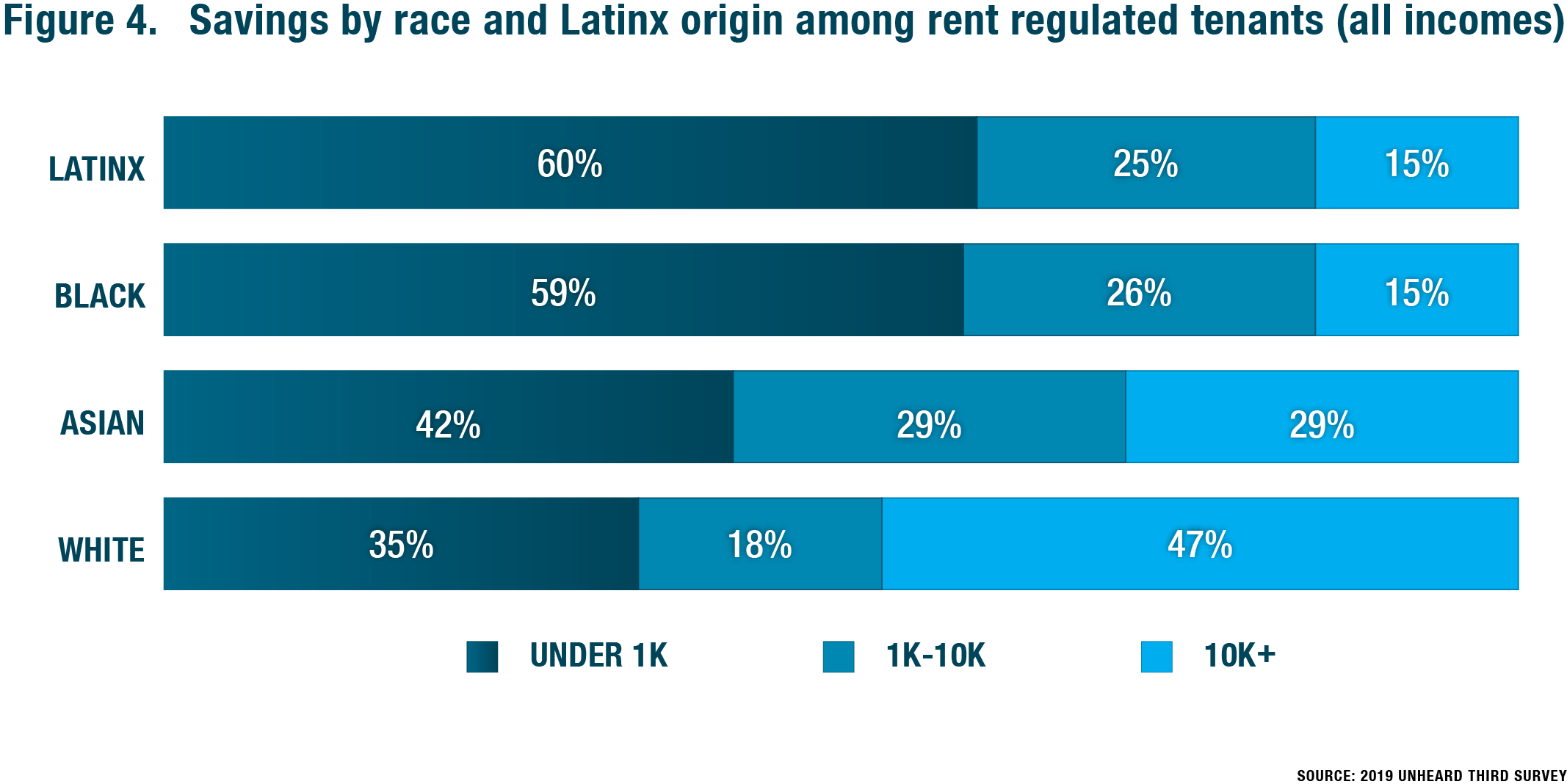
There are also major disparities in savings by race and Latinx origin among regulated renters across all incomes. Sixty percent of Latinx regulated renters and 59 percent of black regulated renters report having less than $1,000 in savings, as compared to 42 percent of Asian renters and 35 percent of white renters. This is in line with national research, which points to a broadening racial wealth gap across all socioeconomic levels.
A sudden shock to an overburdened system
COVID-19 is a major economic shock, impacting low-income renters and renters of color in particular. According to a survey conducted by the CUNY Graduate School of Public Health and Health Policy (CUNY SPH), as of April 19th, earners in 37 percent of all New York households lost their job. Latinx households (44 percent), Asian households (40 percent), and low-income households (42 percent) were particularly hard hit.
While we are unable to disaggregate these job losses by housing type, analysis of 2018 Census data shows that low-income renter households were more likely to include at least one person working in an industry currently at risk for job loss (such as non-essential retail, daycare, and personal care services), compared to moderate/higher-income renters (42 percent vs. 31 percent). Similarly, Latinx and Asian renter households were the most likely to have at least one person working in an at-risk job in 2018 (40 percent and 42 percent).
In addition to renters that were already housing insecure, COVID-19 has pushed hundreds of thousands of others closer to insolvency. The city has 716,000 low and moderate income renter households who are in the labor force and do not receive federal housing assistance like Section 8 vouchers. Our research has showed that more than 160,000 of these renter households in the private market have minimal savings and have lost much or all of their income as of mid-April.
Expanded unemployment insurance—covering more workers, with higher weekly benefits–will help some, but will leave out important segments of the New York City workforce, like undocumented workers. The stimulus check will offer some reprieve as well, but is a one-time payment that also excludes undocumented New Yorkers. In the short term, delays in unemployment insurance claims processing have been a huge problem, because many renters lack savings to get by, even for even a few weeks.
What can the RGB do?
The RGB cannot address systemic issues like wage stagnation or federal disinvestment in the affordable housing sector. But, addressing tenant hardships in rent-stabilized apartments is within the board’s purview. And, RGB action in the past has led to material benefits for low-income renters.
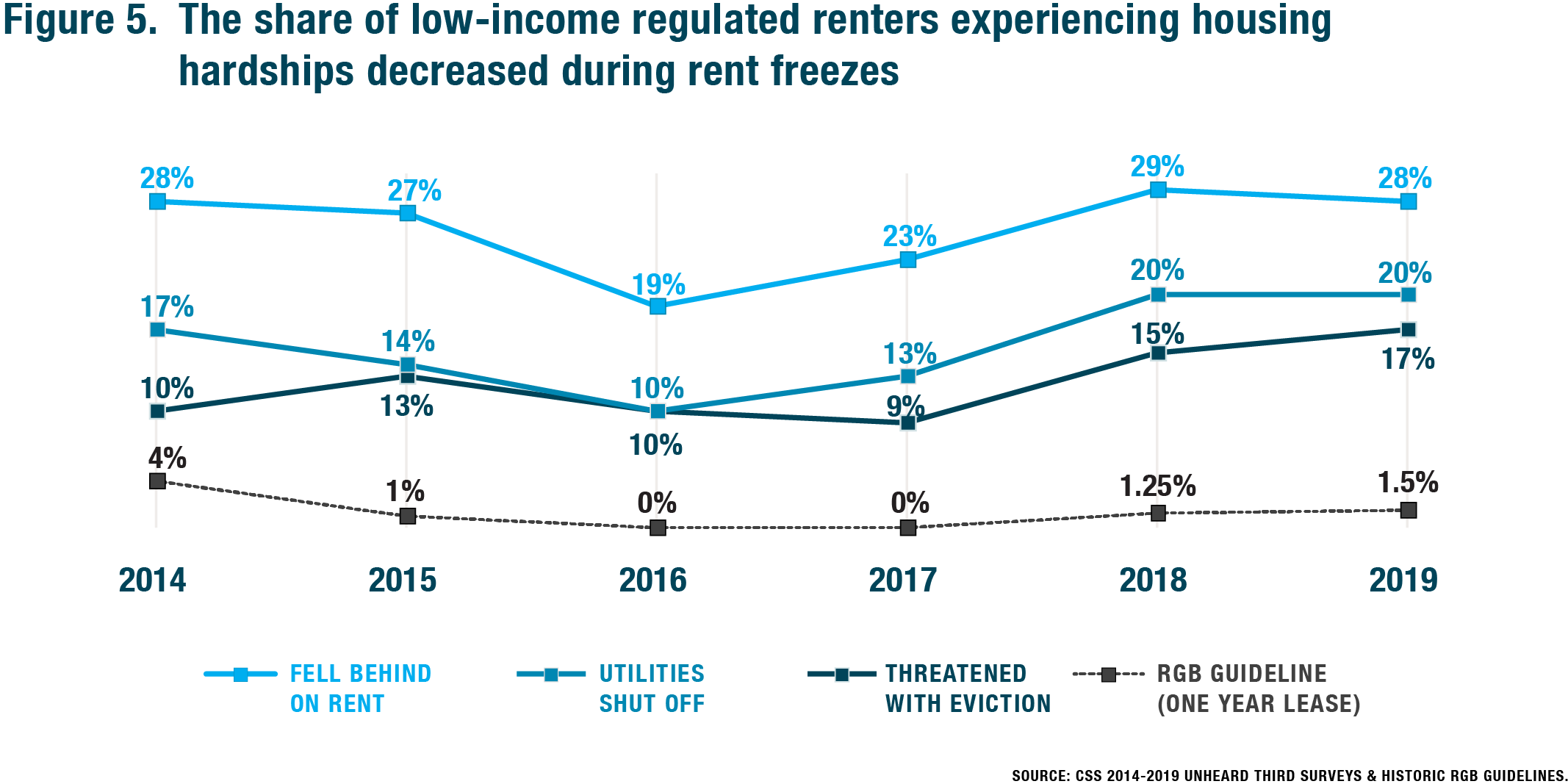
Figure 5 shows the share of low-income regulated renters reporting housing-related hardships–including falling behind on rent, utility shut offs, and eviction threats–from 2014 to 2019. There is an observable dip in housing hardships during the two years of RGB rent freezes in 2016 and 2017. It is important to note that the two rent freezes did not lead to increased building distress (operations costs exceeding income) or abandonment. RGB’s research shows very low shares of distressed buildings from 2016 through 2018. The latest figure available, for 2018, was 5.4 percent, the third lowest ever recorded.
RGB’s rent freezes have eased housing hardships for rent regulated tenants in the past, and can do so again during what will be an extremely trying, and long, pandemic recovery period. We call on the RGB to freeze tenants’ rents for both one and two year leases, to help mitigate the immediate impacts of the pandemic and provide some sense of long-term stability during an incredibly turbulent and uncertain time.
[1] CSS defines low-income households as those earning below twice the federal poverty threshold, or about $41,000 for a family of three.
[2] The Unheard Third is a scientific telephone survey designed by Community Service Society in collaboration with Lake Research Partners who administer it using Random Digit Dialing and professional interviewers. In 2019, 1,829 New York City residents were reached by cell phones and landlines from June 18 to July 20. Interviews were conducted in English, Spanish and Chinese. The margin of error for the entire survey is +/- 2.29 percentage points and +/- 2.97 percentage points for the low-income component.