Testimony: Lessons from New York on How Rent Regulation Can Strengthen Housing Stability in Washington State
Oksana MironovaSamuel SteinIziah Thompson
Thank you to Washington’s Senate Committee on Ways & Means for holding a hearing on HB 1217. Our names are Oksana Mironova, Samuel Stein, and Iziah Thompson, and we are senior policy analysts at the Community Service Society of New York (CSS), a leading nonprofit that promotes economic opportunity for all New Yorkers. CSS uses research, advocacy, and direct services to champion a more equitable city and state.
Tenant stability and housing affordability are central to CSS’s mission, and we have long observed and researched New York State’s rent regulation system. We have found that rent stabilization is the simplest way to extend affordability, protect tenant and neighborhood stability, and encourage building investment.
Rent regulation benefits low-income renters the most
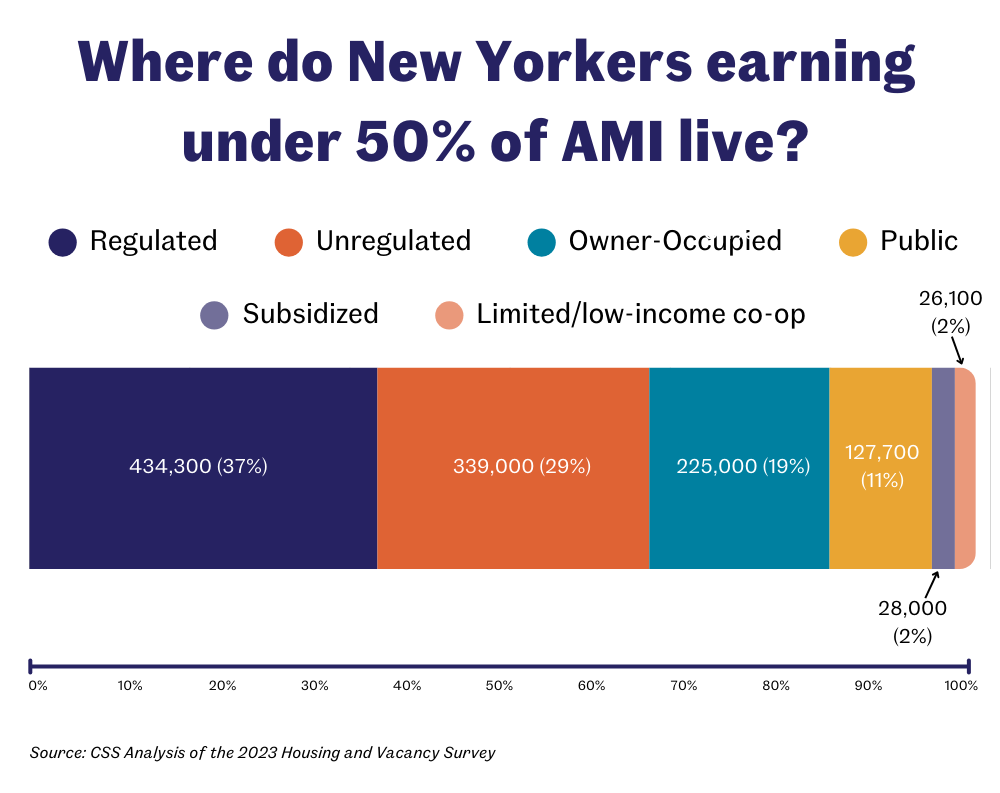
Rent regulation is the backbone of affordability in New York City, protecting 1,020,600 apartments—41 percent of the city’s rentals—from unchecked rent hikes. Thirty seven percent of low-income households (who earn under 50 percent of Area Median Income, or AMI) live in rent regulated apartments—totaling 434,300 households. That is nearly three times as many as those living in public housing and subsidized rentals combined.
Key resource for Latino and Black New Yorkers
Latino and Black New Yorkers rely on rent regulation more than any other racial or ethnic groups—and for these groups, it is the most common housing arrangement. Thirty-eight percent of Latino New Yorkers and 29 percent of Black New Yorkers live in rent regulated apartments. While white and Asian New Yorkers are more likely to be homeowners, 19 percent of white households and 16 percent of Asian households are rent regulated tenants.
Counterbalance to displacement and homelessness
On the neighborhood level, rent regulation acts as a counterbalance to gentrification and as a bulwark against displacement and homelessness, helping residents stay in their apartments. In a tight housing market, where the majority of low-income renters are rent burdened (spending more than 30% of their income on rent), limits on unscrupulous rent increases are central for keeping people in their homes.
In New York City, rent regulation has acted as a stabilizing force during a pandemic-driven resurgence of speculation on multifamily properties. In 2023, the median monthly rent in regulated units was $1,500, which was $500 lower than in unregulated rentals.
Even though rent regulation is not a subsidy program, it stretches public subsidy dollars that prevent evictions and homelessness, including one-time emergency rental assistance grants and ongoing rental assistance in the form of vouchers. As stated by sociologist Matthew Desmond, who advocates for a universal voucher program, “expanding housing vouchers without stabilizing rent would be asking taxpayers to subsidize landlords’ profits.”
Rent regulation does not undermine responsible landlords
Opponents of rent regulation often claim that it will result in disinvestment from buildings and increased maintenance issues. Studies have continuously shown, however, that no such link exists. For example, New Jersey is a good place to test the impacts of rent control policies because the state has a range of municipalities with and without rent regulation. Using a sample of 161 communities in New Jersey, a 2015 study published in the journal Cities tested the impact of rent regulation (both its presence and its relative strictness) on housing quality and foreclosure rates (as a proxy for abandonment). It did not find any significant impact on the two variables when controlling for apartment size, income, race, and median rents.
In 2023, CSS polled New Yorkers about a wide range of issues as part of our annual Unheard Third survey. We asked respondents if their rent went up in the past year, and, if so, whether the landlord had made any improvement to their apartment or building. We found that rent regulated tenants (44 percent) who experienced a rent increase were 12 percentage points more likely to see improvements in their buildings compared to unregulated tenants (32 percent).
While these numbers should be far higher for any tenants experiencing rent increases, they point to an important fact often overlooked in the debates around rent regulation in New York and beyond: according to our survey data, rent stabilized landlords appear more likely to invest in improvements than market-rate landlords. Counter to anti-regulatory arguments, rent regulation does not inhibit building maintenance. Instead, it incentivizes it by making a portion of the rent increase contingent on apartment or building improvements.
Rent regulation not only helps tenants get the repairs and improvements their buildings need, but helps them advocate for public investment without fear of future displacement. In an unregulated rental market, when the public sector makes significant improvements to an area – like adding a new mass transit line or building a new park – nearby landlords can capitalize from this public investment by increasing rents. Tenants understand this and are often reluctant to call for any improvements to their neighborhoods that could ultimately push them out.
In a regulated rental market, private landlords cannot privatize the benefits of public investment in this way. If the city builds a new park or expands transit access, existing tenants do not have to bear rent increases capitalizing on this new local amenity and can stay in the neighborhood to enjoy its benefits. Rent regulation thus provides tenants with the stability necessary for full civic participation, as renters no longer have to fear that neighborhood improvement will result in gentrification and displacement.
We strongly encourage the Washington State legislature to pass HB 1217. Thank you for the opportunity to testify. If you have any questions about this testimony or CSS’s research, please contact me at omironova@cssny.org.