Shortchanging Tipped Workers: Less than the full minimum wage means more hardships
Irene LewNancy Rankin
Anyone riding the subways and buses these days can’t miss the signs proclaiming that the $15 minimum wage has arrived in New York City. The trouble is that it hasn’t arrived for everyone. Left out are the tens of thousands of tipped workers serving us at restaurants, car washes and nail salons. For these workers, the base minimum wage is a lot less. Tips are supposed to make up the difference. In New York City, the minimum wage for tipped workers in small restaurants (10 or fewer workers) is $9 an hour, and $10 for larger establishments. Nail salon and car wash workers must be paid from $10.20 to $12.75 depending on employer size and whether their tips reach a certain threshold per hour. All in all, 16 separate “tipped minimum wages” apply to various categories of workers depending on industry, business size and region of the state. If tips fall short of bringing a worker’s pay up to the regular minimum wage, employers are legally required to make up the gap. But in practice, it is complicated to track, creating problems with compliance and enforcement.
What’s the bottom line for tipped workers? We looked at data from the Census and findings from the 2018 Community Service Society Unheard Third[1] survey to learn how tipped workers are faring. Our analysis reveals that workers relying on tips suffer higher levels of poverty and hardship than workers covered by the full minimum wage.
Tipped workers are more likely than non-tipped employees to be low income, and to depend on public benefits such as SNAP (food stamps) and Medicaid.[2]
Over a third (36 percent) of tipped workers living in New York City are near or below poverty,[3] compared to 20 percent of non-tipped workers eligible for the full minimum wage.[4] The typical tipped worker living in New York City had median earnings of $22,000 annually in 2017, about half of what non-tipped workers earn ($42,000). Nearly one out of every five (18 percent) tipped workers living in New York City used SNAP (food stamp) benefits, compared to 15 percent of non-tipped employees,[5]and 28 percent of tipped workers received Medicaid, in contrast to 18 percent of non-tipped workers.[6]
Workers forced to rely on tips to support their families are nearly twice as likely as non-tipped workers to experience multiple hardships.
Many tipped workers are not earning enough to cover essential expenses like housing, food, or health care. Nearly four out of every 10 tipped workers living in New York City (37 percent) experienced three or more hardships in the past year, compared to 21 percent of workers covered under the full minimum wage.

Housing hardships such as falling behind on the rent or having to move in with other people are much more prevalent among tipped workers.
Forty-three (43) percent of tipped workers said they experienced a housing hardship in the past year, nearly double the rate among non-tipped employees. More than a quarter (27 percent) said that they fell behind on their rent or mortgage payments, well above the share of non-tipped workers (16 percent).
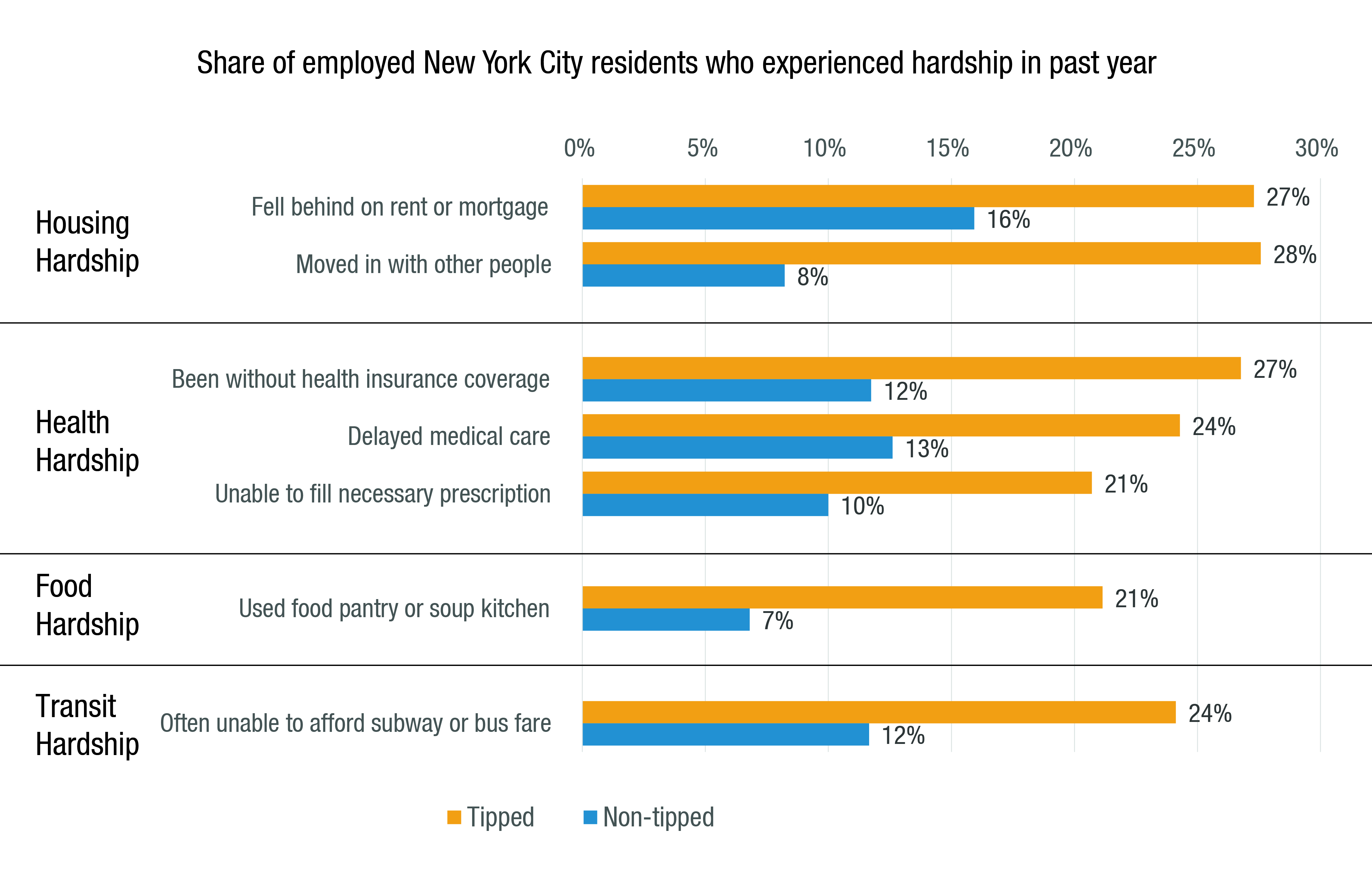
Many of the tipped workers serving you at restaurants struggle with having enough to eat and putting food on the table for their own families.
More than one out of every five tipped workers (21 percent) said that they used a food pantry or soup kitchen, triple the share of employees in non-tipped jobs (7 percent).
Tipped workers are more likely than workers covered under the full minimum wage to face financial insecurity.
Since tips—not a regular paycheck—can account for much of tipped workers’ earnings, weekly income can fluctuate considerably, making it difficult to save and plan for the future. Forty-two percent of tipped workers said that they were worried all or most of the time about their household finances, and nearly half of tipped workers reported having zero or less than $500 in emergency savings, more than double the share of non-tipped workers with so little savings

Tipped workers in New York City are struggling economically.
Compared to other workers, they are more likely to live in poverty, rely on public benefits, suffer hardships in meeting basic needs, and lack even a small financial cushion to deal with a medical emergency or job loss.
Moving to one uniform minimum wage for all workers would help alleviate these hardships and achieve equity among workers. Moreover, reducing the complexities of the current system would aid compliance and enforcement.
Last year, at the direction of Governor Andrew Cuomo, the New York State Department of Labor held public hearings around the state to examine industries and evaluate the possibility of ending the subminimum wage for tipped workers, but a report and recommendations have yet to be released. It is time to end the two-tiered system and establish one fair wage.
Download a printable version of this report here
[1] CSS designed the Unheard Third in collaboration with Lake Research Partners, who administered the survey by phone using professional interviewers. The survey was conducted from July 11 to August 13, 2018, reaching a total of 1,775 New York City residents, ages 18 and older, on cell phones and landlines. Interviews were conducted in English, Spanish, and Chinese. The margin of error for the entire sample is +/- 2.3 percentage points, with higher margins of error for subgroups.
[2] Based on a CSS analysis of 2017 American Community Survey data. Data is for New York City residents.
[3] Below 200 percent of the federal poverty level, which is $50,930 for a family of four with two children in 2018.
[4] Estimate for tipped and non-tipped workers excludes those who are self-employed and would not be covered under minimum wage laws.
[5] This difference is statistically significant at the .05 level.
[6] This difference is statistically significant at the .01 level.