NYCHA and the Pandemic: Impacts on Public Housing Residents
Victor BachTheo HamSamuel Stein
By now it is well known that the COVID-19 pandemic is having a devastating, disproportionate impact on communities of color across the nation. Most of New York City’s public housing developments are among those vulnerable communities, with a citywide population estimated at between 400,000 and 600,000 residents, nearly all of them Black and Latinx. Conditions that prevailed prior to the pandemic also made residents especially susceptible to the virus: densely populated high-rise buildings, deplorable living conditions in aging buildings, many overcrowded apartments, and a largely low-income population with high proportions both of essential workers and of elderly or disabled residents.
Questions about the capacity of the NYC Housing Authority (NYCHA) to manage its properties under “normal” conditions became even more urgent under the stresses of a raging pandemic. The authority’s management failures had led to the appointment of a federal monitor in early 2019.[1]
For several years, the NYC Public Advocate has named NYCHA the city’s largest and worst landlord.
This post, fifth in the series A Roadmap to an Inclusive Recovery: Assessing COVID-19’s Impact on Low-Income New Yorkers, is largely based on CSS’s annual Unheard Third survey of low-income New Yorkers. It focuses on the impacts of the pandemic on NYCHA residents—health, economic, and housing impacts—in comparison with low-income tenants living in other rental housing. Our survey, fielded during the summer of 2020, included questions on health, employment, housing security, public benefits, and hardships. It provided an opportunity to gain some insight into how NYCHA residents and other low-income tenants were faring at that point in time.[2]
The Incidence of Covid-19 Among NYCHA Residents
The NYC Department of Health and Mental Health (DOHMH) provides authoritative data on the incidence of COVID-19 across the city. From the onset of the pandemic in March 2020, it also recorded the incidence of the virus across NYCHA units by development. But release of NYCHA data ended in mid-May for unknown reasons. Nevertheless, it is useful to examine the data at that point.
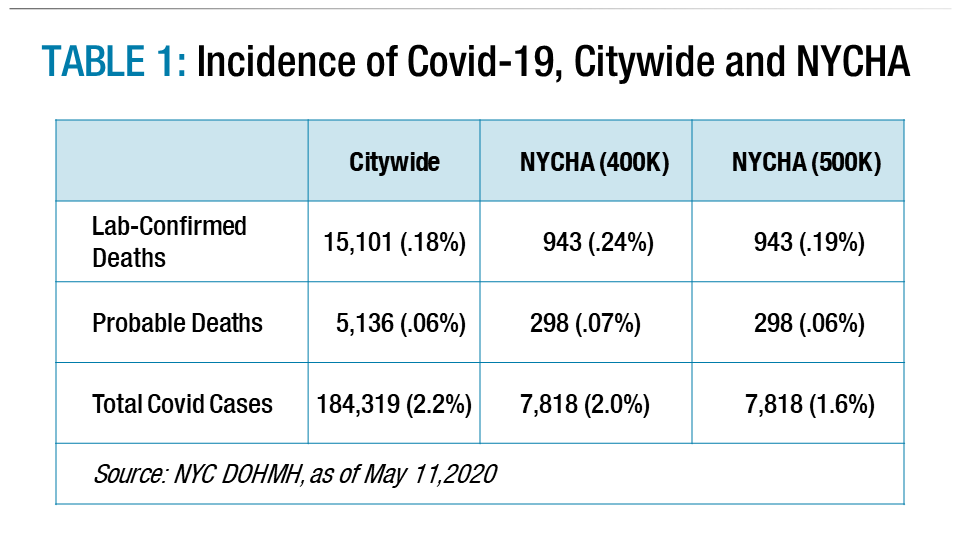
Table 1 indicates that the citywide death rate—lab-confirmed and probable—was 0.24 percent, between two and three persons per thousand (based on a population of 8.39 million.) Comparable NYCHA figures depend on assumptions about its population, officially estimated at 400,000 residents on leases, unofficially between 500,000 and 600,000, owing to the presence of other household members. Table 1 provides two estimates of the NYCHA death rate based on assumed populations of 400,000 and 500,000. In the first case, fatality rates are about 3.1 persons per thousand, in the second 2.5 persons for every thousand residents.
Assuming the higher population is more realistic, NYCHA losses were close to the citywide rate in mid-May. Interestingly, the incidence of COVID cases among NYCHA residents was slightly lower than the citywide rate—1.6 to 2 cases per thousand versus 2.2 citywide.
The data may not be conclusive, due to flaws in data collection, testing, and differences in access to health care between NYCHA communities and others. But it is striking that given NYCHA’s vulnerable population, the health impacts of the pandemic were close to the citywide rate, no worse. By May, no doubt some NYCHA developments were impacted more than others, particularly senior developments. But early anecdotal media reports of a highly concentrated incidence of Covid-19 in public housing may have been exaggerated.
By August 2020, only four months later, the CSS survey found that over a fifth of NYCHA respondents (21%) reported that a household member had been infected. (See Figure 1.) The infection rate was lower (16%) for low-income tenants in other rental housing. To some extent, conditions in NYCHA public housing were more conducive to the transmission of the virus.

Another factor may be the relatively high proportion of essential workers in the NYCHA workforce. They were naturally more exposed because they were unable to shelter in place. (See Figure 2.)

Among working NYCHA respondents, two-thirds (67%) described themselves as essential workers, a far higher proportion than employed low-income tenants elsewhere. Interestingly, unregulated rentals had the lowest proportion of essential workers.
The CSS data does suggest that by summer 2020, NYCHA residents had been more susceptible to the virus than other low-income tenants. The pandemic had penetrated NYCHA developments to a greater extent.
Economic Impacts: Job and Income Losses
Through much of the last decade, prior to the pandemic, over half of NYCHA households had at least one working member. As of 2014, the figure was 60 percent, according to the NYC Housing and Vacancy Survey. By 2019, as the city’s pre-pandemic economy boomed, the figure may have been even higher.
The pandemic had an enormous impact on the citywide economy, particularly among low-income New Yorkers, in terms of temporary or permanent job or income loss. According to the August 2020 CSS survey, 33 percent of New York households had experienced some degree of job or income loss since the pandemic struck, while 45 percent of low-income households experienced similar losses.
The impact on NYCHA households was extensive. Nearly half (48%)—84,000 households—reported temporary or permanent job or income losses, a rate that approximated the losses suffered by low-income households in regulated rentals (51%). The losses were less severe in subsidized apartments (34%) and most severe among households in unregulated apartments (54%), where there were fewer essential workers and more in vulnerable parts of the economy, such as entertainment, hospitality, retail, bars, and restaurants. (See Figure 3.)

Permanent job or income losses, of course, have a more long-lasting impact on the household economies of low-income New Yorkers. And they would call for more extensive relief measures until households and the city’s economy recover. By August 2020, about a quarter (26%) of low-income New York households reported they had experienced this lasting setback. About three out of ten NYCHA respondents (29%) reported such losses, a total of about 50,000 households. Loss rates were similar in rent regulated apartments (30%) but far lower in subsidized housing (16%). (See Figure 4.)

In these instances of permanent loss, we will be concerned about how housing providers responded to the crisis, whether appropriate rent adjustments or concessions were made.
Housing Impacts
Housing insecurity could be expected to intensify as the pandemic took a toll on the health and economic condition of New Yorkers. A federal and state moratorium on evictions helped soften the immediate impact on affected households, as did federal emergency rent assistance that came through the state. But the near future adverse consequences remain to be fully reckoned with—accumulating rent debt, looming evictions, potential displacement, and homelessness.
Making the Rent
As of August 2020, the CSS survey found that a substantial portion of NYCHA and low-income renters who experienced permanent or temporary loss of household income had either already fallen behind in rent or expected to do so in the next two months. (See Figure 5.)

Of the 84,000 NYCHA households who had experienced permanent or temporary household employment income loss due to the pandemic, 20,000 households (24%) had already fallen behind by August 2020. Another 28,600 households (34%) expected to fall behind in the next two months, a total of 58 percent already facing serious rent problems. Similar impacts on low-income tenants in subsidized and unregulated housing were also severe—62 and 56 percent respectively—while those in rent-regulated apartments were relatively lower (42%).
Altogether, over a quarter (28%) of all NYCHA households were in this situation, having suffered household employment income losses and already in or imminently about to fall into rent arrears. The impacts of the pandemic were roughly comparable for low-income tenants in subsidized and regulated rentals, somewhat lower in regulated units. The decline in NYCHA’s rent collection rate from about 90 percent in 2019 to 82 percent by late 2020 is another indication that in mid-pandemic residents were having a harder time with rent payments.[3]
Rent Adjustments
Despite the eviction moratorium, renters are expected to keep up with monthly rent payments or face cataclysmic debt once the moratorium expires. In some cases, landlords have made rent adjustments to lessen the burden on households experiencing job or income losses. The CSS survey tracked two kinds of rent adjustments: rent reductions and rent deferrals. The chart below summarizes adjustments made for NYCHA and for low-income tenants elsewhere.

By August 2020 rent adjustments reached about a quarter (25%) of households experiencing temporary or permanent setbacks in NYCHA and other low-income communities. Roughly half of the adjustments were in the form of rent reductions. Such reductions would be expected in public and subsidized housing, where rents are income-based, but they were granted as frequently for rent regulated tenants. Not surprisingly, rent adjustments occurred far less frequently in unregulated rentals.
But rent concessions are a more critical concern for households who suffer permanent, rather than temporary, job/income losses, where setbacks are more lasting. Under federal law (Brooke Amendment), rents in public and federally-assisted housing are income-based, capped at 30 percent of household income, which is recertified annually. Under normal circumstances, if a household experiences significant income loss, it can request an interim rent recertification to adjust the rent downward. The process requires extensive paperwork and can take several months to process. In April, once the pandemic took effect, NYCHA initiated a rent hardship program, which streamlined the process: residents could self-certify the income loss, reductions were granted in a matter of weeks, retroactive to the date of application.
By August 2020, an estimated 50,000 NYCHA households had experienced permanent employment income setbacks, but only 16,000 (36%) had received rent reductions. (See Figure 7.) The difference may reflect that the hardship program had only recently started or that some of the income losses may not have been significant enough to qualify for a rent change. Nevertheless, reductions occurred more frequently among NYCHA households than among other similarly stressed low-income tenants.
As of March 2021, about 51,000 NYCHA households—about three out of every ten households—benefited from the rent hardship program.[4] The figures suggest that the NYCHA program has proved to be an important safety net for households set back by the pandemic.

These rent reductions occurred more frequently in subsidized housing (35%) and rent-regulated units (24%) as of August 2020. And rent adjustments were seldom offered to tenants in unregulated rentals, who are likely to be hard-hit by the looming eviction crisis.
Living Conditions
Under the health stresses and constraints imposed by the pandemic, NYCHA was forced to cut back on in-apartment repairs and its plan to reduce the outstanding number of work orders.[5] NYCHA was also unable to meet its deadlines for elevator repair, heat and hot water system repairs, lead-paint detection and remediation, toxic mold, and rodent infestation. A new infusion of federal funds under the CARES Act enabled NYCHA to provide protective equipment to residents and staff and to regularly sanitize its buildings. Senior developments were more frequently treated than others. However, resident complaints appeared in the media—some contractors and staff were hesitant to work inside the buildings, and not enough equipment was being provided. Often, resident leaders and community organizations had to step in to purchase or distribute equipment and provide essential services to vulnerable residents.
The CSS survey could not capture in detail the extraordinary pressures under which resident communities were struggling to deal with the pandemic. Several questions continued from previous years tracked conditions: whether respondents registered serious problems with 1) heating, leaks, mold, the need for major repairs, 2) working elevators, door locks, buzzers, or intercoms, and 3) feeling safe in hallways and public areas. In August 2020 a majority of residents continued to register serious problems in each area, but, surprisingly, their concerns had not escalated, as they have every year in the recent past. Marginal improvements occurred in two areas, substantial improvement in a third. (See Table 2.)

Fewer residents registered serious problems with elevator functioning and related building services, a possible result of continuing NYCHA efforts to address these failures prior to the pandemic. However, most residents continued to be concerned about other NYCHA living conditions at roughly similar levels during both years.
Property Management Ratings
Despite the pandemic and its stresses, residents gave NYCHA more favorable ratings in 2020 than they had the year before, particularly in managing buildings and grounds. (See Table 3.) One possible reason is the momentum NYCHA efforts gained since early 2019 to deal with several key issues mandated in the federal monitoring agreement: elevator functioning, heating and hot water outages, lead paint remediation, toxic mold, and rodent infestation. But close to half of residents continued to rate NYCHA property management “fair” or “poor” in dealing with apartment repairs.

In 2020 the CSS survey added a question asking all respondents to rate how well or poorly their owners/managers were handling the pandemic and the protection of residents. The results allow for a comparison of NYCHA performance against other rental sectors serving low-income tenants. (See Table 4.)
NYCHA and the owners of regulated rentals scored highest—63 percent of respondents rated them “good” or “excellent.” In subsidized and unregulated rentals, a lesser majority of tenants were similarly positive. The difference may be explained, in part, by the presence of small property owners among unregulated rentals, a more fragmented, less sophisticated subgroup of landlords. NYCHA and owners of larger, regulated properties were no doubt more institutionally aware of their responsibilities.
Despite media reports early in the pandemic about NYCHA management shortcomings—a lack of protective equipment, particularly masks, and sporadic failures at sanitization—the authority scored well. Under the federal CARES Act (March 2020), housing authorities were given increased operating funds to stem the risks to residents. NYCHA used these funds to purchase protective equipment and contract for sanitization on a regular basis, most frequently in its senior developments. The authority also provided periodic online bulletins advising residents on how to protect themselves. (In addition, resident leaders and community organizations often stepped in to fill gaps in services to vulnerable NYCHA residents.)
NYCHA may have learned its lesson during the 2012 Superstorm Sandy, when it left large portions of its most vulnerable residents stranded, without essential services. This time, NYCHA was more able to concert its efforts and provide systemic supports to its developments.

In August 2020 a working group was convened by the Ford Foundation to assess NYCHA’s experience during the pandemic and Superstorm Sandy, and forward collective recommendations for how the authority and the city can better respond to such crises in the future.[6] Among its key recommendations, the report called for “the creation of crisis-mode city contracting and procurement mechanisms that can get funding into the hands of community-based organizations and resident-led groups in the immediate aftermath of a crisis….” Much has been learned from the current pandemic and previous crises that can be put to use in the future.
NOTES:
[1] See: NYCHA in Flux: Public Housing Residents Respond, Victor Bach, Oksana Mironova, and Tom Waters, Community Service Society, May, 2020.
[2] The 2020 Unheard Third survey was designed in collaboration with Lake Research Partners, who administered the survey by phone using professional interviewers. It was conducted from July 7 through August 4, 2020, and reached a total of 1,632 New York City residents, ages 18 or older. The sample included 1,002 low-income residents (up to 200 percent of federal poverty standards, or FPL), and 630 moderate- and higher-income residents (above 200 percent FPL). The data were weighted slightly by income level, gender, region, age, party identification, education, immigrant status, and race to ensure that it accurately reflects the demographic configuration of these populations. Interviews were conducted in English (1,475), Spanish (90), and Chinese (67). The margin of error for the entire survey is +/- 2.42 percent, for the low-income component is +/- 3.09 percent, and for the higher income component is +/- 3.9 percent, all at the 95 percent confidence interval.
[3] See: NYCHA’s Operating Outlook, Citizens Budget Commission, February 2021, pp. 5-6.
[4] Testimony, Gregory Russ, Hearings, NYC Council Committee on Public Housing, March 12, 2021, page 2.
[5] See Quarterly Reports of the Federal Monitor, www.NYCHAMonitor.com.
[6] Planning for a Just Recovery: A Collective Response for an Equitable and Resilient NYCHA, Ford Foundation, January 2021.