Good Cause for Alarm: Rents Are Rising for Low-Income Tenants in Unregulated Apartments
Samuel SteinOksana Mironova

Context
2022 was a brutal year for rents in New York. Rents went up nearly universally. While rent stabilized tenants had limits on how much their rents could rise, market-rate tenants had none — in large part because the state legislature failed to pass Good Cause, a bill that would allow tenants to challenge unconscionably large rent increases in court.[1] For nearly 378,000 New York City market rate tenants with household incomes under $50,000, such rent increases could very well mean eviction and potentially homelessness.
Summary of Recommendations
- Protect tenants from rent hikes and evictions: The state should pass Good Cause eviction protections, which would prevent unwarranted evictions and would help tenants challenge unconscionable rent increases.
- Help low-income tenants pay the rent: The state should pass the Housing Access Voucher Program, a subsidy program aimed at both preventing eviction and rehousing those experiencing homelessness.
Key Findings
- A clear majority of low-income tenants — 54 percent — saw their rents rise last year, representing a 15-point increase over 2021.
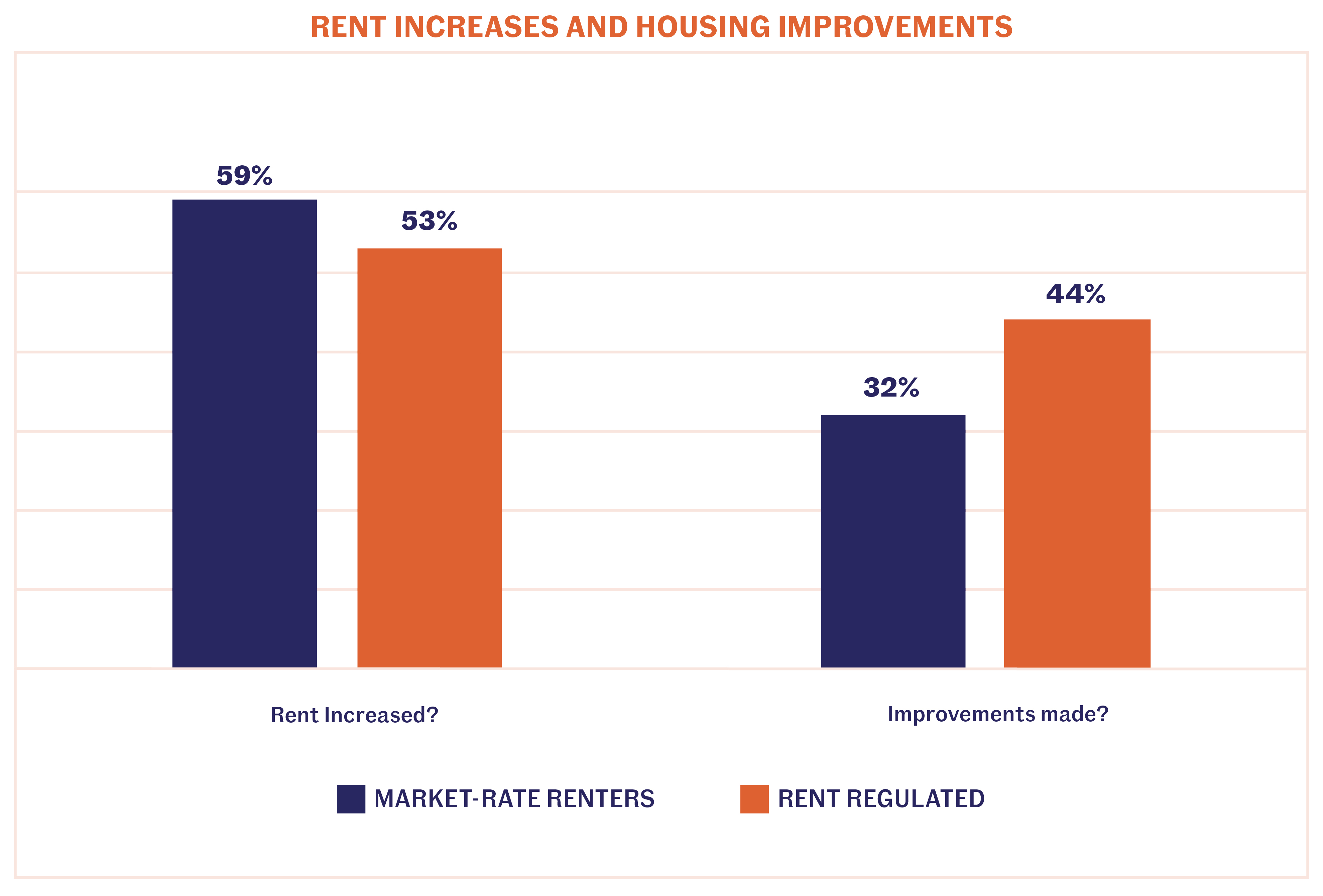
- Most tenants saw no improvement to their building or apartment. Among market rate tenants whose rents rose this past year, only 32 percent saw improvements.
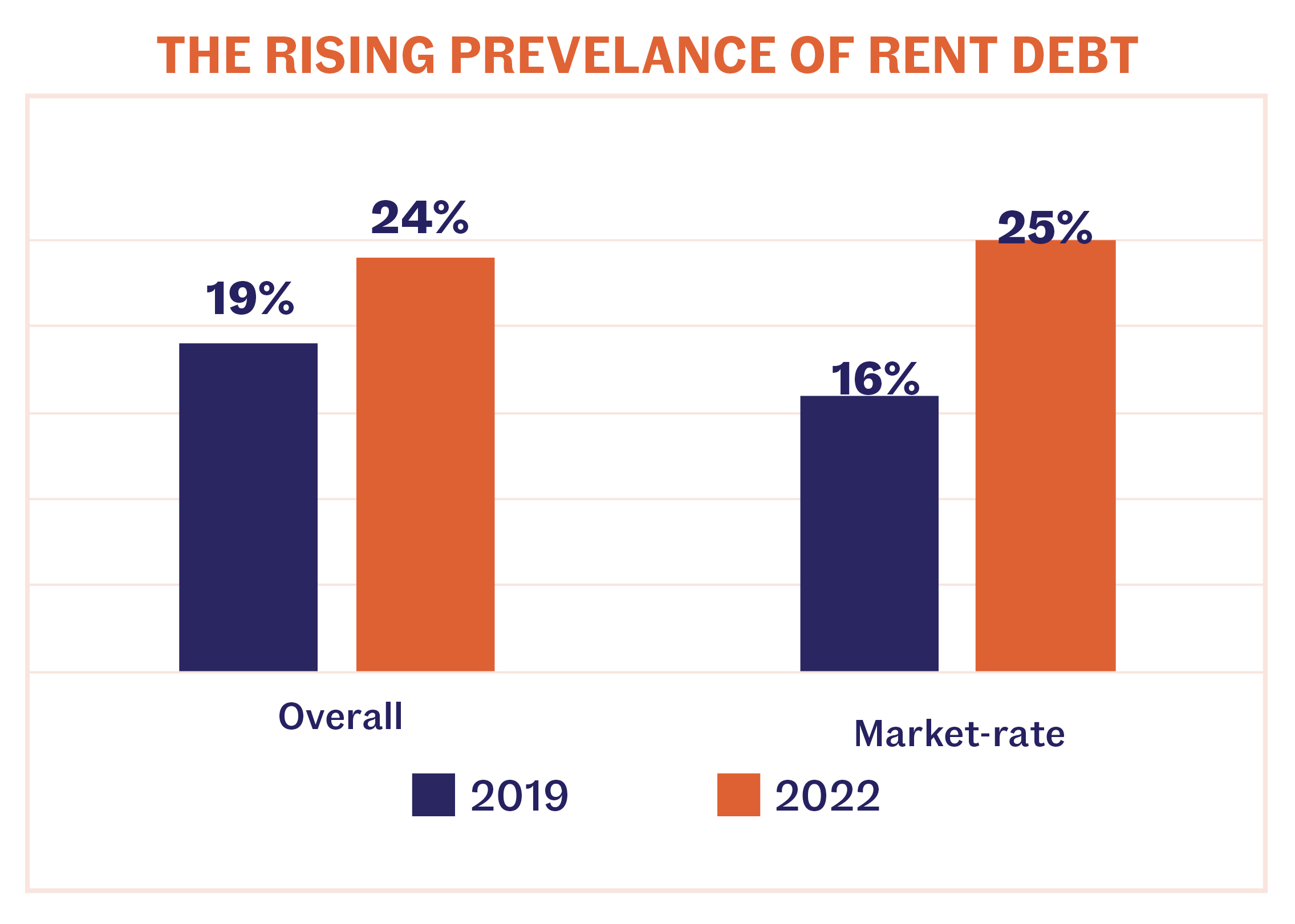
- The percentage of New Yorkers forced to take on rent debt is growing overall. Marketrate tenants are the hardest hit. The percentage of market-rate tenants with rent debt grew from 16 to 25 percent between 2021 to 2022.
- More and more New Yorkers, including 23 percent of those living below the poverty line, had to move in with others because of financial problems.
- All New Yorkers — and especially low-income New Yorkers — rank affordable housing as the single most important thing that would help them advance economically.
More Tenants Saw Their Rents Rise in 2022 than 2021
It has been widely reported that rents in New York City went up this past year. Most of this reporting has relied on asking rent data from online apartment listing sites. According reporting from City Limits using StreetEasy data, “The median rent for a one-bedroom apartment in New York City spiked to $3,267 in August, up 20 percent from three years earlier, the data shows. For a two-bedroom, the median rent reached $3,804 last month—a nearly 27 percent increase from August 2019.”1 According to StreetEasy’s analysis, “tenants priced out of pandemic-era discounted leases generated at least a third (34 percent) of the available inventory” in the second quarter of 2022.[2]
The majority of tenants saw rent increases last year. However, market rate tenants were the most impacted, as compared to 2021. 59 percent saw their rents rise, and none saw their rents fall. The numbers were consistent across incomes. Compared to 2021, this constitutes a 37-point jump for market rate renters — the greatest increase for any housing type.
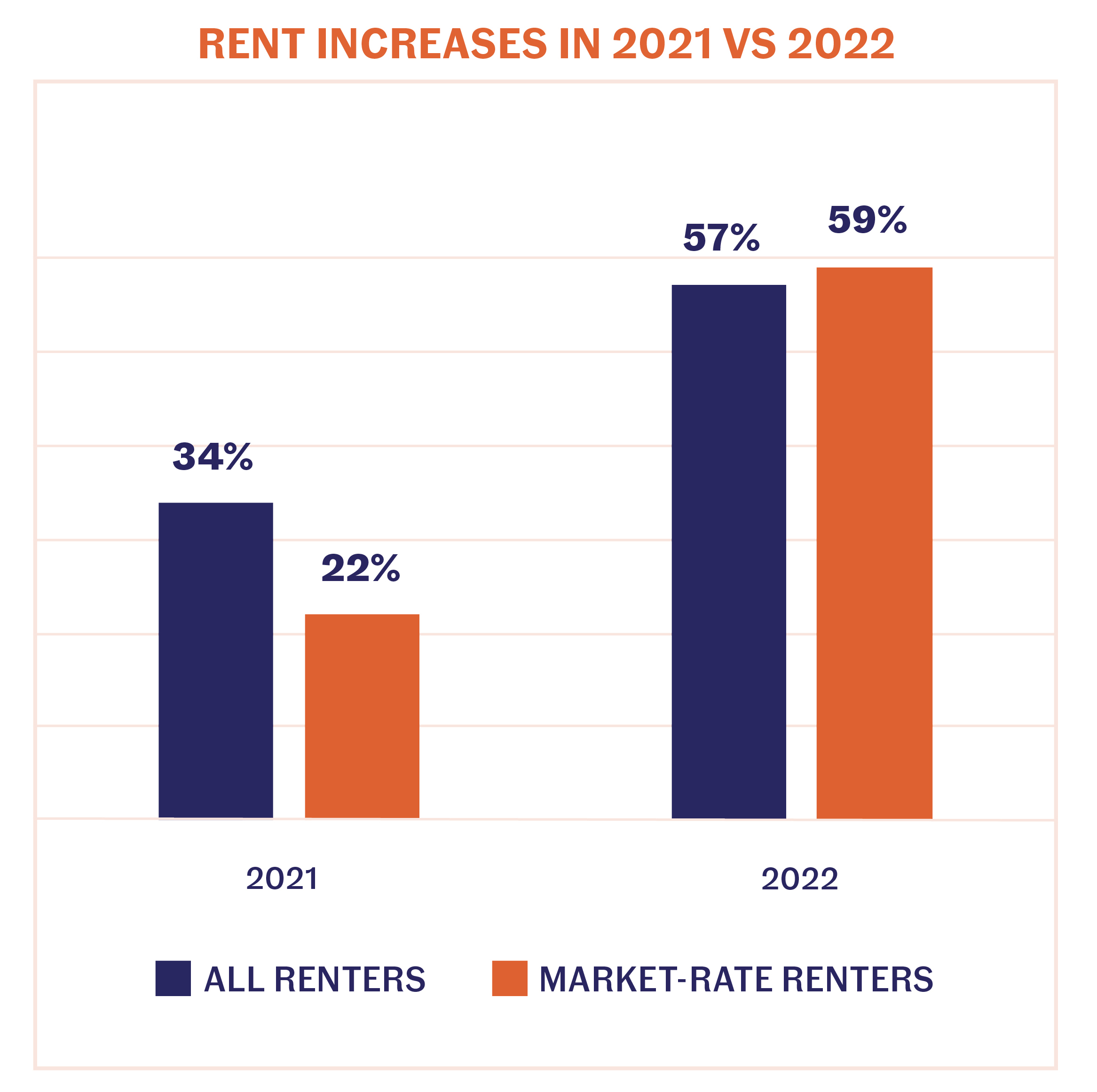
These rent increases are not just affecting highincome renters. A clear majority — 54 percent — of low-income tenants saw their rents rise last year, reflecting a 15-point increase over the previous year.
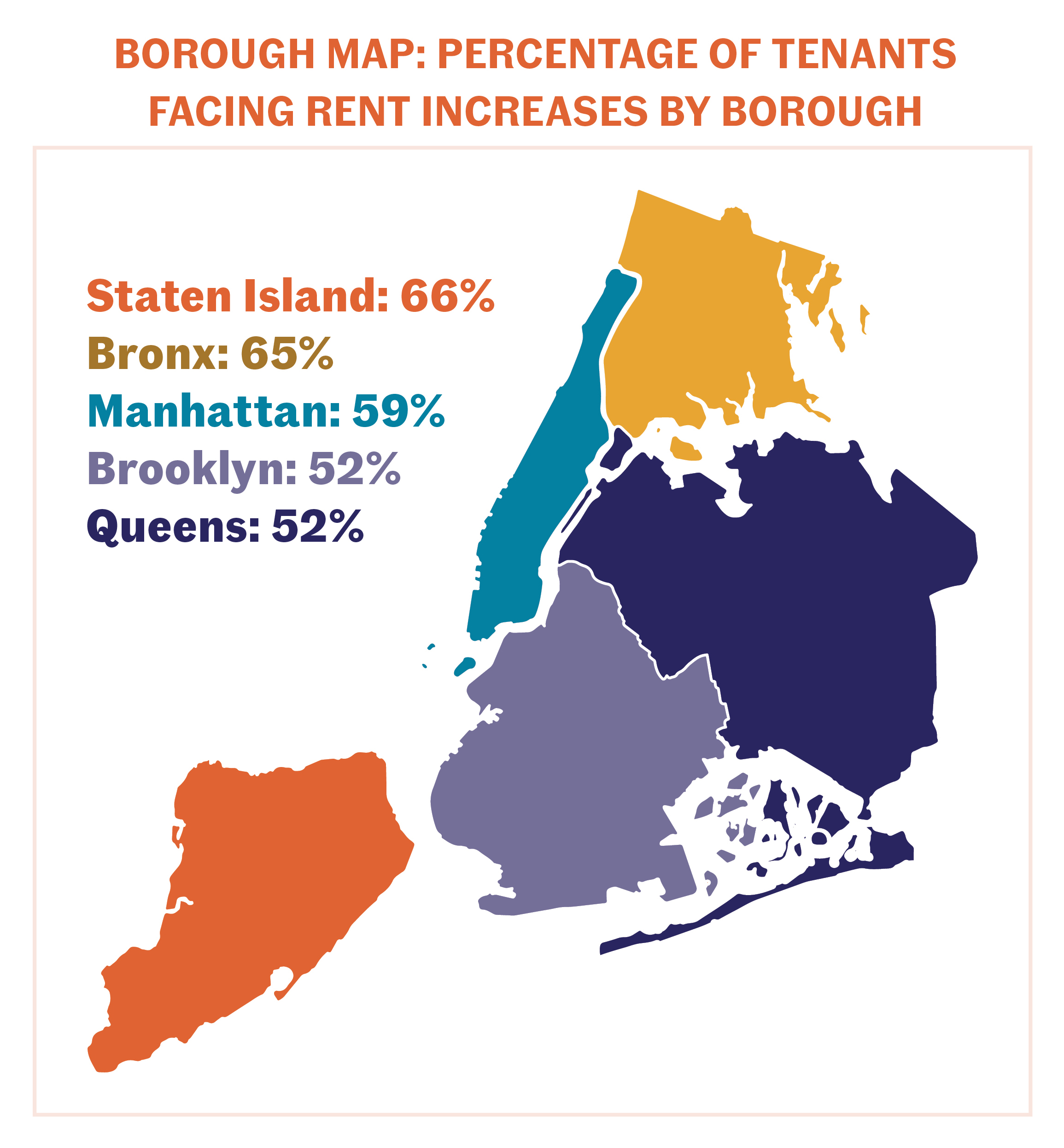
It’s also not just affecting one part of the city. The percentage of tenants facing rent increases was highest in Staten Island — the borough with the lowest proportion of rent stabilized, subsidized or public housing units — and was also high for The Bronx, the city’s poorest borough.
For Many Tenants — and for Market Rate Tenants in Particular — Rent Increases Did Not Come with Apartment or Building Improvements
While a majority of tenants saw their rents increase this past year, an even larger majority reported that their landlord made no corresponding improvement in their apartment or building. Among tenants who experienced a rent increase, less than half (42 percent) saw improvements, with roughly similar outcomes for low and moderate-to-high income tenants.
There were, however, noticeable differences in the rate of improvements by housing type. Rent regulated tenants (44 percent) who experienced a rent increase were 12 points more likely to see improvements in their buildings compared to unregulated tenants (32 percent). While these numbers should be far higher for any tenants experiencing rent increases, they point to an important fact often overlooked in the debates around rent regulation in New York, and beyond: according to our survey data, rent stabilized landlords seem to be more likely to invest in improvements than market-rate landlords. Counter to anti-regulatory arguments, rent regulation does not inhibit investment. Instead, it incentivizes it: making an improvement to a building or an apartment is one of the few ways a landlord can raise rents. Market-rate landlords can simply raise rents based on market signals, while rent-regulated landlords have to do something in their buildings to justify a rent hike beyond the adjustment set annually by the Rent Guidelines Board.
Rent Hikes are Causing Distress, Debt and Displacement
This year’s rent hikes are no trivial matter. While just 9 percent of homeowners reported that being able to afford their monthly housing bills was a very serious problem, far higher rates of tenants raised this as a major concern — and market-rate tenants were particularly worried.
At the same time, the percentage of tenants who have debt from rent rose significantly over the last few years, and the rate of growth has been largest for market-rate tenants.

As a result, many tenants have already fallen behind on rent or expect to soon. A majority — 51 percent — of low-income tenants have either already or will soon fall behind on rent, compared to far lower — though still quite high — 27 percent of moderate- to high-income tenants. This figure is also higher for market-rate tenants (at 44 percent) than rent-regulated renters (at 38 percent).
Eviction attempts, however, are up across the board. As we will discuss more in our next Unheard Third brief, “Assembly-Line Justice,” eviction attempts jumped 5 percentage points from 2021 to 2022, with the biggest increases in Manhattan (+12) and The Bronx (+10). The jump in eviction attempts was steeper for rent regulated tenants (+8) than marketrate tenants (+4). Ironically, this only serves to demonstrate the need for Good Cause eviction protections: whereas landlords have to evict rent stabilized tenants if they want them out, they only have to deny market-rate tenants a lease renewal, a de facto eviction. Passing Good Cause would increase market-rate renters’ ability to stay in their homes.
A growing number of renters are moving out of what are becoming unaffordable apartments, and a substantial proportion of them are moving in with others. The proportion of renters who are doubling- or tripling-up with others in likely overcrowded apartments grew for all income groups, but was highest for the lowest-income and lowest for the highest-income. Moving in with others because of financial problems spiked 13 percentage points from 2021 to 2022 for households living under the federal poverty line.
New Yorkers Believe Housing Costs Are Holding Them Back
In this year’s Unheard Third, we asked New Yorkers what they believe would increase their potential to get ahead economically. Their answer was loud and clear: affordable housing.
46 percent of low-income respondents and 41 percent of moderate- and high-income respondents chose affordable housing as a top priority for themselves personally. This represents a rise in affordable housing as a priority compared to 2021. That rise was visible across the board, but was particularly pronounced for low-income respondents (+9 percentage points) compared to high-income respondents (+5 points). Broken down by housing type, the type of respondents who chose “affordable housing” at the highest rate were market-rate renters, at 58 percent.

Recommendations: Curb Rent Hikes, Strengthen Rent Stabilization, and Help People Pay the Rent
Both the needs and the demands of New Yorkers are clear: we need stronger protections against evictions and rent gouging, and we need tools to make up for the yawning gap between wages and rents. Given the configuration of power at the city and state level, it is State legislators who are best poised to intervene with legislation that would help tenants immediately. In fact, such action is long overdue.
Pass Good Cause Eviction Protections (S3082/ Salazar, A5573/Hunter). This bill would ensure that 1.6 million households across New York State — including about 784,000 in New York City — would have protections against unjust evictions and unwarranted rent hikes. It amounts to a right to remain in one’s home and it gives tenants the right to challenge rent increases greater than 3 percent or 1.5 times the Consumer Price Index. This will not only help protect market-rate tenants against rent gouging and displacement, but will expand tenant power by making it safer for unregulated tenants to organize.
Pass the Housing Access Voucher Program (S2804B/Kavanagh, A3701B/Cymbrowitz). This bill would essentially establish Section 8 for New York State: a state-level rental assistance program to help prevent eviction and homelessness and to rehouse those currently living in shelters or on the streets. With $250 million in first-year funding, this program could provide housing stability for an estimated 16,000 households, or roughly 40,000 people experiencing or at risk of homelessness. The voucher could also be used to ensure deep affordability in new social housing conversions or developments.
About the Unheard Third Survey
The 2022 Unheard Third is a scientific telephone survey of 1,968 New York City adult residents reached by cell phones and landlines from July 12th through August 18th, 2022. It was designed by Community Service Society in collaboration with Lake Research Partners, who administered it using Random Digit Dialing and professional interviewers. The sample included 1,234 low-income residents (up to 200% of federal poverty standards, or FPL), and 734 moderate and higher-income residents (above 200% FPL). Interviews were conducted in English, Spanish, and Chinese. The margin of error for the entire survey is +/- 2.2 percent, for the low-income component is +/- 2.8 percent, and for the higher-income component is +/- 3.6 percent, all at the 95% confidence interval. For further information on the survey please reach out to Emerita Torres at etorres@cssny.org.
Notes
1. David Brand, Ma-Sadio Faye, Quainat Mariam, Manuel Lozano-Velez, Nowshin Rahman, Tiara Soto and Jaelynn Jimenez. “It’s Not Just Manhattan: Rents Are Still Rising Across NYC.” City Limits, September 13, 2022.
2. Kenny Lee. “As Pandemic-Era Leases Expire, NYC Renters Face Toughest Market in Decade.” StreetEasy.com, July 26, 2022. This kind of reporting — while undoubtedly valuable —undercounts rent dynamics in housing most low-income New Yorkers live in by relying on asking rents and not factoring in housing types that are not listed on websites like Zillow and StreetEasy. Our Unheard Third survey, however, shows that many of the same dynamics are facing low-income market rate tenants.