Financial Hardship, Avoiding Care: Results from a Statewide Survey
Amanda DunkerElisabeth Ryden Benjamin
New Yorkers in every part of the state are struggling with health care costs and expect the government to take action, according to a new poll conducted by PerryUndem and Betty&Smith. Survey regions included Buffalo/Rochester, Long Island, New York City, Westchester/Hudson Valley, and the rest of the state.
Over half (53 percent) of New Yorkers fear being unable to pay for basic health care, and nearly 70 percent believe they would be unable to afford care in the event of a major illness. Four in 10 New Yorkers (38 percent) say that they are sacrificing health care because of costs (e.g. delayed care, cutting pills, avoided care, or didn’t fill a prescription). Three in 10 have appealed or questioned a bill and one in five have paid a bill they didn’t think they owed for fear of being placed in collections.
New Yorkers want action on health care costs. Over 90 percent of New Yorkers agree that health care needs to be made affordable for everyone, not just some people. Nearly seven in 10 New Yorkers blame the government, health insurers, drug companies, and hospitals—in that order—for failing to control costs. Three-quarters of respondents say that systemic racism is a problem in the U.S. health care system, with Black and Latinx respondents, women, and Democrats more likely to perceive systemic racism.
The survey explored specific policy solutions, described below, for improving the health care system for patients. These include prohibiting hospitals from placing liens on patients’ homes or garnishing their wages; removing barriers to care based on immigration status; and funding for an independent consumer assistance program.
Support for Medical Debt Reform: Prohibit Hospitals from Placing Liens on Patients’ Homes or Garnishing Wages
Prior CSS research found that over 52,000 New Yorkers were sued by nonprofit hospitals between 2015 and 2020 for a median amount of just $1,900. Patients typically lose these lawsuits, having no means to retain an attorney or inability to cut work to appear in small claims court. These medical debt judgments disproportionately affect low-income New Yorkers and people of color.
Hospitals report to the Department of Health that they filed nearly 5,000 liens on patients’ homes in these medical debt cases in 2017 and 2018. Thousands more patients have had their wages garnished over medical debt judgments, many of whom are low-wage workers at retail stores and fast food restaurants.
The majority of New Yorkers (70 percent) support legislation that would prohibit medical providers from placing liens or garnishing wages to collect a medical debt judgment. The State Legislature is considering a bill (S6522/A7363) that would achieve this, with two editorial boards expressing strong support (Syracuse Post Standard and the Daily News). The bill was introduced by Senator Rivera and Assemblymember Gottfried and has 15 Senate co-sponsors and 34 Assembly co-sponsors.
Strong Support—Across Regions—for Coverage for Excluded Immigrants
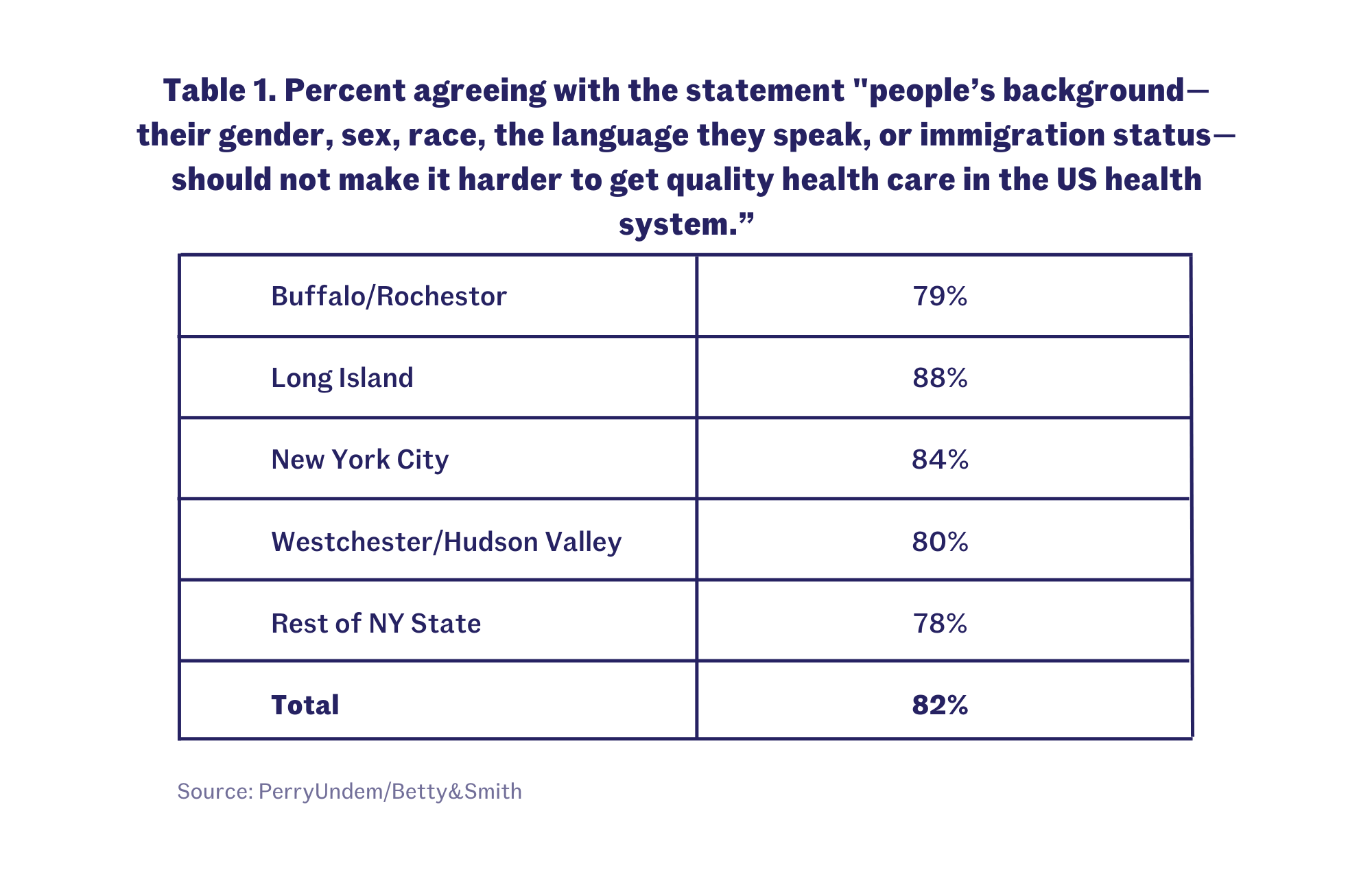
Eight in 10 New Yorkers agreed that gender, age, and immigration status should not make it harder to get health care. This was true for Democrats (90 percent), Independents (80 percent), and Republicans (76 percent). It was also true for every region in the state, with especially strong support (88 percent) in Long Island (see Table 1).
The Citizens Budget Commission and the Community Service Society issued a report earlier this year that estimates that 245,000 immigrant New Yorkers are uninsured because of their status. Two measures in Albany would help address this situation.
- The Coverage4All bill (S1572/A880) would create a state-only funded Essential Plan program. People enrolled in this program would meet the same income requirements as everyone else (200 percent of the federal poverty level or $27,180 per year) and would receive the same benefits as everyone else.
- Equity for pregnant people bill (S1411B/A307B) would ensure that all income-eligible people receive Medicaid for 12 months postpartum. Governor Hochul proposed an expansion to 12 months in the Executive Budget, but excluded immigrant New Yorkers.
Support for Independent Consumer Assistance Programs
Four in 10 respondents reported either fighting a bill that was wrong (31 percent) or just paying a bill that they thought was wrong to avoid being sued or harassed by their provider (20 percent). Medical billing should not be this difficult. Seventy-three percent supported funding an independent consumer assistance program to help patients with these medical billing problems. New York’s consumer assistance program, the Community Health Advocates (CHA), helps over 30,000 people every year, saving them $36 million annually. CHA advocates reduce or eliminate the bills in 84 percent of cases and overturn insurance denials in 89 percent of cases.
This survey confirms what many people already know: health care affordability is a grave concern for New Yorkers, with a majority believing that the government needs to take leadership on bringing down costs, regulating medical, debt and addressing health equity concerns.