Discharged Into Debt: Medical Debt and Racial Disparities in Albany County
Elisabeth Ryden BenjaminAmanda Dunker
In March 2020, CSS issued Discharged Into Debt, a report that documented how New York’s charitable hospitals sued approximately 50,000 New Yorkers in the prior five years. In January 2021, CSS issued A Pandemic Update, profiled in this New York Times article, which found that many charitable hospitals had continued suing patients throughout the pandemic, when these patients had little ability to defend themselves because of COVID-related court closures.
This brief examines the medical debt crisis in Albany County. Not only do 12 percent of Albany residents have delinquent medical debt on their credit reports, but there are profound racial disparities related to who is in debt. While 10 percent of white residents have medical debt, two and half times—or 26 percent—of residents of color have medical debt in Albany.[1]
Compounding the problem, Albany County is a New York State medical debt litigation hotspot. Between 2015 and 2020, five nonprofit charitable hospitals sued 2,900 Albany residents.[2] Not even the once-in-a-century pandemic proved to be a deterrent. Albany’s hospitals continued to sue right through the height of the COVID-19 crisis, filing 548 lawsuits between March and December 2020.
Just five hospitals are responsible for filing lawsuits against patients in Albany. Three of those belong to the Catholic-sponsored St. Peter’s Health Partners network (Albany Memorial, St. Peter’s, and Samaritan hospitals) and are responsible for 71 percent of all medical debt lawsuits in the area. A fourth, Ellis Hospital, soon to be acquired by St. Peter’s Health Partners, is responsible for an additional 5 percent. Albany Medical Center has generated the majority of the remaining area lawsuits against patients (23 percent). As a portion of the number of patients they see (discharges), the most litigious hospitals are Albany Memorial and Samaritan, both of which are part of the Catholic-sponsored St. Peter’s system.
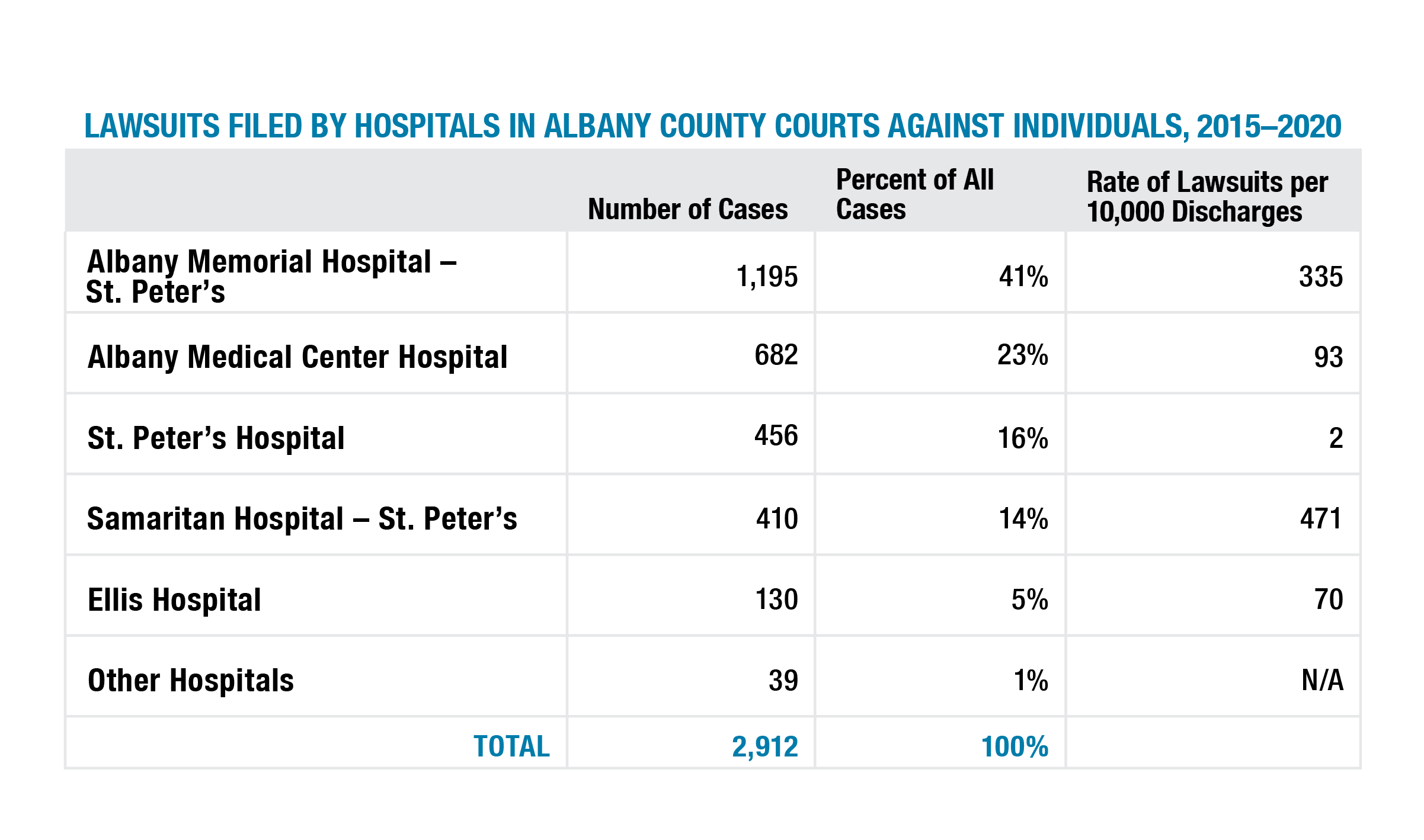
Albany-area hospitals are disproportionately suing residents in low-income, uninsured communities of color
An analysis of a representative sample of lawsuits in Albany County indicates that the communities most burdened by hospital lawsuits are communities of color, low-income communities, and communities with high rates of uninsurance (see Methodology for more information). New York hospitals are required to offer financial assistance to uninsured patients with incomes below 300 percent of the federal poverty guidelines (around $52,000 for a household of two people).[4] Yet this law does not appear to be working very well for Albany-area residents:
- 28 percent (95) of patients in the sample live in communities where the majority of residents are people of color.[5] 64 percent (217 patients) live in communities where over 25 percent of the population are people of color.
- 26 percent (89) live in communities where half or more of households have an income below $50,000.[6] Half of the patients in the sample live in communities where the median household income is less than $53,000.
- 30 percent (103) of the patients in the sample live in communities where the uninsured rate is more than the state’s overall rate of uninsurance—5 percent.[7]
The high rates of lawsuits in neighborhoods with low incomes and high rates of uninsurance suggest that the hospitals have failed to effectively screen eligible patients for financial assistance, despite their charitable missions.
Hospitals sued for relatively small judgment amounts
The median amounts claimed by hospitals against Albany County residents was just $1,955 and the median judgment was $2,190—indicating that court fees and the statutory interest rate of 9 percent are taking their toll against patients. If this pattern is consistent for the rest of the lawsuits filed in Albany County, it means the total amount of judgments sought by these hospitals was around $5.7 million for the entire five-year period. Altogether, the Albany-area hospitals that sued patients for this $5.7 million received roughly $24 million from the state’s Indigent Care Pool in 2019. This ICP program is designed to financially support hospitals’ uncompensated care costs and incentivize them to provide financial assistance to low- and moderate-income patients. However, the Albany hospitals only report spending $12 million on financial assistance for eligible patients in 2019—effectively creating a one-year windfall of $12 million, which is more than double what they sought in court for the entire five-year period CSS researched.
Hospitals are garnishing patients’ wages
Wages were garnished in 27 cases (8 percent of the sample). If this pattern is consistent for all the lawsuits filed in Albany County, it means that 234 county residents have had their wages garnished by hospitals in the past five years. A review of the wage garnishment data indicates that these patients do not work in particularly lucrative positions. The most common employers of the patients whose wages were garnished are health care providers, followed by retailers like Wal-Mart and Denny’s and then manufacturers.[8]
Patients face multiple lawsuits
Eighty-one defendants (24 percent of the sample) had been sued multiple times by hospitals and other health care providers. Twenty-five people in the sample had been sued three or more times, including one woman from the community of Watervliet who was sued by seven different providers: two hospitals, an independent emergency room doctors’ group, an ambulance company, and three large health care systems.
The records search produced enough examples to say more about the typical actions taken at three of Albany’s most litigious hospitals (Samaritan - Albany Memorial, Albany Medical Center, and Samaritan Hospital).[9] The random sample did not include enough cases from St. Peter’s Hospital or Ellis Hospital to be representative.
Profile of Samaritan Hospital and Albany Memorial Hospital (Samaritan)
Samaritan has two locations: Samaritan Hospital, a 257-bed facility in Troy; and Albany Memorial, a 165-bed hospital in the city of Albany. The Samaritan hospitals are part of the Catholic-sponsored St. Peter’s Healthcare Partners (SPHP) network, which also includes St. Peter’s Hospital in Albany. Samaritan’s two campuses were responsible for 55 percent of all lawsuits filed against patients in Albany County (1,605 cases). Together, the two campuses sued 257 patients after the pandemic started.
The Samaritan campuses receive far more funding from the state's ICP than they provide in financial assistance to patients. In fact, the state's ICP payments are so much higher than the amount they spent on financial assistance for patients that the excess could pay for all the medical debt that the hospitals have sought through the court process. For example, New York State gave the two campuses $5.2 million in ICP funding in 2019—but together they only spent $90,000 on financial assistance.[10] The lawsuits Albany Memorial and Samaritan brought against patients during the five years CSS researched were worth $3.5 million—less than the windfall they received in just one year through the ICP program.[11]
Even more egregiously, Samaritan’s two campuses are also aggressively placing liens on their patients’ homes—233 liens in 2018 alone, calling into question how this practice of impoverishing its patients can be reconciled with either its charitable or religious missions.
Both hospitals also make it more difficult for low-income patients to apply for financial assistance by requiring an asset test before approving applications. The state’s Medicaid program also required an asset test until the enactment of the Affordable Care Act eliminated this eligibility barrier. New York’s Hospital Financial Assistance law was written before this change, so it contains the now-obsolete asset test for New Yorkers at Medicaid income-levels only, not for people who have higher incomes. Nearly all insurance programs, including all programs offered through the NY State of Health Marketplace, do not have asset tests. The Patient Medical Debt Protection Act, a bill pending before the state legislature, would modernize New York’s out-of-date Hospital Financial Assistance Law by eliminating the asset test and modernizing other eligibility provisions.[12]
Profile of Albany Medical Center
Albany Medical Center is a 748-bed hospital in the city of Albany. It has sued 682 patients since 2015 (23 percent of all patients sued in Albany County), including 19 patients sued during the pandemic. The median amounts Albany Medical Center claimed against patients was $1,600, meaning that the hospital is suing its patients for an estimated $1.1 million altogether. Albany Medical Center receives about the same amount from the Indigent Care Pool as it reports spending on patients eligible for financial assistance. It places fewer liens on patients’ homes than the SPHP hospitals described above, but nonetheless it placed 43 liens in 2018.
There is a stronger association in the sample between race and lawsuits filed by Albany Medical Center than in the sample for all of Albany County or the Samaritan campuses. About 43 percent of the patients Albany Medical Center sued lived in zip codes where a majority of residents were people of color, compared to 28 percent of all the Albany County lawsuits and 23 percent of all the lawsuits filed by Samaritan and its Albany Memorial Campus.
Conclusion
Albany county is a medical debt litigation hotspot. The hospitals there typically receive far more in state Indigent Care Pool funds than they are seeking in their low-dollar court cases against their patients and appear to be disproportionately suing low-income patients of color. Enactment of the Patient Medical Debt Protection Act would protect Albany-area patients by improving the state’s Hospital Financial Assistance Law and preventing charitable hospitals from seeking a 9 percent commercial interest rate on their court judgments. While these cases do little to improve the financial health of the suing hospitals, they do much to ruin the lives of the patients they sue.
Methodology
CSS used the Ecourts website to find every lawsuit in which a New York State hospital was the plaintiff and the defendant was an individual. Ecourts allowed CSS to see the number of lawsuits filed, the hospitals filing the lawsuits, the defendants’ names, and the location in which the lawsuits were filed. E-courts also provides the month that lawsuits were filed which allowed CSS to identify the number of lawsuits filed during the pandemic.
Partial documentation for the lawsuits identified through Ecourts is available online through most County Clerk’s offices. CSS used a random number generator to create a representative sample of cases filed in Albany County courts, then searched for defendants’ names using the Albany County Clerk’s website. CSS searched the Clerk’s website for 480 defendants who were originally identified through Ecourts, which produced documentation on 339 lawsuits. Additional data provided through this search includes the defendants’ zip codes, amounts claimed by hospitals, documentation when wages have been garnished, and judgment amounts. The zip code data was compared to United States Census Bureau information about race, income, and insurance coverage in the communities in which patients had been sued.
Data on the hospitals’ financial assistance policies and liens placed on patients’ homes was located using the hospitals’ Institutional Cost Reports, which are submitted to the state Department of Health. Discharge data was provided through the state’s SPARCS dataset, most recently updated in 2017. CSS identified affiliations between hospitals using their websites.
Acknowledgments: Marielle Ray and Emily Roach provided valuable research support for this brief.
Read more from our Discharged Into Debt series
[1] Urban Institute, “Debt in America: An Interactive Map,” December 2019, https://apps.urban.org/features/debt-interactive-map/?type=overall&variable=pct_w_medical_debt_in_collections&state=36&county=36075
[2] The eCourts website allows searches by plaintiff; CSS searched for all of New York’s hospitals to get the total number of patients sued. See Amanda Dunker and Elisabeth Benjamin, “Discharged Into Debt: New York’s Nonprofit Hospitals Are Suing Patients,” Community Service Society of New York, March 2020, https://www.cssny.org/publications/entry/discharged-into-debt for more information about the methodology for finding lawsuits.
[3] Total lawsuits filed statewide 2015-2017 compared to discharge data for 2015-2017 available through SPARCS. 2017 is the most recent year for which there is discharge data.
[4] New York Hospital Financial Assistance Law, N.Y. Pub. Health L. §2807-k.
[5] United States Census Bureau, American Community Survey: Demographic and Housing Estimates (Table DP05), 2019: ACS 5-Year Estimates.
[6] United States Census Bureau, American Community Survey: Income in the Past 12 Months (Table S1901), 2019: ACS 5-Year Estimates.
[7] United States Census Bureau, American Community Survey: Selected Characteristics of Health Insurance Coverage in the United States (Table S2701), 2019: ACS 5-Year Estimates.
[8] Employers: Albany Foam and Supply, Albany Medical Center, Capital District Medical Transportation, CDPHP, Center for Disability Services, Computer Technology Services, Daughters of Sarah Nursing Home, Delhaize America, Dennys, DKI Engineering, Frank J. Ryan and Sons, Hannaford Distribution Center, Mohawk Opportunities, North Colonie Schools, NYS ARC, Old World Provisions, Recovery Sports Grill, Seton Health, Stewarts, Unicell Truck Equipment, Upstate OB/GYN Associates, the VA Hospital, and Walmart.
[9] The sample includes 80 lawsuits filed by Albany Memorial, 108 filed by Albany Medical Center, and 82 filed by Samaritan Hospital.
[10] Information about uncollected amounts for patients eligible for financial assistance is available in Exhibit 50 of the Institutional Cost Reports hospitals submitted to the New York State Department of Health for calendar year 2018. ICP distributions were provided by the New York State Department of Health.
[11] The median claim was $2,169, multiplied by 1,605 lawsuits.
[12] Patient Medical Debt Protection Act S.2521A/A.3470A.
CSS is grateful to Robin Hood for its generous support of the End Medical Debt campaign.
