x

Enforce and Defend the Housing Stability and Tenant Protection Act (HSTPA)

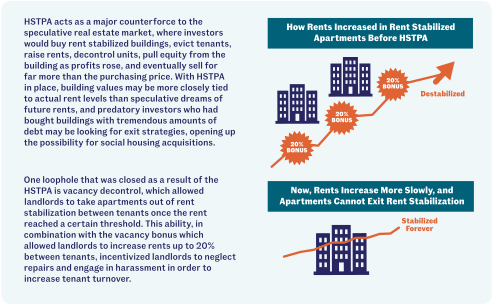
New York State took a crucial step in protecting tenants and, by extension, creating the conditions for social housing expansion, by passing the Housing Stability and Tenant Protection Act of 2019 (HSTPA). This legislation, championed by the Housing Justice for All Coalition, marked a major victory for tenants across the state, including tenants living in counties covered by the state’s rent stabilization laws, and those in jurisdictions that are opting-in for the first time. The law closed numerous loopholes that incentivized steep rent increases and tenant displacement, including vacancy decontrol, which allowed landlords to permanently remove units from rent stabilization.

HSTPA acts as a major counterforce to the speculative real estate market, where investors would buy rent stabilized buildings, evict tenants, raise rents, decontrol units, pull equity from the building as profits rose, and eventually sell for far more than the purchasing price. With HSTPA in place, building values may be more closely tied to actual rent levels than speculative dreams of future rents, and predatory investors who had bought buildings with tremendous amounts of debt may be looking for exit strategies, opening up the possibility for social housing acquisitions.

Now that HSTPA is the law, it must be defended and enforced. There are a series of legal challenges from landlords who hope to strike down either major portions of HSTPA, or the law in its entirety. In order to protect this victory and to preserve the ground on which tenants can organize and social housing conversions can take place, the state must vigorously defend this law in the courts.

At the same time, New York State Homes and Community Renewal (HCR), the agency tasked with enforcing HSTPA, must issue new regulations that clarify how the agency and the state will enforce the law. While HCR sent preliminary regulations to then-Governor Cuomo, he did not sign them, putting the entire process in limbo, leaving tenants without all of the legal protections to which they are entitled. New York State must immediately issue new regulations, clarifying important questions around rent increases and challenges, rent registration, agency transparency, and more.

Connections

» (i) Enact Progressive Taxes to Raise Revenue and Curb Speculation, (ii) Fund Housing Organizing, (iii) Pass Good Cause Eviction Protections.

» To defend the HSTPA, we need additional tools to make speculation less attractive, and expanded resources for tenants who want to fight back against deregulation. Most importantly, we need a unified right to baseline tenant protections across the state, so that tenants across counties, housing types, and rent regulation regimes can fight together to defend and enforce tenant protections.

Potential Impact

» The passage of the HSTPA had the most immediate impact on the approximately 1,022,400 that are rent-stabilized or rent- controlled in New York City. If the HSTPA were to be weakened, it would mean that households in these units would again be under increased threat of displacement because of rising rents or deregulation. Outside of NYC, the HSTPA created the right for new municipalities and counties to opt in to rent stabilization and contained changes to the Real Property and Proceedings Law which gave tenants more power in non-NYC courts.
Next

x

Pass Good Cause Eviction Protection

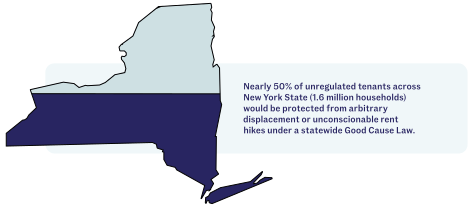
Nearly half of New York State’s tenants do not have the fundamental right to a lease renewal. This includes tenants outside of New York City and a portion of municipalities in Westchester, Rockland, and Nassau counties, as well as tenants in properties less than six units, in newer rental buildings, and in older buildings that have been fully or partially deregulated.

Providing tenants across the state with the universal right to a renewal lease, the monthly rent of which would be capped at a reasonable maximum increase, would go a long way toward expanding the opportunity for social housing conversions. This right — which is generally referred to as Good Cause Eviction Protection, or the Right to Remain — fundamentally shifts the balance of power between tenant and landlord. Without it, landlords can, in essence, evict a tenant at the end of their lease term, simply by denying them a new lease, or by offering one at an unaffordable rent level. This power imbalance makes organizing in any rental housing without good cause eviction protection nearly impossible, because of the looming threat of landlord retribution.

A statewide Good Cause law would work with existing tenant protections to create the conditions for tenants to organize in their buildings, to limit speculation in rental buildings not covered by HSTPA, making it easier for tenant unions, localities, and nonprofits to pursue social housing conversions. Despite significant grassroots support, New York State legislators failed to pass statewide Good Cause Eviction Protection in 2022.

Connections

» (i) Pass Statewide Right to Counsel, (ii) Expand and Reform 7A Administration, (iii) Rent Abatement in Housing Court.

» Passing Good Cause / Right to Remain requires more legal resources across the state to defend and enforce those rights in court. Additionally, these protections allow tenants to pursue bolder organizing strategies to demand safe, stable, and affordable housing from their landlords that they might not otherwise, for fear of not being offered a renewal lease.

Potential Impact

» Creating a statewide Good Cause / Right to Remain would protect an estimated 1.6 million households across New York State who are currently vulnerable to arbitrary displacement or unconscionable rent hikes. This constitutes nearly half of tenants statewide (excluding tenants who already have such protections, like those living in rent stabilized or Section 8 housing, or those living in types of housing not included in this bill, such as owner-occupied small properties).

Back

Next

x

Pass Statewide Right to Counsel

Right to Counsel laws provide tenants facing eviction or taking legal action against their landlord with a lawyer. Some landlords use the threat of eviction as an intimidation tactic against tenants who are organizing, or as a method for systematic displacement of long-term tenants with low rents. The right to a lawyer lowers the rate of spurious eviction filings, and helps tenants fight back against them when they are filed.

Because of the work of the Right to Counsel Coalition, New York City’s low-income tenants are eligible for free legal counsel when they are sued for eviction. But there is more work to be done: first, these rights must be expanded across the state, so that all tenants can have these crucial protections. Next, eligibility should be increased to include all tenants regardless of income; and finally, Right to Counsel should be expanded to cover other kinds of housing cases, particularly tenant-initiated cases.

The expansion of Right to Counsel must be paired with adequate financial resources to hire more tenant lawyers across the state. New York City’s experience after the pandemic shows that appropriate levels of funding and staffing are paramount for these laws to function. This is especially important for lawsuits where a tenant or tenant association takes legal action against their landlord to demand repairs, fight predatory behavior, or demand the temporary removal of the landlord’s control over building management. Tenant-initiated lawsuits are crucial for holding landlords accountable, but are often time- intensive and take deep knowledge of local and state housing laws. The legal capacity to support such efforts are lacking, particularly outside of New York City.

Just like with the HSTPA and Right to Remain, an expanded and adequately funded Right to Counsel law can help support social housing conversions by strengthening tenants’ ability to exercise their rights, and elevate tenants’ safety over landlords’ profits. Despite ample evidence of Right to Counsel’s success in New York City since 2017, New York State legislators failed to pass statewide Right to Counsel in 2022.

Connections

» (i) Pass Good Cause Eviction Protections, (ii) Create Statewide Housing Code Standards, (iii) Expand and Reform 7A Administration.

» An expansion of Right to Counsel would both protect tenants from unjust evictions and add capacity for tenant- initiated actions against negligent or predatory landlords.

Potential Impact

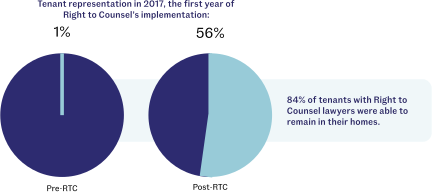
» In 2017, the first year of Right to Counsel’s implementation, tenant representation in affected areas went from 1% to 56%, and 84% of tenants with Right to Counsel lawyers were able to remain in their homes. Meanwhile, the number of eviction cases filed dropped 11% in Right to Counsel areas, compared to a 2% decline in comparable but uncovered areas.

Back

Next

x

Enact a Right to Know (Open Books) Law

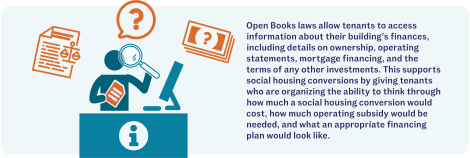
Another way to both bolster tenant power and lay the groundwork for social housing conversions is by strengthening tenants’ ability to access information about their building’s finances, including details on ownership, operating statements, mortgage financing, and the terms of any other investments. Currently, tenants can only guess about their building’s finances, culling together information about their landlord’s income by asking their neighbors about their rents and making assumptions about building expenses. Landlords benefit from this information asymmetry; the less tenants know, the easier it is for landlords to skirt legal obligations to provide repairs, thwart organizing efforts, and hide financial distress, including vulnerability to foreclosure.

An Open Books law would support social housing conversions by giving tenants who are organizing the ability to think through how much a social housing conversion would cost, how much operating subsidy would be needed, and what an appropriate financing plan would look like. Giving tenants access to information about their building’s finances is not without precedent. Under New York City’s 1947 rent control law and the Mitchell Lama program, landlords have to open their books to justify rent increases.

On a broader level, Open Books legislation could serve as the basis for aggregate data on landlord portfolio sizes, net worth, and profits. Without public access to this data, landlords are able to dictate certain terms of the public discourse around housing. In hearings held by the Rent Guidelines Board to determine rent increases for rent stabilized housing, for instance, landlords and investors often argue that they struggle to make necessary repairs because of limited rental income, without being required to disclose information to substantiate those claims. Beyond helping tenants intervene in their own buildings, Open Books legislation would provide a level of transparency at a macro level, which can help build political capital for policies supporting social housing conversions.

Connections

» (i) Pass Tenant / Community Opportunity to Purchase, (ii) Provide Operating Subsidies and Housing Vouchers, (iii) Enforce and Defend the Housing Stability and Tenant Protection Act.

» Understanding their building’s operating costs can help tenants employ their right of first refusal. A fuller picture of how landlords generate profit could also help defend tenant protections against the real estate narrative that rent regulation inevitably leads to disinvestment.

Potential Impact

» Open Books legislation could provide clarity on the role of bank mortgages. Mortgages on rent-stabilized buildings are assumed to be a way to provide funds for operating and capital costs. Debt service on those mortgages is therefore considered a necessary expense. However, in many cases it is more accurate to see mortgage money as a way to leverage buildings and, when possible, profit by pulling equity out. Landlords who claim that they cannot meet expenses at current rent levels should be forced to explain where the use of debt proceeds has gone.

» While information on this topic is scarce, available data shows that, in many parts of New York City, between 40% - 50% of the rental income goes to making mortgage payments, equal to or more than the money invested back into the building as expenses. If that money was used to finance other building purchases or grow their own personal net worth, that should affect landlords’ ability to command rent increases. Tenants have a right to know these details about the way that their buildings operate and how their landlords profit.

Back

Next

x

Pass Clean Hands Legislation

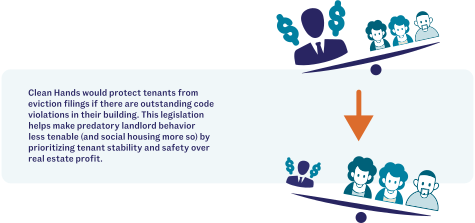
Another way to protect tenants and make predatory practices less profitable is by making a landlord’s right to file an eviction contingent upon the provision of safe and adequate housing. Across New York State, low-income tenants in particular commonly deal with both substandard housing and high rates of eviction. In other words, in the current reality, landlords can indefinitely shirk their legal responsibility to provide decent housing, but maintain the right to file evictions against households as soon as they fall behind on rent or if they see the promise of gentrification and higher rent levels. This logic, wherein tenants can be evicted after having borne the burden of an illegal reduction of services on the part of their landlord, needs to be challenged.

New York’s Right to Counsel coalition proposes to do exactly that, by advocating for what is known as Clean Hands legislation, as part of the Housing Courts Must Change campaign. Ideally, Clean Hands would protect tenants statewide from eviction filings if there are outstanding code violations or contraventions of the Warranty of Habitability (section 235-b of the Real Property Law). If such issues do exist, Clean Hands would make it the responsibility of the landlord to prove that substandard conditions have been cured before proceeding with an eviction filing, requiring a written affidavit that could be challenged by the tenant in court. Like other policies in this section, Clean Hands legislation helps make predatory landlord behavior less tenable, and social housing more so, by prioritizing tenant stability and safety over real estate profit.

Connections

» (i) Create Statewide Housing Code Standards, (ii) Allow for Rent Abatements in Housing Court, (iii) Pass Good Cause Eviction Protections.

» Like the ability to sue for a rent abatement because of substandard conditions, Clean Hands would be an important tenant- initiated action to ensure that robust housing code standards are followed in practice. Clean Hands only works if tenants are assured the right to a renewal lease; otherwise, a landlord who operates housing in poor condition could simply wait out a lease and remove a tenant at the end of that period.

Potential Impact

» In 2019, at least 84% of properties in New York City where there was one or more eviction filing also had at least one open Housing Maintenance Code violation. While it is difficult to know whether those violations were outstanding at the time of court filing, this figure reinforces the idea that eviction filings take place predominantly in properties where landlords do not fulfill their responsibility to provide safe and decent housing.

Back

Next

Tenants’ Rights and Protections

(click around the image to learn more)
< Back

Enforce & Defend Housing Stability & Tenant Protection Act

Enforce & Defend Housing Stability & Tenant Protection Act

HSTPA acts as a major counterforce to the speculative real estate market.

BannerJurisdiction: State BannerBudget: Revenue Neutral Banner BannerProcess: Judicial and Administrative

Learn more

Pass Good Cause Eviction Protection

Pass Good Cause Eviction Protection

Nearly half of New York State’s tenants do not have the fundamental right to a lease renewal.

BannerBannerBannerJurisdiction: Local and State, or Federal BannerBudget: Revenue Neutral BannerProcess: Legislative Learn more < Back
< Back

Pass Statewide Right to Counsel

Pass Statewide Right to Counsel

Right to Counsel laws provide tenants facing eviction or taking legal action against their landlord with a lawyer.

BannerJurisdiction: State BannerBudget: Operating BannerProcess: Legislative
Learn more

Enact Right to Know / Open Books

Enact Right to Know / Open Books

Open Books laws allow tenants to access information about their building’s finances.

BannerJurisdiction: State BannerBudget: Revenue Neutral BannerProcess: Legislative Learn more < Back
< Back

Pass Clean Hands Legislation

Pass Clean Hands Legislation

Clean Hands would protect tenants from eviction filings if there are outstanding code violations in their building. Learn more

BannerJurisdiction: State BannerBudget: Revenue Neutral BannerProcess: Legislative
Cloud Cloud Cloud Cloud Cloud Cloud Cloud Cloud Cloud
Activists Activists Activists