The most direct way for municipalities to convert buildings into social housing is to use public property, particularly the vacant, abandoned, tax-delinquent, or otherwise distressed lots and buildings over which local governments have jurisdiction. Employing this distressed stock towards the creation of social housing, however, requires a major shift away from long-standing practices on two fronts. First, municipalities and public agencies must stop passing publicly- owned property to private actors. Second, they must return to the bold use of tools like municipal foreclosure, and even eminent domain, to acquire and transfer private housing under poor stewardship to social housing entities
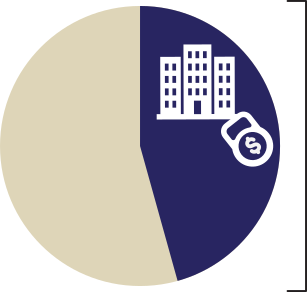
Today, the predominant policy goal in public property disposition is to return them to the tax rolls, providing the economic justification for transferring properties to private actors at extremely discounted prices. An analysis by the Association for Neighborhood Housing and Development, for instance, found that between 2014 and 2018, 75 percent of New York City’s vacant public land dispositions went to for-profit entities6 — sometimes for just $1 per parcel.
In cases of publicly-owned, occupied residential buildings, there is a similarly long pattern of transfers to private actors. In the 1970s and 1980s, following the devastation of landlord abandonment and mass municipal foreclosures, tenants and nonprofit groups used persistent organizing and sweat equity to get the city to transfer buildings into their control, creating a major wave of social housing conversions. The New York City Housing Authority also frequently took ownership of distressed land and housing, temporarily transferring the ownership to private entities for redevelopment, then regaining title after construction and ultimately operating the buildings as public housing. At the same time, however, city agencies transferred thousands of similar properties to for-profit private actors, which was later understood to lead to far inferior outcomes for tenants, as compared to social housing transfers.
During the Giuliani mayoralty, New York City took a step backward, moving away from municipal foreclosure and toward a system of selling municipal liens to a trust operated by a private and unaccountable third-party entity. This system squandered any leverage New York City had to convert residential properties into forms of social housing, leaving behind tenants in physically distressed and tax delinquent rental housing, while putting undue pressure on low-income homeowners of color. While this particular kind of bulk tax lien sales do not exist outside of New York City, upstate municipalities also commonly sell off publicly- owned housing to private investors, usually through opaque and undemocratic land banks.
In place of the prevailing attitude, we need public agencies to resume using municipal foreclosure to intervene in distressed housing, while also learning from the mistakes of the past. This would both hold predatory and negligent landlords accountable, and allow for more properties to be transferred to responsible owners via a social housing entity. Specifically, we must abolish the tax lien sale in New York City — the epitome of bad policy that prioritizes private investors over homeowners and tenants — and move away from selling tax foreclosed housing to private investors throughout New York State. In place of these approaches, we should establish a new process for public tax collection, in rem foreclosure, and disposition to Community Land Trusts (CLT) and other forms of collective, cooperative, and/or public ownership.
The goals of such a program would be to: 1) re- municipalize public debt collection; 2) prevent displacement, either of owner-occupiers or tenants; and 3) promote long-term affordability through community ownership and social housing.9 The vehicles to reach these goals would be different for struggling owner-occupiers than for delinquent absentee landlords. For owner-occupied homes where the owner has fallen behind on taxes, municipalities should first pursue a repayment program. If the homeowner is unable to repay their debts, a CLT would work to assume ownership of the land, while preserving the dweller’s ownership of the home with equity restrictions at resale. For rental housing, cities should pursue in rem foreclosure, transferring the building to a preservation-minded owner (such as the building’s residents, a local nonprofit developer, a CLT, or a land bank), and either maintaining public ownership of the land or transferring it to a CLT.
Importantly, this new approach should include the careful use of eminent domain, when other tools are inadequate. Historically, eminent domain has been used both as a tool for public and cooperative housing construction, and for racist land grabs and harmful infrastructure siting.10 Today it is mostly used to create large-scale private facilities like sports stadiums, private university expansions, and pharmaceutical facilities. Eminent domain can be reconceived as a means for social housing conversions in buildings where owners have put their tenants’ wellbeing at risk in pursuit of profit. In such cases, the owners would be compensated for the value of their property, and the state would take ownership of occupied housing and transfer its operations to a social housing provider.
Connections
» (i) Transform Land Banks into Social Housing Intermediaries, (ii) Support Social Housing Infrastructure, (iii) Acquire and Convert Hotels and Office Buildings
» Reforming land banks to serve in the interest of social housing is integral to any new system of public debt collection, as they are the intermediaries used to transfer housing. Democratically accountable land banks could distribute property to social housing entities at different scales — from CLTs up to Public Housing Authorities — in order to help meet critical housing needs on both the local and statewide levels. Crucially, the State must fund programs for new and existing organizations to develop these capacities further, particularly in parts of New York that have less of a history with social housing conversions and operations. The development of this infrastructure works to create viable alternatives to the status quo.
» Similar to converting hotels and offices, a reimagined public disposition system can also help create supportive housing and housing for the formerly homeless. Many buildings that have cycled through the predatory market have vacant units that can be reserved for formerly homeless and extremely low-income households. Homeless set-aside units in publicly financed buildings are one of the best pathways for people coming out of shelter to access permanent housing. Rethinking municipal foreclosure and public disposition would broaden the amount of preservation opportunities and government financed buildings, and therefore of potential set-aside units to house formerly homeless households.
Impact
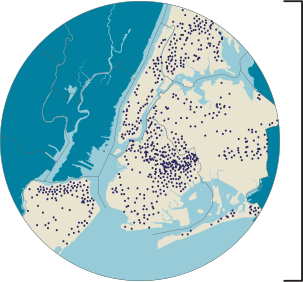
The last New York City tax lien sale was held in 2021. The city sold tax liens on properties to a privately managed trust, as it had almost every year since 1997. These sales subject tenants or small homeowners to further speculation and rounds of flipping, disinvestment, and potentially gentrification, when they could easily be used instead as leverage to promote social ownership of land or buildings. The 2021 lien sale also included vacant lots, which could have been used to build new social housing developments or put to other community uses (such as gardens or worker-owned cooperatives). Every year the city continues this predatory process, it subjects more tenants and homeowners to speculation and displacement while giving up its leverage to promote social housing.