x

Fund Preservation Purchases

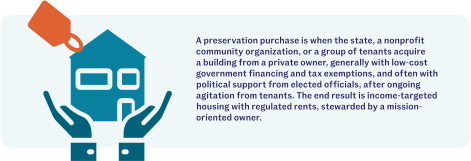
In high-cost markets, preservation purchases are expensive. Landlords are able to find buyers even for highly-distressed buildings with limited rent rolls, typically at a price higher than what they initially paid. This drives up multifamily building costs beyond the reach of tenant unions and nonprofits. Expanded tenant protections outlined in Part 3, including rent stabilization, the Right to Remain, and Right to Counsel have begun to change these market dynamics in the areas where they have been enacted. TOPA legislation would provide tenants with an organizing strategy for challenging the most speculative purchases. However, municipalities must assist preservation purchasers more frequently, targeting privately-owned housing in chronic disrepair. This requires a significant increase of subsidy levels available to preservation purchasers, with clear funding guidelines. Community groups working collaboratively with tenants organizing for new ownership of their buildings should receive particular priority.

Existing City and State preservation purchase programs include the New York City Acquisition Fund, Neighborhood Pillars, and the Shelter Modernization Program. All three provide good frameworks, but would need to be modified and significantly expanded. The Shelter Modernization Program is the most recent example of bold public action in this vein in New York City, in which the City purchased several buildings that were previously a part of the Cluster Site Shelter program. This program, notorious for landlord abuse and horrendous — sometimes deadly — conditions for tenants, was phased out during the de Blasio administration with a promise, long demanded by organizers, that the City would purchase the buildings and convert them into high-quality permanently affordable housing. The City purchased 45 buildings totaling hundreds of units through three clustered acquisitions and has been working with community-based nonprofit organizations to stabilize building conditions, while planning a substantive long-term renovation. While this preservation purchase came under criticism due to its high acquisition cost, it is important to note that the capital commitment spent upfront reduces the long term operating costs of rental payments. In addition, the implicit benefits of increased quality and stability in the housing reduce additional social costs.

Preservation purchases are less common outside of New York City, but have taken place after persistent organizing campaigns. For example, after years of deplorable living conditions, the residents of 447 Thurston Road, with the support of the City Wide Tenant Union of Rochester, compelled the City of Rochester to sue the landlord for repairs. Through this lawsuit, the tenants were able to negotiate a sale of the building to a regional developer. Unfortunately, due to the lack of social housing infrastructure in the city, the tenants ultimately had little control over the building’s ownership model. State and Federal funding should be extended to make preservation purchases more possible across the state, and the social housing infrastructure must be developed, so that opportunities like this are not lost in the future.

In order to ensure not just the acquisition of distressed housing but also any necessary rehabilitation, local municipalities and New York State must fully staff up public agencies (such as HCR and HPD) and ensure that government workers have the resources and support they need to close on these projects in a timely manner. NYC Department of Buildings and related entities in other municipalities, as well as private entities such as ConEdison and National Grid, should be required to prioritize social housing developments to avoid unnecessary delays.

Connections

» (i) Collect Civil and Financial Penalties, (ii) Expand and Reform 7A Administration, (iii) Pass Tenant / Community Opportunity to Purchase

» Increased enforcement programs and civil penalties heighten the leverage the City has in negotiations with owners over the purchase price for buildings they seek to acquire. Additional organizing tools, like 7A administrators and TOPA, would help tenants push their buildings toward preservation purchases.

Potential Impact

» There are countless examples of the difficulties of creating deeply and permanently affordable housing in high-value markets and the shortcomings of relying on market actors in preservation. One New York City parcel with zoning that would allow for nearly 600 units of housing to be built as of right, is particularly illustrative, even though it is of vacant land and not existing housing. This vacant lot went through City foreclosure in 1981 and was sold in 1983 for $15,000 with no regulatory or deed restrictions. Over the next thirty years, the property changed hands twice each time for a purchase price of less than $1 million. In 2007, it was bought by a for-profit affordable housing developer for $5 million with a loan from NYC’s Acquisition Loan Fund for $13.7 million. By September 2020, the group had not broken ground on the site and sold their interest in the property to another for-profit affordable housing group for $18.2 million. The sale represented a profit of over$13 million. This money was earned while the lot sat empty and the owners added no value to the community. As of late 2021, a different for-profit affordable housing group was exploring buying the property: this time the price tag was close to $30 million. The lot remains vacant today.

» Earlier this year, Housing Justice for All conducted a preliminary analysis of the costs of preservation purchases, looking at prevailing prices for multifamily and single-family housing across New York State and applying estimates for financing and rehabilitation costs. That analysis suggests that with $1 billion in state funding each year for the next five years, the state could finance 20,000 homes and apartments annually.
Next

x

Enact Progressive Taxes to Raise Revenue and Curb Speculation

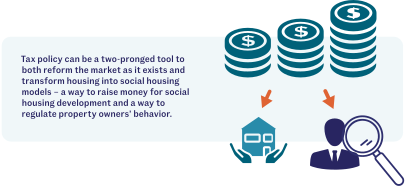
Tax policy can be a two-pronged tool to both reform the market as it exists and transform housing into social housing models – a way to raise money for social housing development and a way to regulate property owners’ behavior. In principle, the former should not entirely rely on the latter to succeed; in other words, we can’t always depend on rising tax revenues from the kind of housing we don’t want in order to fund the kinds of housing we do want. General tax revenue, then, should provide the basis for social housing conversions, while punitive taxes on speculative luxury real estate should be used to disincentivize such development models while providing extra fuel to expand social housing programs.

In its Fiscal Year 2022 budget, New York State passed revenue raisers that could – and should – herald in a new era of progressive taxation which demands more of the wealthy while easing burdens on the working class. Advocates rightly want to take this program further, expanding capacity by increasing rates for the state’s wealthiest households and corporations, and creating new taxes on capital gains, financial transactions, and high levels of inheritance.

In addition to those general revenue raisers, the State has recently considered several tools that would penalize speculative behaviors on the part of high-end property owners. A “pied-a-terre tax” – named after the French word for an only- occasionally used home – would target the expensive and largely empty homes where the ultra-rich park their wealth. A tax on real estate flipping would impose substantial charges on properties that sell within two years of their initial purpose. Finally, the overall property tax structure must be overhauled in New York City and many other municipalities. Tax assessment practices and formulas have been designed to put a significantly higher tax burden on many working-class homeowners than on the wealthy, with low- and moderate-income homeowners of color often paying three times the rate that wealthy and predominantly white brownstone and coop/condo owners are charged.

Creating these new progressive tax programs should be considered on top of removing regressive tax incentives that currently contribute to our overheated real estate market. The greatest such example is 421a, a gigantic developer tax incentive that was recently rebranded with the Orwellian moniker “Affordable New York.” This program denies the city of New York nearly $2 billion a year in potential tax revenue, and thus constitutes the city’s single largest public expenditure on housing — more than the city spends on public or subsidized housing, and more than the federal government spends on the city’s public housing and Section 8 vouchers. It provides little truly affordable housing, however, and has contributed to the historic land value inflation that exacerbates the city’s overall affordability crisis. 421-a was allowed to expire at the end of the 2022 legislative session, but the real estate industry is fighting for it to be reinstated as soon as possible.

Meanwhile, upstate municipalities can avail themselves of the state’s 485-a tax break, which was initially designed to incentivize mixed-use redevelopment of commercial and industrial buildings, but has instead become a lucrative tax break for expensive housing, primarily aimed at students. The city of Buffalo — the biggest user of 485-a tax breaks — forwent over $81 million in fiscal year 2021. Local activists argue that while the new development consumes city services, it adds little to the city’s tax coffers, thus increasing the burden on smaller property owners, who in turn pass those costs on to their unregulated tenants.

Connections

» (i) Fund Preservation Purchases, (ii) Pass Tenant / Community Opportunity to Purchase, (iii) Acquire and Convert Hotel and Office Buildings

» Every non-neutral budgetary item must be funded with public revenue, and will rely on healthy public budgets. This is especially important since cooling speculative markets and converting for-profit housing to social housing also means reducing the share of budgets that are derived from property taxes. In order to fund all that will go into social housing production — building code enforcement, acquisitions, conversions, operating subsidies, organizing support and more — we will need new, reliable and progressive revenue streams.

» Similarly, anti-speculative taxes can raise money for urgent social housing programs. But unlike those broad progressive taxes, these specific programs should only aim to supplement baseline budgets to allow for additional projects or programs on top of what was already allocated.

Potential Impact

» In 2021, the Invest In Our New York coalition (of which CSS was a part) estimated that its package of bills could raise $50 billion for New York State, of which at least $6 billion could be allocated to public and social housing programs.

» The New York City Independent Budget Office conducted a study of multiple means of rebalancing the property tax code, some of which are closer to “progressive revenue raisers” but most are aimed at taxing speculation, flipping, warehousing, high-end development and other socially injurious real estate behaviors. They estimate that these programs could generate over $1.4 billion a year, including $232 million from a pied-a-terre tax and $300 million from a city mansion tax.

Back

Next

x

Fund Housing Organizing

Strong and well-resourced organizing campaigns are crucial to the success of social housing at every level: production, day to day health and operation, and its long term political durability. Preservation purchases are far more likely to happen in organized buildings, where tenants are drawing attention to landlord neglect and garnering political support. In short, nothing happens without organizing.

Cities and the State should increase public resources for tenant organizing, particularly in places with the highest levels of speculation and the worst records of building code and tenants’ rights violations. In New York City, one such initiative is Stabilizing NYC, which promotes proactive organizing in buildings with predatory financial strategies. The FY2022 budget allocated $4 million for this program, over $1 million more than the year prior. Similarly, New York City has committed funding to organizing groups to ensure that tenants understand their Right to Counsel.

Organizing is also essential after a social housing conversion. Running and maintaining high-quality housing takes a lot of work. Residents must come together to: collect rent and manage the books; hire contractors to make repairs; comply with various City and State housing laws and regulatory agreements; handle disputes; and much more. This important work is often overlooked. Frequently, a small minority of residents in a building bear the majority of the burden. External support from community organizations and CLTs can help residents navigate difficult situations, activate participation among new residents, and steward the long-term democratic control of social housing.

The City of New York has provided paid technical assistance to HDFC co-ops, but it has been chronically underfunded and poorly structured. Social housing residents must continue to organize, not just internally but politically, to demand the resources they need to maintain their housing in the long term.

Connections

» (i) Pass Tenant / Community Opportunity to Purchase, (ii) Expand and Reform 7A Administration, (iii) Support Social Housing Infrastructure

» The state can legislate TOPA or more frequently enforce appoint 7A administrators, but no buildings will actually go through a conversion unless tenants are organized and prepared to take action. Additionally, the power needed to demand transformative concessions in the first place — from better policy to better funding for the host of social housing entities needed — relies on widespread housing organizing.

Potential Impact

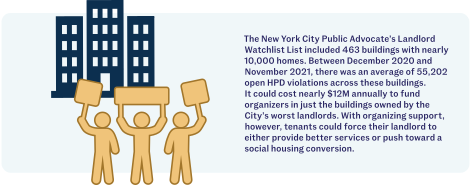
» The New York City Public Advocate’s 2021 Landlord Watchlist included 463 buildings with nearly 10,000 homes. Between December 2020 and November 2021, there were 55,202 open HPD violations across these buildings.

» Community organizing is intensive work. One organizer can spend several hours a week on just one building: meeting with tenants one on one, helping tenants navigate City and State agencies to assert their rights, planning meetings, coordinating tenant association strategy, and much more. By some estimates, it could cost $12 million annually to fund organizers in just the buildings owned by the City’s worst landlord – and we need organizers in many more buildings than those.

Back

Next

x

Provide Operating Subsidies and Housing Vouchers

Long term social housing stewardship requires ongoing operating subsidies to pay for regular maintenance, labor costs, services for residents, and — in some cases — taxes and debt service. This is particularly true in developments where rents are set low enough to make the housing affordable to extremely low-income households and the collective rental income does not cover the cost of operations.

Operating subsidies can come in many different forms, including project-based vouchers (where the money is attached to a particular building or unit, as in Project-Based Section 8) and tenant- based vouchers (where the money is attached to a particular resident, as in federal Housing Choice Vouchers, New York City’s CityFHEPS voucher, or the proposed New York State Housing Access Voucher Program). They can also be effectively combined with capital subsidies, like direct grants or low-interest loans for socially-beneficial building improvements (such as green energy retrofits); tax breaks (including full exemptions and partial abatements); or mortgage write-downs (in which the government pays part of the upfront costs) to minimize future debt obligations.

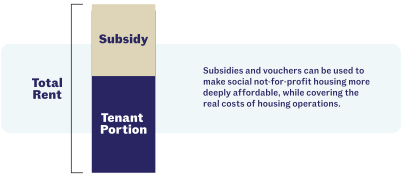
Operating subsidies are agnostic: they are simply ways the government pays to maintain housing. They can be used to subsidize luxury developers and boost landlord profits (and today they frequently are), but they can also be used to make not-for-profit housing more deeply affordable and sustainable, while covering the real costs of housing operations. Social housing operating subsidies should be:

Connections

» (i) Pass Tenant / Community Opportunity to Purchase, (ii) Acquire and Convert Hotel and Office Buildings, (iii) Acquire Distressed Debt

» New or preserved social housing that is deeply affordable will require ongoing operating subsidies. Buildings that are converted through TOPA or COPA, for example, will need support in order to remain affordable while simultaneously bringing their buildings up to a higher standard of maintenance and sustainability. Additionally, operating subsidies that are available only to purchasers who agree to keep the housing affordable allow preservation purchasers to compete with speculative market actors, who may be making assumptions about their ability to raise the rents by deferring maintenance or pursuing evictions. Operating subsidies are also especially important for hotel and office acquisitions, in order to support formerly homeless households who become residents, as well as distressed debt acquisitions, as high debt service requirements must be supported with adequate revenue from the building.

Potential Impact

» Housing vouchers can be instrumental toward the creation of social housing. The amount of private debt that an affordable housing project can leverage is directly dependent on the affordability levels of residential and commercial rents. The higher the rent the more private debt a project can support, lowering the upfront capital investment required from the state. If operating subsidies are available, typically in the form of Section 8 rental assistance, the housing project is able to leverage this additional private debt while still maintaining affordability at extremely low levels. The rent is typically set at the fair market rent (FMR) levels determined by HUD annually (for instance, $2,053 for a 2 bedroom in 2021 in Manhattan). The future tenant contributes 30% of their income and the government makes up the difference each year based on annual recertification.

» Rental vouchers are already being used in several forms of social housing in New York City, including limited equity co-ops that were created from rental housing that was previously owned by private actors. Renters in these buildings are able to become cooperators because purchase prices are kept extremely low and operating subsidies are made available in the form of a Section 8 voucher. Structuring a program in this way ensures that tenants of all income levels are able to contribute to the democratic management of their buildings.

Back

Next

x

Support Social Housing Infrastructure

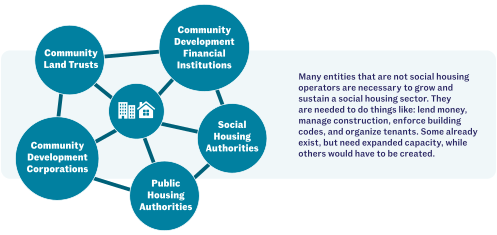
To make use of funding for acquisition and operating subsidies, new social housing entities must also be created, funded, and supported. These entities, including new organizations, coalitions, and public agencies, are needed to create the infrastructure that makes social housing possible. These entities organize and intervene in distressed housing, create democratic and accountable ownership structures, and work with governments and land banks to take title to housing.

A growing social housing ecosystem can both expand existing social housing entities (like housing nonprofits) and pursue larger goals, like rebuilding housing capacity and expertise lost over the last 50 years of austerity. Social housing infrastructure includes:

Connections

» (i) Pass Tenant / Community Opportunity to Purchase, (ii) Transform Land Banks into Social Housing Intermediaries, (iii) Fund Housing Organizing

» For TOPA and COPA to have maximum impact, tenant associations need a social housing infrastructure that is able to assist in acquisition, transfer, and building operations, depending on the chosen housing model. Land banks, as temporary holders of distressed housing, likewise require this infrastructure in order to find permanent social ownership and management for land and housing. Finally, a strong social housing infrastructure can both collaborate with tenant and housing organizing, and also support ongoing organizing in already converted social housing, which is crucial to any transformative social housing program.

Potential Impact

» According to the New York City Community Land Initiative (NYCCLI), there are now 17 CLTs in New York City, many of which have incorporated over the last few years. In 2021, those groups fought for and won $1.5 million in the New York City budget, to be used for technical support to continue developing the NYCCLI network. For these CLTs to be able to intervene at scale in land and housing markets, they require acquisition funding, coordination with mayoral administrators and agencies, and continued organizing. However, the growth of the CLT movement in New York City is an encouraging sign for the expansion of social housing in the coming years.

Back

Next

Financial Resources for Housing Justice

(click around the image to learn more)
< Back

Fund Preservation Purchases

Fund Preservation Purchases

Income-targeted housing with regulated rents, stewarded by a mission- oriented owner.

Learn more

Banner Banner BannerJurisdiction: Local, State and Federal BannerBudget: Capital BannerProcess: Administrative
< Back

Enact Progressive Taxes to Raise Revenue & Curb Speculation

Enact Progressive Taxes to Raise Revenue & Curb Speculation

Use tax policy to both raise money for social housing development and regulate property owners’ behavior.

Learn more

BannerJurisdiction: State BannerBudget: Revenue Positive BannerProcess: Legislative
< Back

Fund Housing Organizing

Fund Housing Organizing

Strong and well-resourced organizing campaigns are crucial to the success of social housing.

BannerJurisdiction: Local BannerBudget: Operating BannerProcess: Legislative
Learn more

Provide Operating Subsidies & Housing Vouchers

< Back

Subsidies and vouchers can be used to make social not-for-profit housing more affordable.

BannerBannerBannerJurisdiction: Local, State or FederalBannerBudget: OperatingBannerBannerProcess: Legislative and AdministrativeLearn more
< Back

Support Social Housing Infrastructure

Support Social Housing Infrastructure

New social housing entities must also be created, funded, and supported. Learn more

Banner Banner BannerJurisdiction: Localm State, and Federal Banner BannerBudget: Operating and Captial Banner BannerProcess: Legislative and Administrative
Cloud Cloud Cloud Cloud Cloud Cloud Cloud Cloud Cloud
Activists Activists