x

Create Statewide Housing Code Standards

New York State has a patchwork system of overlapping housing codes that can confuse tenants about their rights and landlords about their obligations. The Uniform Fire Prevention and Building Code governs building maintenance outside of New York City, and directs the state to aid local governments with their code enforcement. The New York State Multiple Dwelling Law governs design and construction of buildings, and sets standards for light and air, sanitation, and fire protection. It applies to cities with a population greater than 325,000 (which currently includes only New York City and Long Island’s Hempstead and Brookhaven). The Multiple Residence Law, a weaker standard, applies to towns, villages and cities with a population of less than 325,000. In addition to the Multiple Residence Law, New York City as well as some larger municipalities like Albany, Newburgh, Rochester, and Mount Vernon have local rental housing maintenance laws.

Given these overlapping codes, it is often difficult for tenants to determine exactly what their rights are and who they should contact to report unsafe conditions. In bigger cities, it may be a designated code enforcement agency but in smaller towns and villages, it is often the local fire or sheriff’s department. Without enforcement capacity or a proper understanding of the rights of tenants to safe conditions, even local officials who want to address egregious conditions are frequently unsure about how to proceed.

New York State should expand the more robust of its housing codes, like the New York City Housing Maintenance Code and the New York State Multiple Dwelling Law, across the state, eliminating the patchwork system. A tenant in Binghamton should have the same legal tools to address unsafe living conditions as a tenant in the Bronx. Insufficient code enforcement, coupled with the lack of a right to a renewal lease, means that nearly half of New York State renters either have to put up with dangerous living conditions or leave their homes, as tenants who complain are often evicted before the landlord is compelled to make repairs. This dynamic allows landlords to abdicate their legal responsibility to provide quality housing, and to milk unsafe buildings.

Statewide housing codes would also help build a broader constituency of tenants who can advocate more effectively for increased funding. Protecting tenants across the State requires a commitment to bigger budgets for under-funded housing code enforcement agencies. Further, new enforcement entities in counties and municipalities where they do not yet exist should be established. In addition, organizing pressure is necessary to change the culture of code enforcement that is forgiving of landlords who allow dangerous living conditions to persist. While recent initiatives like the NY Attorney General’s Cities RISE program are a start, the State must do more to significantly increase code enforcement funding to under-resourced jurisdictions, employing both state and federal resources, including Community Development Block Grants (CDBG). The funds can support the development of local code enforcement infrastructure, technology and record keeping upgrades, and tenant and landlord education about rights and responsibilities.

Connections

» (i) Expand Proactive Enforcement, (ii) Collect Civil and Financial Penalties, (iii) Allow for Rent Abatements in Housing Court.

» Statewide housing code standards require municipalities to proactively monitor housing conditions and establish penalties that deter non-compliance. By providing a clear legal baseline, statewide standards would complement new or reformed tools for tenants to sue in court to demand safe conditions.

Potential Impact

» In 2019, the New York State Senate’s Committee on Investigations and Government Operations released a report on the dire state of code enforcement across the state, with case studies of Albany, Newburgh, Mount Vernon, and the Town of Ramapo. The report concluded that code enforcement is simply not prioritized, which leads to poor compliance that endangers the lives of residents.

» The report recommends the provision of significant financial assistance to local governments that want to expand code enforcement. It also notes that existing money collected by the Department of State for local code enforcement has, since 1991, not been disbursed. These funds amount to between $12 and $20 million each year; while not nearly enough to fund robust enforcement, it is a sign of just how deprioritized funding for code enforcement currently is.
Next

x

Expand Proactive Enforcement

To create a robust code enforcement system, municipalities must proactively assess rental housing, and intervene in issues as they arise. In New York State, municipalities largely only rely on tenant-initiated complaints to identify dangerous living conditions. The City of New York has several proactive enforcement programs — including the Alternative Enforcement Program (AEP), Certificate of No Harassment (CONH), Proactive Preservation Initiative (PPI) and the Emergency Repair Program (ERP) — which either trigger active monitoring of a building’s conditions or allow the City to directly make repairs in long-decrepit buildings, at the owner’s expense. Outside of New York City, proactive enforcement is rare. One example is Albany’s Residential Occupancy Permit (ROP) system, which requires an inspection of all rental units in the city every 24 months. Based on the successful campaign in Albany, tenants in Syracuse won a similar program. There are also Emergency Repair Ordinances that local tenant organizations fought to pass in both Rochester and Albany, which allow code enforcement officers to bid out the work to repair building violations when a landlord refuses to comply.

While these programs are a start, they do not go nearly far enough. Though New York City has more than two million renter households, CONH covers around 1,100 rental properties, while the AEP program targets 250 properties annually. While AEP is an effective enforcement mechanism that should be expanded to additional buildings each year, a significant percentage of buildings remain in the program year after year, indicating that New York City lacks an escalation strategy for landlords refusing to comply with increased enforcement. While the ERP program is used more frequently, it often leads to shoddy and surface-level repairs.

Outside of New York City, Albany and Syracuse’s ROP system requires only that bare minimum life and safety standards be met in order for the city to issue a new permit. Further, Rochester and Albany’s code enforcement agencies only utilize their Emergency Repair Ordinances in the most extreme circumstances, often issuing extensions on repeated violations, while tenants suffer worsening conditions.

In order to compel landlords to reinvest in their properties, the government should take a proactive enforcement role. Code enforcement agencies across the state must implement clear timelines for the resolution of violations and transparent processes by which proactive enforcement is triggered, rather than leaving the decision-making to individual code inspectors. Further, proactive enforcement must be accompanied by heavier financial penalties, which create points of leverage to convert long-neglected and distressed properties into social housing. And most importantly, agencies proactively enforcing housing codes must work collaboratively with tenants and community groups, who have intimate knowledge of the history of building neglect and past efforts to force the owner to behave responsibly. When landlords continually refuse to keep their buildings in habitable conditions, these enforcement agencies must rely on tenants to drive escalation strategies, up to and including transfer of ownership or conversion to social housing.

Connections

» (i) Abolish the Tax Lien Sale and Reimagine the In Rem Process, (ii) Fund Housing Organizing, (iii) Pass Good Cause Eviction Protections.

» For proactive enforcement to be done in collaboration with tenants, more tenant associations must be formed across the state. To achieve this, we need both better funding for organizing and better protections for tenants, so that they can organize without the fear of their lease not being renewed.

Potential Impact

» Throughout 2019, New York City spent close to $48 million across more than 10,000 properties to correct dangerous issues in rental buildings through proactive enforcement programs. A year later, by the end of 2020, one data source estimated that landlords had paid back less than $8 million of those costs. Similarly, in 2018, the City of Albany’s Corporation Counsel won $364,580 in court judgments for code violations, but only collected about $5,000 of those judgments.

Back

Next

x

Collect Civil & Financial Penalties

Appropriately heavy civil and financial penalties can disincentivize landlords from maintaining their properties at substandard levels. Under New York’s existing laws and programs, many landlords regard code enforcement programs and city and tenant- initiated lawsuits as little more than the cost of doing business. Increased fines, penalties, and interest rates for landlords who own buildings with significant and persistent violations can change this dynamic, making it unprofitable to maintain unsafe conditions or by triggering municipal foreclosure.

New York City has the most robust code enforcement system in the state. The city agencies tasked with enforcing building codes can levy and collect fines either through administrative proceedings or by suing landlords who fail to follow the Housing Maintenance Code. However, large portions of these fines and penalties sit unpaid for years, or are forgiven in exchange for agreements that the repairs be made over time. The situation in the rest of the State is even worse: penalties for housing violations are trivial, often remain unpaid for years, and have little effect on landlord behavior.

Tenants often find that reporting poor conditions does not lead to meaningful building improvements. Even when repairs are made, they are often done on the surface level, leaving underlying problems to fester. This cycle, where tenants continually file complaints about issues that are never truly resolved, is demoralizing. Tenants are forced to adjust to unsafe living conditions, and lose hope in the potential for collective change. The lack of serious financial consequences undermines the overall code enforcement system.

The City must escalate enforcement against landlords who repeatedly fail to make repairs, and push to recover 100% of levied fines and penalties, including the costs of repairs under proactive enforcement programs. For landlords who refuse to pay, public agencies must establish and proactively implement a transparent process to either force collection or initiate municipal foreclosure, and to transfer foreclosed properties to social housing entities.

Connections

» (i) Reimagine Public Disposition and Municipal Foreclosure, (ii) Transform Land Banks into Social Housing Intermediaries, (iii) Support Social Housing Infrastructure.

» Paired with proactive enforcement, civil and financial penalties give governments leverage to convert neglected properties to social housing. Landlords who neglect their buildings, put the lives of their tenants at risk, and refuse to both make repairs and pay fines should lose their properties through municipal foreclosure. These buildings can be transferred to local land banks, go through a rehabilitation process, and eventually be transferred to social housing entities ready to steward the property for the long term

Potential Impact

» As of the end of 2020, in each of New York City’s five boroughs, between 65% and 85% of open housing code violations in rent stabilized buildings have remained unresolved for a year or more. This translates into over 550,000 housing code violations that NYC tenants dealt with over the course of 2020. The sheer number of outstanding violations illustrates that New York City’s maintenance code and the financial penalties associated with it (which are the strongest in the state) is not enough to incentivize all landlords to maintain their buildings.

Back

Next

x

Expand and Reform 7A Administration

If a landlord allows their building to become physically distressed, Article 7A of New York’s Real Property Actions and Proceedings Law provides tenants in New York City, as well as Nassau, Suffolk, Rockland, and Westchester counties, with the right to petition the court to take away operational control of their buildings from their landlord and hand it over to an administrator for management and rehabilitation.

In the 1970s and 1980s, 7A administrators were common in disinvested neighborhoods, facilitating transitions to nonprofits or limited equity coops. Today, 7A cases are far more rare, and serve as a cudgel to temporarily force building repairs, just for the duration of the case. Landlords often let 7A cases drag on for long enough to remedy just enough unsafe conditions to exit the program, immediately letting the property deteriorate again after dismissal or settlement.

Article 7A can once again serve as a crucial tool for tenants fighting for safe and habitable conditions. The program should be used to rehabilitate neglected buildings and transfer them to responsible, long- term stewardship by social housing operators. The 7A administrator appointment process must be reformed to be quicker and more accessible to tenants. Further, Article 7A should be available to all tenants across New York State.

Connections

» (i) Pass Statewide Right to Counsel, (ii) Fund Housing Organizing, (iii) Reimagine Public Disposition and Municipal Foreclosure.

» Because 7A cases are drawn-out and complex, they require access to lawyers and significant organizing resources. 7A administrators can also be thought of as an intermediate step of moving buildings out of the hands of predatory landlords and into social housing entities, either through municipal foreclosure or a preservation purchase.

Potential Impact

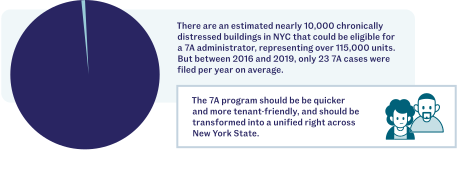
» Between 2016 and 2019, an annual average of 23 7A cases were filed in New York City housing courts. In contrast, we estimate that there are currently close to 10,000 chronically distressed buildings in NYC, representing over 115,000 units. (Chronic distress defined as: more than 2.5 B or C Housing Code violations per unit during at least 6 quarters since 2008).

Back

Next

x

Allow for Rent Abatements in Housing Court

Allowing tenants to seek rent abatements through the courts can help force landlords to adhere to housing codes. For many years, only tenants in New York City have had the right to sue for repairs in substandard housing, through what is known as an Housing Part (HP) action. Successful HPs result in court ordered injunctions to make repairs. Similar to other forms of state mandated repairs, these injunctions often result in shoddy, surface-level work. Further, landlords sometimes simply ignore these court mandates, choosing the potential for additional legal costs over spending money on chronic building issues. Beyond HP actions, rent- stabilized tenants in New York City can also request a rent abatement through HCR, but that process is notoriously slow, sometimes taking up to a few years for an abatement.

This can all change with the passage of the Tenant Dignity and Safe Housing Act (TDSHA), which as of June 2022 had passed both houses of the New York State Senate. TDSHA would provide a range of private rights of action for tenants across the State, including rent reduction, court injunction, and suspension of eviction action until repairs are made. The relief sought by tenants through TDSHA would directly impact landlords’ bottom-line, particularly the ability to sue for rent abatements. This mechanism incentivizes safer conditions in buildings. It also undermines speculative real estate models that rely on deferred maintenance and substandard living conditions, helping make predatory real estate investment less attractive and, opening up the possibility of social housing conversions.

Connections

» (i) Pass Statewide Right to Counsel, (ii) Fund Housing Organizing, (iii) Collect Civil and Financial Penalties.

» Like other policies, rent abatements in housing court would require additional organizing capacity and legal resources, which strengthening and expanding Right to Counsel could help provide. Rent abatements are also similar in theory to more frequent uses of serious financial penalties; both start from the notion that the only way to compel long-negligent or predatory landlords to change behavior is by threatening their net profit.

Potential Impact

» Between 2016 and 2019, there was an annual average of over 12,000 HP cases filed in New York City housing courts, each representing a tenant or tenant association seeking a court- ordered injunction for repairs in a unit or building. If tenants statewide were given the option to seek rent reductions for substandard conditions, we could provide tens of thousands of households across the state a better pathway to safe and habitable housing.

Back

Next

Code Enforcement & Tools for Safe Conditions

(click around the image to learn more)
< Back

Create Statewide Housing Code Standards

Create Statewide Housing Code Standards

Establish statewide housing code standards and increasing funding for enforcement.

Learn more

BannerJurisdiction: State BannerBudget: Operating BannerProcess: Administrative
< Back

Expand & Reform 7A

10,000 buildings in NYC could be eligible for a 7A administrator.

Learn more

BannerJurisdiction: StateBannerBudget: NeutralBannerBannerProcess:Legislative and Administrative
< Back

Collect Civil & Financial Penalties

Collect Civil & Financial Penalties

Financial penalties can disincentivize landlords from maintaining their properties at substandard levels

BannerBannerJurisdiction: Local or State BannerBudget: Revenue Positive BannerProcess: Administrative

Expand Proactive Enforcement

Expand Proactive Enforcement

< Back

Find code violations, rather than rely on tenant complaints.

BannerJurisdiction: LocalBannerBudget: OperatingBannerProcess: AdministrativeLearn more
< Back

Allow for Rent Abatements in Housing Court

Allow for Rent Abatements in Housing Court

Allow for an individual to sue for a rent reduction until repairs are made.

Learn more

BannerJurisdiction: State BannerBudget: Neutral BannerProcess: Legislative
Cloud Cloud Cloud Cloud Cloud Cloud Cloud Cloud Cloud
Activists Activists Activists Activists Activists Activists